Translated from Philip Schaff's History of The Christian Church
第八章 基督教艺术
目录
§ 102. 宗教与艺术
§ 103. 教会建筑
§ 104. 教堂的祝圣
§ 105. 教堂的内部布置
§ 106. 建筑风格:巴西利卡
§ 107. 拜占庭式
§ 108. 洗礼堂、墓葬礼拜堂与地下墓室
§ 109. 十字架与苦像
§ 110. 基督的图像
§ 111. 圣母与圣徒的图像
§ 112. 奉献的礼物
§ 113. 教会诗歌与音乐
§ 114. 东方教会的诗歌
§ 115. 拉丁赞美诗
§ 116. 拉丁诗人与赞美诗
§ 102. 宗教与艺术
人是具有理智的存在,能够思考和认识;是具有道德的存在,能够立志和行动;也是具有审美能力的存在,能够感受和欣赏。与这三种基本能力相对应的,是古老的真、善、美三联体,以及三个领域:科学,即对真理的认识;德行,即善的实践;艺术,即美的表现、理想与现实的和谐。这三个要素同样出于上帝,也同样以上帝为归宿。
宗教与其说是这三个领域之外的一个独立领域,不如说是将它们全都提升、圣化,使之归荣耀于上帝。宗教体现圣洁的观念,也就是与上帝联合的观念;上帝乃是一切真、善、美的本原。基督教既是完全的宗教,也是完全的人性。它所恨恶的惟有罪;而罪并非人性原有之物,乃是从外面侵入人性的。基督教如同面酵,要使全团发起来。它旨在使灵魂的一切恩赐和能力和谐地展开。它要救赎并重生整个人,使人与上帝享有蒙福的相交。它启迪悟性,圣化意志,赐心灵以平安,甚至将身体分别为圣,成为圣灵的殿。古语说:“Homo sum, nihil humani a me alienum puto”(我是人,凡属人的事,我都不以为与己无关),这句话惟有在基督徒身上才完全真实。使徒说:“万有全是你们的。”万有都出于上帝,也都为着上帝。尽管这些真理受到种种滥用,或被不完善而操之过早地应用,我们却决不可忘记它们。
因此,正如有基督教的科学、属灵的雄辩和基督教的德行,也有基督教的艺术。情感与想象力和理性与意志一样,都需要救赎,也都能够成圣。
艺术本有的、最高的使命在于敬拜上帝。我们当“以圣洁的美”敬拜上帝。一切科学在神学与神智学 (theosophy) 中达到顶峰,一切艺术在崇拜中臻于完全。圣经赋予艺术这样的地位,使它与宗教有最密切的联系,从《创世记》第一章直到《启示录》最后一章,从无罪的乐园直到得荣耀的新地,莫不如此。这尤其适用于两种最富灵性、最高尚的艺术——诗歌与音乐;从起初直到终局,在上帝国度历史的一切伟大时期中,它们都宣扬上帝的颂赞。圣经中相当大的一部分:《诗篇》《约伯记》《雅歌》、比喻、《启示录》,以及历史书、先知书和教训书中的许多篇章,都是诗,而且是在这个词最纯粹、最高的意义上的诗。基督教伴随着天军的歌声来到世间,教会的最终成全,也将是诗歌与音乐在天上圣所的事奉中达到的最终成全。
艺术在一切文明民族中,向来都与崇拜有密切的联系。在异教徒中,它为偶像崇拜服务。因此,早期基督徒对它抱有厌恶或疑虑。然而,希腊人的哲学和罗马人的法律也同样如此;但哲学与法律本身并非应当反对的事物。一切都取决于赋予这些恩赐以生命的精神,以及人使它们服务的目的。
君士坦丁 (Constantine) 治下教会外在处境的巨大变革,消除了人们对艺术的偏见,也清除了运用艺术为教会服务的障碍。于是,一种基督教艺术兴起了,它使对上帝的敬拜更加美好、丰富,并在建筑、绘画、诗歌和乐曲中创造了不朽的杰作,造就历世历代的人;不过,正如早期教会的崇拜总体上保留了犹太教和异教的许多成分,基督教艺术史也呈现出许多不纯与迷信之处,激起了抗议,也使这些抗议有了正当的理由。艺术家败坏了艺术,正如神学家败坏了神学,祭司败坏了教会。然而,纠正这些缺陷的方法,不是废除艺术并将它逐出教会,而是以基督教的精神更新它,不断使它趋于纯净,为基督教服务,因为基督教是真理、美与圣洁的宗教。
因此,从这时起,教会史也必须将各种艺术及其与基督教崇拜的关系纳入考察的范围。此后便有了基督教建筑史、雕塑史、绘画史,尤其是基督教诗歌史与音乐史。
§ 103. 教会建筑
关于一般建筑史,参看库格勒 (Kugler)、金克尔 (Kinkel)、施纳泽 (Schnaase) 等人论造型艺术的著作;另参克罗伊泽 (Kreuser):《基督教教堂建筑:其历史、象征与雕塑》(Der christliche Kirchenbau, seine Geschichte, Symbolik u. Bildnerei),波恩 (Bonn),1851年,2卷;以及奈特 (Knight)、布朗 (Brown)、克洛斯 (Close)、J. 弗格森 (J. Ferguson) 等人的英文著作,后者著有《建筑史》(A Hist. of Architecture),伦敦 (Lond.),1865年,3卷。
建筑应当为公开敬拜上帝提供合宜的外在场所,在人间建造上帝的殿宇,使他在那里与自己的子民相交,并以天上的恩赐赐福给他们。这是建筑艺术最高的职分与荣耀。建筑是敬虔的婢女。美丽的教堂是一篇石头写成的讲章,它的尖塔则是指向天上的手指。在旧约之下,没有任何建筑比耶路撒冷的圣殿更为重要或辉煌;这殿是奉上帝的命令,照着旷野会幕的样式建造的。然而,这也不过是将来之事的一个意义深长的表征和影儿。
诚然,基督教不受地点的限制,可以在各处敬拜无所不在的上帝。使徒和殉道者曾在简陋的私人住宅,甚至在旷野和地下墓窟中举行最庄严的崇拜;在整个受逼迫的时期,严格意义上的教堂建筑寥寥无几。然而,这种缺乏并非出于良心上的反对,而是由于基督徒受压迫的处境。他们一享有内外的和平,便建造专供敬拜的场所;在教会正常而有秩序的状况下,这些场所之于公共崇拜,与特定的神圣时日一样不可或缺。有别于私人场所的正式教堂建筑,最早的确凿遗迹见于第三世纪下半叶,即德修 (Decius) 与戴克里先 (Diocletian) 两次逼迫之间四十三年的安宁时期。1但这些建筑在后一次逼迫中被摧毁了。
严格说来,建造教堂的时期始于君士坦丁大帝。基督教得到国家承认,并获准拥有财产之后,便在罗马帝国各地兴建礼拜堂。第四世纪此类建筑的数量,可能超过此后任何一个时期,惟十九世纪的美国或许例外;在那里,每十年便有数百座教堂和礼拜堂建成,而在欧洲的大城市中,教堂的增建远远赶不上人口的增长。2君士坦丁与他的母亲海伦娜 (Helena) 率先树立了良好的榜样。皇帝不仅以巴西利卡式教堂 (basilicas) 装点他的新都,也以此装点巴勒斯坦的圣地以及非洲的君士坦丁城 (Constantine),经费一部分由他自己承担,一部分出自国库。他的帝位继承者,除尤利安 (Julian) 外,以及主教和富有的平信徒,都竞相建造、装饰教堂,并增添其中的财富。这被视为蒙上帝喜悦而有功德的工作。在这里,野心与自义同为上帝荣耀发热心混杂在一起,几乎处处皆然。金口约翰 (Chrysostom) 甚至哀叹,人们在兴建教堂时常常忘记穷人;他指出,仅仅装饰祭坛、墙壁和地面还不够,最要紧的是将灵魂作为活祭献给主。3哲罗姆 (Jerome) 也责备那些因献给上帝的贵重礼物而傲然自夸的人,指引他们宁可去帮助贫困的基督徒同胞,因为基督真正的殿不是石造的房屋,而是信徒的灵魂。
第四世纪的罗马城已有四十多座大教堂。4在君士坦丁堡 (Constantinople),君士坦丁所建的使徒教堂和圣索菲亚教堂 (St. Sophia),以其宏伟与美丽尤为出众,并在第五世纪由查士丁尼 (Justinian) 大加扩建和美化。有时,异教神庙或其他公共建筑被改作基督教的礼拜场所。例如,福卡斯皇帝 (Phocas,602—610年) 将万神殿 (Pantheon) 赠给罗马主教博尼法斯四世 (Boniface IV);这座建筑由阿格里帕 (Agrippa) 在奥古斯都 (Augustus) 治下建造,以巨大而壮丽的穹顶闻名(今称 chiesa della rotonda,即圆形教堂),从此奉献给童贞女马利亚和众殉道者。
但一般而言,异教神庙规模狭小,又往往呈圆形,不适于基督教的崇拜,因为基督教的崇拜在建筑内部举行,需要宽敞的空间容纳会众,使他们能听见讲道与经文诵读;异教的祭祀则在柱廊前举行,群众在圣所外面观看。雅典卫城 (Acropolis) 上的潘德罗索斯 (Pandrosos) 神庙只能容纳少数人,甚至帕特农神庙 (Parthenon) 也不及一座普通教堂宽敞。罗马的万神殿是一个例外,比大多数神庙大得多。小型圆形异教神庙最容易改为基督教的洗礼堂和墓葬礼拜堂。无疑,更常见的做法,是将废弃或毁坏的神庙的材料用于建造教堂。
§ 104. 教堂的祝圣
新教堂的祝圣极为隆重,仪式包括祷告、唱诗、圣餐、出席主教的颂词,以及安放圣徒遗物。5这一礼仪将教堂从一切世俗用途中分别出来,专用于事奉和颂赞上帝,并造就他的子民。所罗门圣殿的奉献礼,6以及圣殿被异教的叙利亚人亵渎之后的洁净礼,7为这一习俗提供了圣经依据。在受逼迫的时期,祝圣礼想必只能悄然举行。但如今,这些场合成了万人赴会的节庆。许多主教,如狄奥多勒 (Theodoret),甚至邀请异教徒前来参加。优西比乌 (Eusebius) 为我们留下了最早对此类庆典的描述:圣墓所在地救赎主教堂的祝圣礼,8以及推罗 (Tyre) 一座教堂的祝圣礼。9
依照犹太人的先例,10人们通常每年庆祝教堂祝圣的周年纪念。11
教堂或奉献给神圣的三位一体,或奉献给三个位格中的一位,尤其是基督;也有奉献给童贞女马利亚、使徒——尤其是彼得、保罗和约翰——或杰出的殉道者及圣徒的。
当然,奉献的观念绝不必然包含一种迷信的想法,以为无所不在的上帝被拘限在某个地方。相反,所罗门早在耶路撒冷圣殿的奉献礼上就已说过:“看哪,天和天上的天尚且不足你居住的,何况我所建的这殿呢!”亚他那修 (Athanasius) 有一次因地方不足,在复活节召集会众到一座新建而尚未祝圣的教堂聚会,受到责难;他便援引主吩咐我们进内室祷告的话,说明这道命令使一切地方都成为圣洁。金口约翰 (Chrysostom) 力劝每一家都应成为教会,每一位家长都应成为属灵的牧者,记得自己连为儿女和仆人也必须交账。12构成教会的,不是墙壁和屋顶,而是信仰与生活;13在教堂祷告的益处,与其说来自那地方特有的圣洁,不如说来自基督徒的团契、爱心的联结和祭司的祷告。14奥古斯丁 (Augustine) 向他的会众提出了极好的劝勉:“你们有责任将所得的才干交付生息;每个人都必须在自己家中作主教;他必须留意,使他的妻子、儿子、女儿、仆人既然都是重价买来的,就持守真信仰。使徒的教训使主人居于仆人之上,也约束仆人顺服主人,但基督已为双方付了赎价。”15
§ 105. 教堂的内部布置
基督教教堂的内部布置,一部分仿照耶路撒冷的圣殿,一部分直接出于基督教的精神。因此,它和整个大公教会体系一样,呈现出犹太教与基督教的混合。其根基是祭司职分与献祭的观念,以及借此与上帝相交的观念。
因此,君士坦丁 (Constantine) 以后,每座大教堂都有三个主要部分,一方面对应于所罗门圣殿的各个部分,另一方面对应于参加聚会者的三个阶层,即慕道者、信徒和祭司,或亲近上帝的三个阶段。全体信众可以直接来到施恩宝座前的福音观念,在这里尚未显现。祭司阶层处处介于其间。
- 门廊:其中又须区分:
内门廊,是属于教堂本体的一座有顶厅堂,称为 πρόναος*,或因其狭长的形状,通常称为 νάρθηξ*、ferula,字面意思即杖、竿。16它也有乐园之名,因为门廊一侧的墙壁上常绘有亚当、夏娃在乐园中的图画——这大概是要表示,亚当堕落的后裔在基督的教会中重新寻得了失去的乐园。内院是所有未受洗者、慕道者、异教徒和犹太人,以及被判处轻度补赎的教会成员所在的地方;他们可以听讲道和诵读圣经,却必须在举行圣餐之前退出。
外门廊,αὐλή*、atrium,也称 locus lugentium 或 hiemantium,即哀哭者或露宿风雨者之地,是露天的,完全不在圣墙围护之内,因此严格说来并不属于上帝的殿。受重度补赎处分的人,即所谓“哀哭者”,17必须留在这里,任凭风吹雨打,流泪恳求进入教堂的人为他们作基督徒的代祷。
在这外门廊或前院中,设有洗濯盆;18依照犹太人和异教徒的古老习俗——罗马教会至今仍然保持——敬拜者每次进入教堂,都必须在此洗濯,以象征内心的洁净。19
约在第九世纪以后,教堂不再建造宽敞的门廊,洗濯盆便移入教堂内,成为固定在门边的圣水盆,据认为是仿照所罗门圣殿祭司院中的铜海而设。20这种象征性的习俗很容易附带上迷信观念,以为圣水具有神奇的效力。甚至在伪托的《使徒宪章》(Apostolic Constitutions) 中,祝圣过的水就被称为“驱除疾病、吓退邪灵的工具,是身体和灵魂的良药,并能洁净罪恶”;这些说法虽然主要是指作为重生之洗的洗礼圣水,却很容易被民众应用于一切祝圣过的水。在罗马天主教会,水的祝圣礼21在复活节主日晚间举行;在希腊—俄罗斯教会,则每年举行三次。
- 殿的正体,22即圣所,23或教堂的中殿,24仿佛是新约的方舟。这一部分从入口延伸至祭坛的台阶;视教堂大小,有时设有两条或四条侧廊,是为平信徒群体,即已受洗的信众而设。男子坐在右边南侧(男殿),女子坐在左边北侧(女殿);在男女分隔更为严格的东方各国,女子则坐在上层廊座。25修士、修女以及高级文官,尤其是皇帝及其家属,通常在祭坛两侧半圆形的壁龛中设有专门的尊位。
主殿约居中的位置设有讲坛,或称 ambo;26后来则设两个读经台,左边是福音书台,右边是书信台,诵经员或执事在这里宣读指定的经文。讲道并不总是在讲坛上进行,更多时候是在祭坛的台阶上(因此有“从栏杆处讲道”的说法),或在祭桌后面的主教座上进行。27
读经台与祭坛之间是 odeum,28即歌咏者的位置,左右两侧则是低级教士(诵经员或读经员、驱魔者、辅祭)的座位。中殿的这一部分略高于教堂的地面,却不及祭坛诗班席高,因此也称下诗班席,又称阶台,因为须经台阶 (gradus) 登上。在东方教会,诗班席与中殿几乎没有分隔,二者共同组成 ναός*,即殿堂;在西方,诗班席与圣坛区则合称为 cancelli 或 chancel,即圣坛。
- 至圣所,29或严格意义上的诗班席;30为与下诗班席区别,也称高诗班席,31供祭司使用,并在此献上圣餐之祭。除皇帝(在东方)以外,平信徒一概不得进入。它呈半圆形或贝壳形,32位于教堂的东端,与入口相对,因为基督徒所当转向的光来自东方。33它与教堂其余部分之间,以栏杆或格栅隔开,34另有帷幕或圣门;在希腊教会,这种圣门因其上的圣画而称为圣像壁,iconostas。35东方教会至今仍使用这种屏障,而在西方,它后来逐渐被低矮的栏杆取代。
圣坛区中央立着祭坛,36通常是一张桌子,有时则是带盖的箱子;最初用木制,自第六世纪初以后,则用石头或大理石,甚至用金银制成。其后有墙,上方有覆罩的穹顶形华盖,37华盖之上通常固定着十字架。祭坛内部中空,用来安放殉道者的遗物;凡条件许可,都恰好设在一位殉道者的坟墓之上,这大概是依据《启示录》的话:“我看见在祭坛底下,有为上帝的道、并为所作的见证被杀之人的灵魂。”38人们常在教堂之下建造地下礼拜堂或墓室,39使教堂恰好坐落在圣徒的安葬处,同时也使人长久记得逼迫时期在地下洞室中举行的早期敬拜。
因此,祭坛具有双重职能:既是坟墓(同时也是一种新的、更高生命的纪念碑),又是献祭的地方。它显然是整座教堂最神圣的所在,其他一切都以它为中心;而在新教中,讲坛与上帝的道居于前列,祭坛与圣礼则退居其后。因此,祭坛也以最华美的方式装饰:覆以贵重的织物,安置十字架,或在后期安置苦像;点燃象征基督为世界之光的蜡烛,40这些蜡烛事先已为教会用途而祝圣;41又放上精美的圣经或弥撒书,尤其是圣体龛,即保存祝圣过的圣饼的小屋,中世纪德国的石匠和雕刻家曾在这上面展现出惊人的技艺。
侧祭坛直到大格列高利 (Gregory the Great) 时才开始使用。伊格那丢 (Ignatius)、42亚他那修、拿先斯的贵格利 (Gregory Nazianzen) 和奥古斯丁所知道的,都是一座教堂只有一个祭坛。希腊教会至今仍是如此。这种侧祭坛的引入,与殉道者及遗物崇拜的发展有关;不过,它们并不属于祭坛区,而是设在教堂的中殿。
祭坛左侧是备祭台 (prothesis),43用以预备圣餐的饼酒,希腊教会至今仍在使用;右侧是圣器室,44祭司在此更换礼服,并退入其中默祷。祭坛后面的弧形墙前(若有基督登宝座的画像,就在该画下方),设有主教座,45可以俯瞰全堂。其两侧呈半圆形排列着长老的座位。只有教士才获准在祭坛栏杆以内领受圣餐。46
§ 106. 建筑风格:巴西利卡
参看下列关于巴西利卡 (Basilicas) 的著作:P. 萨尔内利 (P. Sarnelli),《古代巴西利卡志》(Antica Basilicografia),那不勒斯 (Neapoli),1686年;钱皮尼 (Ciampini),罗马 (Rom.),1693年;古滕松与克纳普 (Guttensohn & Knapp),《基督教宗教古迹,或罗马古代教堂集》(Monumenta di Rel. christ., ossia raccolta delle antiche chiese di Roma),罗马,1822年及后,3卷,另有德译本,慕尼黑 (München),1843年;本生 (Bunsen),《基督教罗马的巴西利卡》(Die Basiliken des christlichen Roms),慕尼黑,1843年,为前书的评注;冯·夸斯特 (Von Quast),柏林 (Berl.),1845年;以及策斯特曼 (Zestermann),《古代与基督教的巴西利卡》(Die antiken und die christlichen Basiliken),莱比锡 (Leipz.),1847年。
从第四世纪简朴的巴西利卡,到第十三、十四世纪完美的哥特式主教座堂,教堂建筑的历史,同其他基督教艺术和学术的历史一样,显示出基督教原则逐步驾驭并改造既有的犹太教和异教形式的过程。教会承受了万国的遗产,却只能逐渐清除其中罪恶的杂质,以自己的精神贯穿其中,使之服务于自己的目的;因为教会是借着人的自由,而非不顾人的自由来完成其使命的;它不是以魔法改变各民族,而是循正当途径教育他们。
西方建筑的历史更为丰富。东方满足于拜占庭式 (Byzantine) 风格,较为严格地沿袭圆形庙宇、洗礼堂和陵墓的形式;西方则从罗马巴西利卡出发,发展出多种风格。
最早的基督教教堂并不模仿异教庙宇的样式,因为这些庙宇除了与偶像崇拜相连——这本身已极为触犯基督徒的情感——其形式和布局也如我们已经指出的,完全不适合基督教的敬拜。早期基督教建筑仿效巴西利卡 (basilicas),所以按这种样式建造的教堂本身也称为巴西利卡。基督教巴西利卡与异教巴西利卡之间的联系,向来为人所承认,也为著名的鉴赏家所坚持;47但近代有些研究者否认这种联系,48主张基督教巴西利卡有完全独立的起源。就建筑的内部布局和象征意义而言,这一说法完全正确:这些只能归功于基督教的精神。而且据我们所知,也没有任何司法或商业巴西利卡曾被改建为基督教教堂。49但在外部建筑形式上,两者无疑有亲缘关系,而教会采用这种古典形式,看来也没有什么不可。
巴西利卡,50即王家大厅,是供司法和商业使用的公共建筑,结构简朴而优美,呈长方形,由一个主厅,即中殿,和两个、往往四个侧廊组成;51侧廊与中央空间之间以柱廊分隔,高度略低。民众在这里聚集,从事交易和娱乐。在大厅与入口相对的一端,有一个略高的半圆形凹室(apsis,后殿;tribune,审判台),上覆半穹顶,内设法官和辩护人的座位,司法事务就在这里办理。审判台的地板下面,有时还有一处地窖般的拘禁所,用来关押被控犯罪的人。
建筑史中也有一种报应。正如十字架从软弱的标志变为荣耀和得胜的标志,基督和无数殉道者被判处死刑的巴西利卡,也必成为敬拜被钉十字架者的场所。审判台变成了祭坛;其后执政官的座位变成了主教的座椅;陪审员的长凳变成了长老的座位;办理事务和交易的大厅变成了信众虔诚敬拜的场所;地下监牢变成了地穴或安葬之所,成为基督教殉道者在天上的诞生之地。此外又有其他改变,尤其是在后殿与中殿之间增设横殿,使巴西利卡具有十字架的象征形式——这十字架从前受人鄙视,如今却满有荣耀——可以说,构成了一座平卧的苦像。各臂等长的十字架称为希腊式;各臂不等长、横殿短于从入口到祭坛的中殿者,称为拉丁式。高塔表现基督教仰望上天的精神,直到第九世纪才出现,当时建造它们主要是为了悬挂钟铃。
这种样式在第四世纪迅速为东西方所接受,尤以罗马为甚;那里至今还保存着相当数量的巴西利卡,有些保留着古老可敬的简朴面貌,有些则经过后世改建。埃斯奎林山 (Esquiline) 上的圣母大殿 (St. Maria Maggiore),最能展现古代巴西利卡的面貌。其他例子还有:罗马最古老的主要教堂——拉特兰圣约翰教堂 (S. Giovanni in Laterano,以罗马贵族拉特兰家族命名),奉献给福音书作者约翰和施洗约翰;城外通往奥斯提亚 (Ostia) 道路上的圣保罗教堂,该堂于1823年焚毁,后来按同一样式宏丽地重建,并于1854年12月由教皇祝圣;还有圣革利免教堂 (S. Clemente)、城外的圣阿涅塞教堂 (S. Agnese) 和圣洛伦佐教堂 (S. Lorenzo)。旧圣彼得教堂 (Basilica Vaticana) 建在这位使徒殉道之处,即尼禄竞技场的原址;它在十五世纪被拆除(最后的残余直到1606年才拆尽),其富丽堂皇超过罗马所有其他教堂。众所周知,重建时没有沿用原来的样式,而是采用了十六世纪的意大利式。
除罗马以外,拉文纳 (Ravenna) 也有丰富的古老教堂建筑,其中最引人注目的是克拉塞圣阿波利纳雷大教堂 (S. Apollinare in Classe,位于距主城三英里的港镇,约建于第六世纪中叶)。它和这座城里所有的教堂一样,没有横殿。
在东罗马帝国,早在君士坦丁 (Constantine) 统治时,就已出现若干偏离旧式、向拜占庭式过渡的建筑。那里或多或少沿袭罗马巴西利卡样式的最古老建筑,有推罗 (Tyre) 的教堂,始建于313年,中世纪时被毁,但我们可从历史学家优西比乌 (Eusebius) 的描述中得知其面貌;52君士坦丁在君士坦丁堡 (Constantinople) 所建的原圣索菲亚教堂 (St. Sophia);以及他和母亲海伦娜 (Helena) 同样在圣地建造的几座教堂,分别位于幔利 (Mamre),即希伯仑 (Hebron),伯利恒 (Bethlehem) 基督降生之处,纪念升天的橄榄山,以及加略山 (Mount Calvary) 的圣墓上方。查士丁尼 (Justinian) 在建造宏丽的拜占庭式教堂之余,有时也为变换样式而建造巴西利卡;其中最美的是耶路撒冷圣马利亚教堂,意在仿效所罗门的圣殿,但它后来被穆罕默德教徒彻底毁灭了。53
§ 107. 拜占庭式
普罗科匹乌斯 (Procopius):《查士丁尼的建筑》(De aedificiis Justiniani),第I卷,第1–3章。Car. Dufresne Dom. du Cange:《基督教的君士坦丁堡》(Constantinopolis Christiana),威尼斯 (Venet.),1729年。萨尔岑贝格与科尔蒂姆 (Salzenberg und Kortüm):《君士坦丁堡第五至第十二世纪的早期基督教建筑古迹》(Altchristliche Baudenkmale Constantinopels vom V. bis XII Jahrh.),附40幅精美铜版图及插图。柏林,1854年。
我们在这一时期遇到的第二种样式,是拜占庭式 (Byzantine)。它在西方改变了巴西利卡样式,在东方则很快取而代之,并在俄罗斯—希腊教会中一直保留至今。这种样式始于第六世纪,亦即博学而热爱艺术的查士丁尼一世皇帝 (Justinian I., 527–565) 的统治时期。那是君士坦丁堡和中央集权的政教专制制度的鼎盛时期,在许多方面都类似法国路易十四 (Louis XIV) 的时代。
这种样式的特征是半球形穹顶,犹如满有荣光的苍穹,横跨在希腊式或拉丁式十字架的中央,由粗大的柱子支撑(而非巴西利卡那样纤细的柱子),并以其高度和突出的地位统摄建筑的其他部分。这种穹顶一方面与拜占庭帝国的中央集权原则相呼应,54但同时也比平顶的巴西利卡更鲜明地表现出基督教精神从大地向高天奋升的趋向;这种趋向后来在日耳曼式主教座堂的尖拱和高塔中表现得更为清楚。“在巴西利卡样式中,一切都朝向建筑的尽头,即祭坛和主教宝座所在之处;这种占主导地位的关联,使向上的趋向无法得到自由表现。穹顶建筑则将一切集中于建筑宽广的中央,其上巍然耸立着庄严的中央穹顶,高得令人敬畏,不由分说地将人的目光引向上方。巴西利卡的后殿呈现出地平线的形象,公义的太阳从那里在荣耀中升起;拜占庭建筑则在穹顶中以崇高而威严的气势,展现整个苍穹的形象,但也因此削弱了祭坛的突出地位,只给它留下一个次要的位置。”
诚然,穹顶并非全新的事物。罗马的万神殿 (Pantheon) 建于奥古斯都 (Augustus) 时代,即公元前26年,其壮观的穹顶直径达一百三十二英尺。但这里的穹顶立于环形墙体之上,因而扎根于大地,完全符合异教的性格。拜占庭式穹顶则由少数以拱相连的柱子支撑,如苍穹一般,在空灵的高处自由地横跨教堂中央的空间,而不以墙壁将这一空间封闭起来。
中央主穹顶55四周有四座较小的穹顶,呈方形排列;每座穹顶上都高耸着一个镀金十字架。在较早的教堂中,十字架立于一弯新月之上,悬挂着各式链条,并由这些链条固定在穹顶上。
这类建筑中最崇高、最完备的,是君士坦丁堡著名的圣索菲亚教堂。查士丁尼皇帝按照特拉勒斯的安提米乌斯 (Anthemius of Tralles) 和米利都的伊西多尔 (Isidore of Miletus) 两位建筑师的设计,以奢华的亚洲式富丽气象兴建了这座教堂(公元532–537年),并将其奉献给救赎主;56但在土耳其人征服之后,它被改为穆罕默德教的清真寺 (Aja Sofia)。教堂宽二百二十八英尺,长二百五十二英尺;穹顶由四根巨柱支撑,在祭坛上方高达一百六十九英尺,直径一百零八英尺,自由而轻盈地浮在宽大的中央空间之上,用拜占庭宫廷传记作家普罗科匹乌斯的话来说,仿佛不是立于坚实的大地 (terra firma),而是用金链从天上悬挂下来。57建筑采用了最昂贵的材料:带有玫瑰色和白色纹理的弗里吉亚 (Phrygian) 大理石、尼罗河的暗红色大理石、拉科尼亚 (Laconia) 的绿色大理石、博斯普鲁斯 (Bosphorus) 的黑白斑点大理石,以及利比亚 (Libyan) 的金色大理石。当穹顶映照点亮的银吊灯的辉光,并从上方加倍反射下来时,确实足以使人想起苍穹中繁星的万般光华,也足以解释查士丁尼在祝圣之日的那种骄傲自得:他随着庄严的行列走过落成的建筑,高声说道:“所罗门啊,我已经胜过你了!”58此后,圣索菲亚教堂便成为新希腊建筑的宏伟典范,不仅为基督教东方和俄罗斯教会所效法,甚至穆罕默德教徒建造清真寺时也以它为典范。
在西方,亚得里亚海 (Adriatic) 沿岸的拉文纳城,自霍诺里乌斯 (Honorius) 时代起(公元404年),成为西罗马帝国、或总督区的治所,也是古罗马富丽气象和艺术的最后庇护所,保存着拜占庭式建筑的优美古迹;其中尤以主教马克西米安 (Maximian) 于547年建造的圣维塔莱教堂 (St. Vitale) 最为突出。59
在西方,直到第九世纪,通常仍保留巴西利卡的平面布局,以及柱子和柱上楣构,同时将拜占庭式的穹顶和拱顶与之结合。由此产生了所谓罗马式 (Romanesque),或圆拱式,从第十世纪至第十三世纪盛行一时;继之而起的是第十三至第十五世纪的日耳曼式 (Germanic),或尖拱式,其宏伟杰作便是哥特式主教座堂。自第十五世纪起,建筑中盛行折衷与混杂,直到近代才有人尝试重现古代样式。相反,东方教会从未超越拜占庭式,其创造力在查士丁尼时代之后几乎完全停滞。不过,希腊—俄罗斯教会将来或许会发展出某种新的样式。
§ 108. 洗礼堂、墓葬礼拜堂与地下墓室
洗礼堂 (Baptisteries),或称光照堂 (Photisteries),60是专供施行洗礼的礼拜堂,自成一种教会建筑形式。最初几个世纪,洗礼是在露天的河流中,或私人住宅内施行的。但在基督教公开礼拜获得合法地位之后,第四世纪便开始出现专供这一圣礼使用的建筑;有的完全独立,有的则以有顶的通道与主教堂相连(位于西面正门的一侧);这些建筑通常奉献给施洗约翰。对它们的需要,一部分出于当时仍然盛行的浸礼习俗,一部分则由于受洗者的人数往往成百上千;因为当时洗礼通常一年只举行三四次,在各大节日(复活节、五旬节、显现节和圣诞节)的前夕,于主教驻地施行,而教堂本身则挤满了祷告的会众。
这些洗礼堂不像巴西利卡那样呈长方形,而是圆形的(如同大多数罗马神庙),通常覆以穹顶。堂的中央,如罗马温泉胜地的浴室和游泳馆一样,设有一座大型洗礼池,61沿几级台阶可以下到池中。池的四周设有柱廊,以及供旁观者使用的圆形或多边形廊台;正门前则有宽敞的前厅,呈四面围墙的矩形或椭圆形。洗礼堂通常分为男女两部分。内部装饰富丽,洗礼池尤其如此;池上常描绘着象征性的图像:切慕溪水的鹿、羔羊,或约翰为基督施洗。最早的洗礼堂,是罗马由君士坦丁兴建的圣彼得教堂的洗礼堂,其流动的池水来自梵蒂冈山 (Vatican hill) 的一处泉源;堂内饰以美丽的镶嵌画,其中的绿色、金色和紫色倒映在水中。现存最著名的洗礼堂,是罗马拉特兰教堂 (Lateran church) 的洗礼堂,其最初的设计据说出自君士坦丁,但随着岁月推移,已经历了种种改动。62
第六世纪以后,成人受洗已属罕见,于是在教堂门廊内,或教堂内部入口左侧安放洗礼池,便成为惯例;后来施洗不再专由主教主持,而是每位牧师都可施行,于是各堂区教堂都具备了这样的设施。不过,洗礼堂也继续使用,甚至到了中世纪后期,偶尔仍有新建的洗礼堂。
最后,君士坦丁时代以后,人们惯常在殉道者的墓地上兴建小型礼拜所或纪念礼拜堂,以纪念他们。63这些场所尤其用于个人的灵性造就。
地下礼拜堂,或称地下墓室 (crypts),与建在其上的教堂相连,使人想起逼迫时期地下墓窟中的礼拜。这些墓室总给人极其肃穆庄严的印象,其中许多也具有相当重要的考古价值。
§ 109. 十字架与苦像
雅克·格雷策 (Jac. Gretser,罗马天主教徒):《基督的十字架》(De cruce Christi),2卷,Ingolst.,1608年。尤斯特·利普修斯 (Just. Lipsius):《基督的十字架》(De cruce Christi),Antw.,1694年。弗·明特 (Fr. Münter):《古代基督徒的象征与艺术表现》(Die Sinnbilder u. Kunstvorstellungen der alten Christen),Altona,1825年。C. J. 赫费勒 (C. J. Hefele,罗马天主教徒):《苦像的年代与最早形式》(Alter u. älteste Form der Crucifixe),载其《教会史、考古学与礼仪学论集》(Beiträge zur Kirchengesch., Archäologie u. Liturgik),第2卷,Tübingen,1864年,第265页及后。
十字架作为救赎的象征,以及在额头、眼睛、嘴、胸前,甚至衣服的某些部位画十字的做法,在这一时期,无论在基督徒的私人生活中,还是在公共礼拜中,都已普遍使用,正如早在第二世纪时一样。它们也以多种方式被滥用于迷信;异教徒在德尔图良 (Tertullian) 时代64加给基督徒的绰号——十字架崇拜者,65在许多情况下也并非全无根据。如今教会既已升至统治地位,除朴素的木十字架外,也出现了许多金银十字架,或镶满珍珠宝石的华贵十字架。66
据优西比乌 (Eusebius) 的记述,十字架在君士坦丁一生中所起的显著作用,是众所周知的:它成为促使他归信的工具;由五十人擎持,引领他战胜马克森提乌斯 (Maxentius) 和李锡尼 (Licinius);刻在他的旗帜、士兵的武器、宫殿和公共场所之上,并置于他本人的雕像右手中。此后不久,尤利安 (Julian) 就指责基督徒崇拜十字架的木头。金口约翰 (Chrysostom) 说:67“那普遍遭人憎恶的标记,那极刑的标记,如今已成为人人渴慕爱戴的对象。我们看见它处处得胜;在房屋上、屋顶上、墙壁上,在城市和村落中,在市场上、道路旁、旷野里,在山上和谷中,在海上、船上,在书籍和武器上,在衣服上,在婚房里、筵席间,在金银器皿上,以珍珠镶成,绘在墙壁上,在床上,在重病牲畜的身体上,在被鬼附之人的身体上〔——为要驱除疾病和魔鬼——〕,在欢乐者的舞蹈中,在苦修者的团体里,我们都能找到它。”此外,人们还惯常在窗户和地板上画十字,并把十字的标记佩在额上。68按照奥古斯丁的说法,这一标记是要提醒信徒:他们所蒙的呼召,是以真正的谦卑跟随基督,经过苦难,进入荣耀。
对于取自自然界的其他基督教象征,我们也可以作同样的叙述;例如用好牧人、羔羊、鱼等来表现基督,这些我们在前一时期已经见过。69
在本时期接近结束时,我们才首次见到苦像 (crucifixes),也就是不再空无一物,而是带有被钉救主形象的十字架。向苦像过渡的形式,可见于第五世纪附在十字架上的羔羊像,甚至基督半身像,有时在顶端,有时在底部。70后来,基督的全身像被固定在十字架上,早先的形式便让位于此。公元692年,君士坦丁堡的特鲁洛会议 (Trullan council,又称第五、六次补充会议,Quinisextum) 在第82条教规中规定:“今后,圣像上应当安置基督的人形,以取代羔羊。”71但后来东方正教会禁止一切立体雕像,苦像也包括在内;它只容许基督和圣徒的绘画。早期拉丁教会的苦像有碍审美,扰乱虔敬;然而,天主教艺术在其鼎盛时期,却成功地在受苦垂死的救赎主形象中,将最深切、最神圣的痛苦与至高尊严的表现结合起来。中世纪时,苦像旁常添上一组人物:马利亚、约翰、一名兵丁,以及悔罪的抹大拉的马利亚,后者跪着抱住十字架的柱身。
§ 110. 基督的图像
弗·库格勒 (Fr. Kugler):《自君士坦丁以来的绘画史手册》(Handbuch der Geschichte der Malerei seit Constantin dem),Berlin,1847年,2卷;以及其他绘画史著作。另有 C. 格吕奈森 (C. Grüneisen):《神性的图像表现》(Die bildliche Darstellung der Gottheit),Stuttgart,1828年。关于圣像破坏争论,参看迈姆堡 (Maimbourg,罗马天主教徒):《圣像破坏派异端史》(Histoire de l’hérésie de l’Iconoclastes),Par.,1679年及后,2卷。达莱乌斯 (Dallaeus,加尔文派):《论圣像》(De imaginibus),Lugd. Bat.,1642年。弗·斯潘海姆 (Fr. Spanheim):《重述圣像史》(Historia imaginum restituta),Lugd. Bat.,1686年。P. E. 雅布隆斯基 (P. E. Jablonski,†1757):《主基督图像的起源》(De origine imaginum Christi Domini),载《小品集》(Opuscul.),Water 编,Lugd. Bat.,1804年,第iii卷。瓦尔希 (Walch):《异端史》(Ketzergesch.),第x、xi卷。J. 马克思 (J. Marx):《拜占庭皇帝的圣像破坏运动》(Der Bildersturm der byzantinischen Kaiser),Trier,1839年。W. 格林 (W. Grimm):《基督图像起源的传说》(Die Sage vom Ursprunge der Christusbilder),Berlin,1843年。L. 格吕克泽利希 (L. Glückselig):《基督考古学》(Christus-Archäologie),Prag,1863年。赫费勒 (Hefele):《教会史论集》(Beiträge zur Kirchengeschichte),第ii卷,Tüb.,1861年(《基督图像》,Christusbilder,第254页及后)。参看哈泽 (Hase)《耶稣传》(Leben Jesu),第79页所列文献(第5版,1865年)。
所罗门的圣殿使基督徒对于教会建筑的合法性和功用不存疑问,第二条诫命却似乎直接禁止基督教的绘画或雕塑。甚至一位近代罗马天主教史家也说:72“原始教会没有基督的图像,因为当时多数基督徒仍然恪守摩西的诫命(《出埃及记》20:4);尤其是,无论顾及外邦基督徒,还是犹太基督徒,都不容许使用任何图像。对后者而言,陈列和敬奉图像,自然是可憎的事;对刚刚归信的异教徒而言,图像则可能诱使他们重陷偶像崇拜。此外,教会为了自身的名誉,也必须不用图像,尤其不可表现主的形象,免得不信者以为教会不过是一种新式而特殊的异教和受造物崇拜。再者,早期基督徒对于主肉身形貌的观念,并不使他们产生制作基督肖像的欲望,甚至没有丝毫这样的动机。受压迫的教会心目中的主,只有奴仆的形象,被人藐视,形容憔悴,正如《以赛亚书》53:2、3对耶和华仆人的描述。”
最初的基督图像起源于异端和异教。诺斯替派 (Gnostic) 中的卡波克拉底派 (Carpocratians) 将戴冠的基督画像,与毕达哥拉斯 (Pythagoras)、柏拉图 (Plato)、亚里士多德 (Aristotle) 及其他哲人的像一同崇拜,并声称彼拉多曾命人为基督画像。73亚历山大·塞韦鲁皇帝 (Alexander Severus,公元222–235年) 本着同样的泛神论英雄崇拜精神,在自己的私人礼拜堂里陈设亚伯拉罕、俄耳甫斯 (Orpheus)、阿波罗尼乌斯 (Apollonius) 和基督的像,供自己礼拜。
君士坦丁以后,正统教会走向使用圣像的第一步,是对基督外在形貌的观念发生了改变。受逼迫的教会满目所见,是耶稣卑微受苦的奴仆形象,并在患难中从中得到安慰和力量。得胜的教会则看见同一位主在天上的荣耀中,坐在父的右边,统治他的仇敌。前者认为,基督在降卑的状态中(但不是在升高的状态中),甚至面貌可憎,或至少“无佳形美容”;这是对《以赛亚书》52:14及53:2、3中受苦的上帝仆人的描述,作了过于拘泥字面的理解。74后者则按照对《诗篇》45:3的弥赛亚式解释,在他身上看见人类美的理想,“比世人更美”,“嘴里满有恩惠”。75
然而,仅凭这一点,还不足以证明制作基督图像是正当的。因为,首先,关于耶稣容貌的可靠记载付之阙如;再者,神性的一切丰盛与完全无罪的人性,统一地住在他里面,而人的艺术似乎无力恰当地表现这样的一位。
在这一问题上,形成了两种相反的倾向,日后引发了激烈而旷日持久的圣像争论;直到787年在尼西亚 (Nice) 召开的第七次大公会议上,使用和敬拜圣像才在教会中取得胜利。
- 一方面,尼西亚会议以前对于绘画或雕塑图像的成见仍然存在,因为人们担心这样做会接近异教的偶像崇拜,或将基督教降低到感官的领域。但这种敌意通常只针对基督的图像;正如尼安德 (Neander) 恰当地指出的,76我们决不能由此推断,他们拒绝以一切图像表现宗教题材;因为基督的图像所遭遇的反对,有其特殊的理由。
教会史家优西比乌 (Eusebius) 在致君士坦提娅 (Constantia) 皇后的信中,以最强烈的措辞反对基督的图像。这位皇后是李锡尼 (Licinius) 的遗孀、君士坦丁的姊妹,曾向他索取这样一幅图像。他说,基督已经脱去他在地上的奴仆形象,保罗也劝我们不要再依恋感官所及的事物;77他天上身体超绝的荣耀,是人无法想象、也无法表现的;况且,第二条诫命禁止我们为自己制造天上或地上任何事物的形像。他曾从一位妇人那里取走基督和保罗的图像,免得使人以为,基督徒也像拜偶像的人一样,随身携带自己上帝的图像。信徒倒应当首先把心灵的眼目注视在基督的神性上,并为此洁净自己的心;因为只有清心的人才能得见上帝。78然而,同一位优西比乌在记述君士坦丁出于基督徒的热忱,命人在新帝都广场上的公共纪念建筑上,以象征基督的形象,即好牧人和狮子坑中的但以理像,作为装饰时,却丝毫没有表示不满。79他还告诉我们,那位患血漏的妇人在蒙神迹医治之后(《马太福音》9:20),出于感激,在腓立比的凯撒利亚 (Caesarea Philippi),即帕尼亚斯 (Paneas),自己的住所前立了两尊铜像:一尊是跪着的妇人,另一尊是一位伸手扶助她的庄严男子(基督);他曾在帕尼亚斯亲眼看见这些铜像。80在同一处,他也提到自己所见过的基督及使徒彼得、保罗的画像(可能属于卡波克拉底派〔Carpocratian〕),并说,对于那些从前是异教徒、惯于用这种方式向恩人表示感激的人,这并不足为奇。
塞浦路斯 (Cyprus) 那位心胸狭隘的狂热者伊皮法纽 (Epiphanius,† 403),似乎也是图像的反对者。他在巴勒斯坦 (Palestine) 的阿纳布拉塔 (Anablatha) 村,看见祭坛帷幕上有基督或某位圣徒的画像,81便把帷幕扯下,因为在教会中悬挂人的画像有违圣经;他还劝教会执事把这块布用来包裹某个穷人的尸体。82然而,这种专断的行为激起了极大的愤慨,伊皮法纽不得不用另一幅帷幕,赔偿自己给这所乡村教会造成的损失。
- 当时盛行的时代精神,已经十分明确地赞同这种有形的表现方式,视其为培养德行与虔敬的有力辅助,尤其对未受教育的阶层更是如此;事实上,图像的使用主要正是从这一阶层兴起的。
诚然,雕塑表现从未在东方流行。希腊教会不容许雕像,甚至禁止带有受难基督像的十字架。在西方,这一时期的雕塑也几乎仅限于浅浮雕和高浮雕,尤其见于石棺,以及教会装饰中的象牙和黄金雕刻。雕塑因其本性更受有限形体的约束,比其他艺术离基督教更远。
相反,绘画几乎普遍被用于宗教服务;其最初的原因,并非后来才发展起来的艺术冲动,而是一种实际需要:人们需要将虔敬尊崇的对象,以具体的形态呈现在眼前,代替只有受过教育的人才能阅读的圣书。儿童普遍喜爱图画,也与此相近。
教会教师赞同并维护这种需要,尽管他们自己并不如此直接地需要这类辅助。事实上,后来的传统将它追溯到使徒时代,并把福音书作者路加视为第一位宗教画家。其中只有一点是真实的:他在自己的福音书和《使徒行传》中,为主、主的母亲和门徒勾画了生动而忠实的形象;这些形象的价值,无疑远远超过一切彩绘图画和大理石雕像。83
大巴西尔 (Basil the Great,† 379) 说:“我承认上帝的儿子在肉身中显现,也承认圣马利亚为上帝之母,因她按肉身生了他。我也接纳圣使徒、先知和殉道者。我尊敬他们的图像,并恭敬地亲吻,因为这些图像是由圣使徒传下来的,不但未被禁止,反而绘在我们所有的教堂里。”84他的兄弟尼撒的贵格利 (Gregory of Nyssa),也在纪念殉道者狄奥多尔 (Theodore) 的讲辞中赞扬宗教绘画,说它“惯于从墙上默默地说话,并由此带来许多益处”。诺拉 (Nola) 的主教保利努斯 (Paulinus) 每年节期都命人在圣斐利克斯 (St. Felix) 教堂陈列圣经图画;他认为,借助这些图画,未受教育的乡民才能明白圣经中的情景,否则便无从理解;这些情景深印在他们的记忆中,唤起圣洁的思想和情感,并约束他们远离各种罪恶。85塞浦路斯尼亚波利斯 (Neapolis) 的主教利昂提乌斯 (Leontius),于六世纪末撰写了一部驳斥犹太人的基督教护教著作,其中论及偶像崇拜的指控。他断言,摩西律法所反对的,并不是一概使用宗教图像,而只是对图像作偶像式的崇拜;因为会幕和圣殿本身就有基路伯及其他形象。他拥护图像,尤其着眼于其有益的影响。他说:“几乎在全世界,每天都有放荡之徒、杀人犯、强盗、淫乱者和拜偶像的人,因看一眼基督的十字架而生出痛悔,进而弃绝世界,实行各样的美德。”86利昂提乌斯还已援引许多图像流出鲜血这一神奇的事实。87
由于前面已经提及的困难,即难以恰当地表现基督本身,最早的题材便是旧约中那些以预表方式预言救赎主历史的情景。因此,最初象征基督的羔羊、鱼和牧人,取材于自然领域;从这里迈出的第一步,是进入基督以前的启示领域,而后又进一步,进入福音历史本身的领域。这类图画中受人喜爱的题材有:献以撒——预表十字架上的伟大献祭;摩西用杖使磐石出水的神迹——或根据《哥林多前书》10:4,解释为指基督自己,或更具体地,而且也更常见地,解释为指基督从童女腹中降生;受苦的约伯——预表基督最深的降卑;狮子坑中的但以理——象征救赎主在阴间制伏魔鬼和死亡;先知约拿从大鱼腹中神奇获救——预示复活;88以及以利亚被接升天——预示基督的升天。
大约在五世纪中叶,恰当基督位格的教义在形式上得到确立之时,最早表现基督本身的图像出现了,传统甚至说这些是忠于原貌的肖像。89从那时起,表现这位神而人的困难,便因已有实际的图像而被消除了;承认基督的图像,尤其是圣母抱圣婴像,甚至成了检验正统信仰的标准,用以对抗聂斯托利派 (Nestorian) 将基督二性作抽象分离的异端。据图尔的格列高利 (Gregory of Tours) 见证,在六世纪,基督的画像不仅悬挂于教堂,也悬挂于几乎每一个私人住宅之中。90
在这些基督图像中,有两种不同的类型为教会所接纳:
救世主像 (Salvator),表现出安详、庄严与属天的温柔,毫无一丝忧伤的痕迹。据传说,这是一幅以神迹印在布上的肖像,是基督亲自应埃德萨 (Edessa) 王阿布加鲁斯 (Abgarus) 的请求而赠给他的。91原像当然早已失落,或者毋宁说,它从未存在过;它只不过是五世纪以后出现的拜占庭式 (Byzantine) 基督肖像的一个神话式名称。这种肖像构成了此后各种基督形象的基础,直到拉斐尔 (Raphael) 和米开朗琪罗 (Michael Angelo) 的时代。这些图画将主的容貌表现为青春健美的盛时:额头开阔高耸,双眼明亮有神,鼻梁长而挺直,头发从中间分开,胡须略带红色。
“看哪,这个人”像 (Ecce Homo),表现戴着荆棘冠冕的受苦救主。传统将它追溯至圣维罗妮卡 (St. Veronica):她在救主前往各各他 (Golgotha) 的路上随行,并把自己的面纱递给他擦去脸上的汗水;于是,主以神迹将自己戴着荆棘冠冕的头部形象印在布上。92
阿布加鲁斯像与维罗妮卡像,都声称起源于神迹,自称是 εἰκόνες ἀχειροποίηται*,即非人手所造的图像。然而,除此以外,传统也讲到路加和尼哥底母以自然方式绘制的基督画像。罗马拉特兰 (Lateran) 的至圣所礼拜堂 (Sancta Sanctorum) 中,那幅归于路加名下的救世主像,便属于埃德萨式或拜占庭式的类型。
既然这些据称为主所作的肖像如此不同,我们就不必对基督图像的差异感到惊讶;反圣像派 (Iconoclasts) 正是以此作为反对圣像的论据。事实上,每个民族都按照自己当时的艺术与德行理想,塑造了各自的基督形象。
普布利乌斯·伦图卢斯 (Publius Lentulus,据称是彼拉多的一位朋友) 致罗马元老院的拉丁文书信中,那段伪托的基督外貌描述,对基督形象的表现产生了很大的影响。它把基督描绘为身形修长、容貌高贵、黑发中分、额头俊美、双眼清澈、口鼻完美、胡须带红的一位男子。93另一段更早、且在若干方面不同的描述,出自大马士革的约翰 (John of Damascus),或八世纪的另一位作者。他说:“基督身材魁伟,眼睛美丽,鼻子大,头发卷曲,身躯略弯,正值壮年,胡须黑色,肤色微黄,与他的母亲相似。”94
无论是彩绘、铜铸还是大理石雕刻,任何基督的形象,都无法达到那在上帝之子、人子身上成为真实的完美之美的理想。在这里,艺术最崇高的创造,也不过是天上原型的微弱反映;然而,它们仍证明,永活的基督不断地对伟大画家和雕塑家的想象与情感,施加着何等强大的影响,而他也必将如此,直到世界的末了。
§ 111. 圣母与圣徒的图像
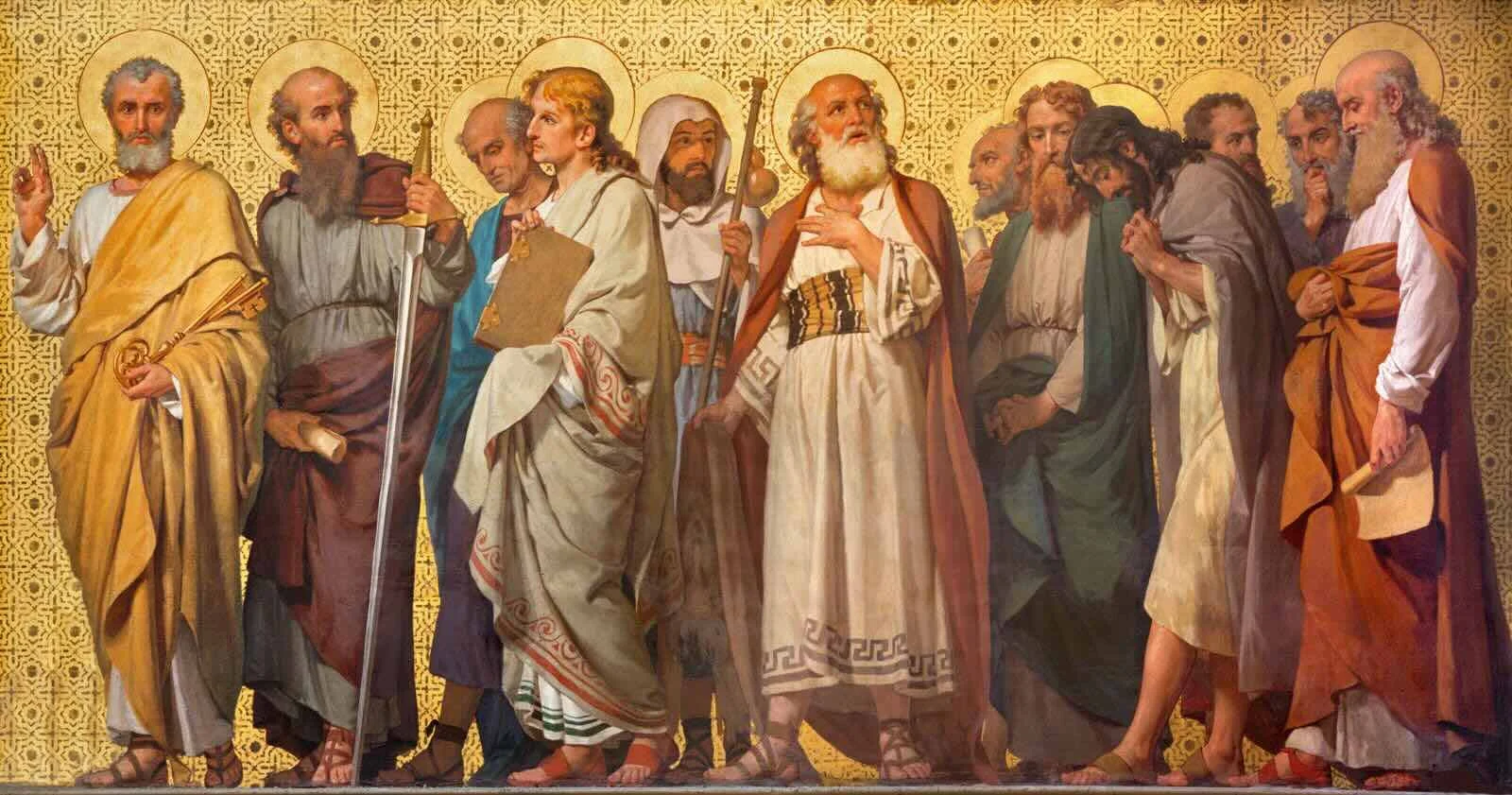
除基督的图像之外,人们也为神圣历史中的杰出人物制作图像,尤其是怀抱圣婴的蒙福童女;以三位君王之姿在马槽前敬拜的东方博士;95四位福音书作者、十二使徒,特别是彼得和保罗;96逼迫时期的许多殉道者和圣徒,以及后来受人尊敬的主教和修士。97
根据八世纪或更晚时期的一种传统,福音书作者路加不但画过基督,也画过马利亚和两位主要使徒。更晚的传说甚至把七幅圣母像归于他名下,据称其中几幅仍然存在;例如,罗马圣母大殿 (Maria Maggiore) 的博尔盖塞 (Borghese) 礼拜堂中就有一幅。圣母像很早便显露出一种努力,要将童女表现为女性美貌、纯洁与可爱的理想,并使她与她神圣的儿子相似。98彼得通常被画成圆头、头发与胡须卷曲的样子;保罗则是长脸、头顶秃发、胡须尖削。两人往往都手持书卷,或者前者手持十字架和(天国的)钥匙,后者手持(圣道与圣灵的)宝剑。
这些表现基督、圣徒和圣经事件的图像,见于地下墓窟及其他埋葬之所、石棺和墓碑、私人住宅、杯子和印戒之上,也见于教堂的墙壁,尤其是祭坛后方的墙壁上(尽管305年的埃尔维拉会议 (council of Elvira) 曾加以禁止)。99
圣经抄本、礼仪书、私人住宅,甚至拜占庭帝国 (Byzantine empire) 大城市中官员的衣袍,也都饰以圣经图画。四世纪后半叶,本都 (Pontus) 的阿马西亚 (Amasea) 主教阿斯特里乌斯 (Asterius) 曾反对穿着这些“蒙上帝喜悦的衣服”,100并劝人不如把变卖这些衣服所得的钱用来尊重上帝活的形象、周济穷人;与其把瘫子穿在衣上,不如去探望病人;与其随身带着那跪下抱住耶稣双脚的有罪女人的图像,不如流下痛悔的眼泪,为自己的罪哀哭。
在图像前俯伏,101以表示对图像所代表的圣徒的敬意,这种习俗最早于六世纪出现在希腊教会。此后,无知的民众在许多情况下把图像与其所代表的对象混同起来,认为这外在的物质之物具有行神迹的魔力,并把种种迷信观念附着于图像之上——这也是意料之中的事。甚至奥古斯丁 (Augustin) 也曾哀叹,粗陋无知的基督徒群众中有许多崇拜图像的人,102不过,他把这些人列入人数众多的挂名基督徒之中,认为他们并不认识福音的本质。
作为艺术品,这些早期基督教绘画与雕塑总体上价值很低,远不及教会建筑。它们与其说优美和谐,不如说庄重高远。因为它们最初并非出于审美趣味,而是出于实际需要,而且至少在希腊帝国,主要由修士制作。以庄重与崇高为起点,而不像异教那样以感官之美为起点,这完全符合基督教的精神。由此也就有了它对裸体的厌恶,以及用衣饰端庄地遮盖丰腴形体的做法;只容许露出手、脚和面容。
众所周知,基督教的审美趣味后来发生了变化;根据“在洁净的人,凡物都洁净”的原则,它甚至把十字架上的基督,以及在母亲胸前吃奶或在母亲怀中的圣婴,都表现为赤身露体的形象。
此外,在君士坦丁 (Constantine) 时代,古代的古典绘画与雕塑已经严重衰落;即使在它们最鼎盛的时期,也未能充分表现基督教的原则。
从这一观点来看,那许多古老艺术品在随后时期破坏圣像的风暴中,被当作纯粹的偶像崇拜器具而无情地摧毁,其损失并不十分值得惋惜。直到中世纪后期,教会建筑已臻极盛之时,基督教艺术才成功地使绘画与雕塑呈现出前所未有的繁荣,并且至少在绘画领域,远远超过了古希腊人的杰作。雕塑只能在人的有限界限之内表现人,既没有生命的红润,也没有眼睛的光彩,宛如来自死者国度的朦胧形体;它或许在古希腊人那里就已达到完美的顶峰,连卡诺瓦 (Canova) 和托瓦尔森 (Thorwaldsen) 也未能超越。然而,绘画能够表现人与周围世界的有机联系,并且能够在一定程度上,借着面容和眼睛,表现人心灵与精神的无穷深处;它一直等到基督教原则的影响之下,才完成其完美的使命,并在列奥纳多·达·芬奇 (Leonardo da Vinci)、弗拉·贝亚托·安杰利科 (Fra Beato Angelico)、科雷乔 (Correggio) 和阿尔布雷希特·丢勒 (Albrecht Dürer) 的基督像,以及拉斐尔 (Raphael) 的圣母像中,产生了迄今为止为艺术史增光的最崇高作品。
§ 112. 奉献的礼物
在这里,还须提到教堂装饰的另一种形式,即奉献的礼物;这种做法在异教徒和犹太人中早已成为习俗。例如,德尔斐 (Delphi) 神庙由于获赠兵器、金银器皿、雕像等物,变得极其富有。几乎每一座海神尼普顿 (Neptune) 的庙宇中,都悬挂着还愿牌,是人们为感谢这位神明救自己脱离海难而奉献的。103犹太人中似乎也有类似的习俗;因为《撒母耳记上》第21章暗示,大卫曾把非利士人歌利亚的刀存放在圣所中。在祭司的院子里,可以看见大量的刀、矛、贵重器皿及其他珍贵物品。
君士坦丁用金、银和宝石等丰厚礼物,装饰耶路撒冷教堂的祭坛区域。索佐门 (Sozomen) 告诉我们,104耶路撒冷主教区利罗 (Cyril) 在一次饥荒期间,变卖了教会的财宝和奉献的圣物;后来有人从一名女演员的服装中,认出了一件他曾献给教会的礼服。
这类礼物中有一种特殊的形式,即纪念神奇医治的物品,105出现于五世纪;至少最早提到它们的是狄奥多勒 (Theodoret)。他在论殉道者的第八篇讲论中说:“那些怀着信心的确据祈求的人,得着了他们所求的;他们为证明自己蒙了医治而献上的圣物,清楚地证实了这一点。有的人献上金银制成的脚,有的人献上金银制成的手;这些礼物表明他们已脱离那些病患,是痊愈者为此献上的凭证。”随着对圣徒的崇拜,这种习俗大为盛行,到中世纪已极为普遍。凡从疾病中康复的人,都认为自己首先有义务献上一件礼物,向自己在患难中求助的圣徒表示感谢。孩子有幸从出牙热中存活下来的父母,会向圣阿波罗尼娅 (St. Apollonia) 献上蜡制颌骨(据传说,她所有的牙齿都曾被刽子手的仆役用钳子拔掉)。同样,人们为旅途顺利完成而向圣朱利安 (St. Julian) 献礼,为从狩猎的危险中平安归来而向圣胡伯特 (St. Hubert) 献礼,使他们所得的礼物极为丰厚;然而,童女马利亚所得的比所有圣徒都多。几乎每一座供有能行神迹的上帝之母像的教堂或礼拜堂,即使如今也拥有大量金银制成的谢礼,以感谢平安归来和疾病痊愈。
§ 113. 教会诗歌与音乐
J. 兰巴赫 (J. Rambach):《基督教会历代圣歌选》(Anthologie christl. Gesänge aus allen Jahrh. der christl. Kirche)。阿尔托纳 (Altona),1817–1833年。H. A. 丹尼尔 (H. A. Daniel):《圣歌宝库》(Thesaurus hymnologicus)。哈勒 (Hal.),1841–1856年,5卷。埃德莱斯坦·迪·梅里尔 (Edélestand du Méril):《十二世纪以前的拉丁民间诗歌》(Poésies populaires latines antérieures au douzième siècle)。巴黎,1843年。C. 福特拉格 (C. Fortlage):《基督教早期圣歌》(Gesänge der christl. Vorzeit)。柏林,1844年。G. A. 柯尼希斯费尔德 (G. A. Königsfeld) 与 A. W. 冯·施莱格尔 (A. W. v. Schlegel):《古代基督教赞美诗与圣歌:拉丁文与德文》(Altchristliche Hymnen u. Gesaenge lateinisch u. Deutsch)。波恩,1847年。柯尼希斯费尔德编第二集,波恩,1865年。E. E. 科赫 (E. E. Koch):《基督教会、尤其德国福音派教会的圣诗与教会歌唱史》(Geschichte des Kirchenlieds u. Kirchengesangs der christl., insbesondere der deutschen evangel. Kirche)。第2版,斯图加特,1852年及后,4卷(第i卷,第10–30页)。F. J. 莫内 (F. J. Mone):《中世纪拉丁赞美诗》(Latein. Hymnen des Mittelalters)(据抄本编成),弗赖堡,1853–1855年。(第i卷,颂赞上帝与天使的赞美诗;第ii卷,颂赞马利亚的赞美诗;第iii卷,颂赞圣徒的赞美诗。)贝斯勒 (Bässler):《二至十五世纪古代基督教诗歌选》(Auswahl Alt-christl. Lieder vom 2–15ten Jahrh.)。柏林,1858年。R. Ch. 特伦奇 (R. Ch. Trench):《拉丁圣诗:以抒情诗为主,选编实用本,附注释与导论》(Sacred Latin Poetry, chiefly lyrical, selected and arranged for use; with Notes and Introduction)(1849年),修订第2版,伦敦与剑桥,1864年。J. M. 尼尔博士 (Dr. J. M. Neale,牛津萨克维尔学院) 的重要圣诗学著作:《中世纪教会拉丁诗歌》(The Ecclesiastical Latin Poetry of the Middle Ages)(载于亨利·汤普森 (Henry Thompson) 的《罗马文学史》(History of Roman Literature),伦敦与格拉斯哥,1852年,第213页及后);《中世纪赞美诗与继抒咏》(Mediaeval Hymns and Sequences),伦敦,1851年;《弥撒经书中的继抒咏》(Sequentiae ex Missalibus),1852年;《东方教会赞美诗》(Hymns of the Eastern Church),1862年;发表于《教会学家》(Ecclesiologist) 的数篇文章;以及载于《礼仪学论集》(Essays on Liturgiology) 等书中的拉丁文论文《论继抒咏》(De Sequentiis),第359页及后。(另参J. 钱德勒 (J. Chandler):《初代教会赞美诗:首次搜集、翻译并编排》(The Hymns of the Primitive Church, now first collected, translated, and arranged),伦敦,1837年。)
诗歌及其孪生姊妹音乐,是最崇高、最属灵的艺术;与建筑、绘画和雕塑相比,它们更契合基督教的精神,也远为充分地服务于敬虔和造就的目的。它们运用言词与音调,因而比造型艺术借助石材与色彩,更能直接向人的心灵说话,也更能充分表达思想与情感世界的一切丰富内涵。众所周知,在旧约中,它们是敬拜上帝的基本组成部分;在历代及基督教会几乎所有支派中,也一直如此。
在宗教诗歌的各种体裁中,赞美诗最早出现,也最为重要。它有丰富的历史,其中蕴藏着基督徒生命中最深刻的经历。然而,它直到在德语和英语的福音派教会中,才达到充分的繁荣;在那里,它如同圣经一样,首次真正成为人民的共同财富,而不再局限于祭司或诗班。
狭义的赞美诗属于抒情诗,即表达情感的诗,与史诗和戏剧诗相区别。它也因其敬虔的性质、通俗的形式以及适宜歌唱的特点,而有别于其他抒情诗体(颂诗、挽歌、十四行诗、康塔塔等)。赞美诗是一种通俗的属灵歌曲,以高尚、简洁而人人能懂的形式,表达健全的基督徒情感,适合全体信徒会众诵读和歌唱,并从中得到造就。因此,它不可包含任何与圣经、教会教义、基督徒共同经历或敬虔精神不相符合的内容。每一个有信心的基督徒,都能同唱《荣耀归于至高上帝》(Gloria in Excelsis) 或《我们赞美你,上帝》(Te Deum)。经典赞美诗固然相对稀少,却超越了信条上的分歧,以属天的和谐化解人间意见的不协之音。在这一点上,它们类似《诗篇》;争战中的教会各支派,天天都从《诗篇》中汲取滋养和安慰。它们身披美丽与圣洁欢欣的安息日盛装,展现基督徒生命的繁盛。它们在一切敬虔的心中回响,如每日升起的太阳、每年归来的春天,具有不可磨灭的清新与力量。事实上,它们有益的效力随岁月而增长,好像医病的草药,捣得越久,药力越厚。它们是奋战中教会的真正恩人,是奉差遣服役的天使,为那将要承受救恩的人效力。除圣经以外,一部好的赞美诗集,就是最丰富的造就之泉。
《诗篇》是最古老的基督教赞美诗集,是教会从旧约承继而来的。弥赛亚在地上的显现,是基督教诗歌的开端;马利亚、以利沙伯、西面和天军,都以不朽的颂歌迎接他。因此,宗教与诗歌在福音中结合。在使徒书信中,也可见早期基督徒诗歌的痕迹,就是一些富有节奏的引文,而这些引文并不能确证取自旧约。106从老普林尼 (the elder Pliny) 致图拉真 (Trajan) 的信中,我们得知,二世纪初,基督徒已用诗歌颂赞基督为他们的上帝;从较晚的史料中,我们又得知,这类诗歌为数众多。107
尽管如此,逼迫时期的完整宗教诗歌,流传至今的,只有亚历山大的革利免 (Clement of Alexandria) 献给神圣逻各斯 (Logos) 的诗——不过,这首诗不能称为赞美诗,而且很可能从未打算供公共敬拜使用——以及《使徒宪章》中的《晨歌》108和《晚歌》109;尤其是前者,即所谓《荣耀归于至高上帝》(Gloria in Excelsis),它扩充了天军的颂荣,至今仍在基督教世界各处回响。其次是《我们赞美你,上帝》(Te Deum) 的东方原始形式,即 καθ’ ἑκάστην ἡμέραν*,其年代早于安布罗斯 (Ambrose)。《三圣颂》(Ter Sanctus) 以及若干古代礼仪祷文,也可视为诗歌。因为赞美诗其实无非是祷告披上了诗意灵感的节日盛装,而最好的礼仪祷文也都是诗的创作。格律和押韵绝非必不可少。
古代大公教会的赞美诗,便是在这些富有生机的圣经及早期基督教典范之上兴起的,构成了赞美诗史的第一阶段;随后是中世纪阶段,再后是福音派新教阶段,各有其不同的时期。
§ 114. 东方教会的诗歌
参阅丹尼尔 (Daniel)《赞美诗宝库》(Thesaurus hymnologicus) 第三卷(希腊文部分由 B. 福尔姆鲍姆 [B. Vormbaum] 编纂);§ 113所引 J. M. 尼尔 (J. M. Neale) 的著作;伦敦《基督徒纪念刊》(Christian Remembrancer) 1859年4月号所载《希腊赞美诗》(Greek Hymnology) 一文;另参§ 98所引礼仪学著作。
希腊教会在基督教教义和文化的各个领域都居于领先地位,又从古希腊承受了如此丰富的诗歌遗产,我们自然会期望,它在教会诗歌上也能定下基调。然而,这一期望只在极有限的程度上实现了。《荣耀归于至高上帝》(Gloria in excelsis) 和《我们赞美你,上帝》(Te Deum) 无疑是早期教会流传至今的圣诗中最珍贵的瑰宝;前者全部、后者部分源自东方,或许可追溯至三世纪或二世纪。110但除了这些韵律散文体的赞美诗,前六个世纪的希腊教会在这一领域,并未产生任何具有持久价值或得到普遍使用的作品。111它长期以来几乎专用大卫的《诗篇》;正如金口约翰 (Chrysostom) 所说,在基督徒的聚会中,开头、中间、末了都是大卫。为了反对异端的偏好,它甚至坚决反对在公共敬拜中使用非受默示的诗歌。阿里乌派 (Arians) 和亚波里拿留派 (Apollinarians),如同在他们之前的诺斯替派 (Gnostics) 一样,把宗教诗歌和音乐用作向民众推介、传播其谬误的手段,因而使这些艺术蒙受恶名,尽管滥用绝不能成为禁止正当使用的理由。约公元360年的老底嘉会议 (council of Laodicea),甚至禁止在教会中使用一切非受默示的诗歌或“私人赞美诗”;112451年的迦克墩会议 (council of Chalcedon) 又确认了这项法令。
然而,也有例外。金口约翰认为,要抵消君士坦丁堡 (Constantinople) 阿里乌派赞美诗使人偏离正道的影响,最有效的办法,就是以游行中庄严的交替唱和颂荣作为积极的解药。拿先斯的贵格利 (Gregory Nazianzen) 曾用古典格律撰写正统赞美诗;但这些诗具有思辨神学的性质,又缺乏通俗精神,因而从未进入教会使用。耶路撒冷的索弗罗尼乌斯 (Sophronius of Jerusalem) 用阿那克里翁体诗节颂扬重大节日;托勒迈斯的叙内修斯 (Synesius of Ptolemais,约公元410年) 撰写哲理赞美诗;埃及帕诺波利斯的农努斯 (Nonnus of Panopolis) 用六音步诗改写《约翰福音》;还有皇帝狄奥多西二世 (Theodosius II) 的妻子欧多克西娅 (Eudoxia),以及查士丁尼一世 (Justinian I) 时的政治家保罗·西伦提亚里乌斯 (Paul Silentiarius),他留下若干短诗,另有一篇为圣索菲亚教堂献堂而作、饶有趣味的诗体描写。这些人的作品也都可作如是观。严格说来,君士坦丁堡主教阿纳托利乌斯 (Anatolius,† 458) 才是这一时期唯一在某种程度上实现了教会赞美诗理想、其诗歌又适合民众使用的诗人。113
叙利亚教会是所有东方教会中,最先创作通俗的正统诗歌并将其纳入公共敬拜的,以对抗诺斯替派巴尔代撒尼斯 (Bardesanes,约公元170年) 及其子哈摩尼乌斯 (Harmonius) 的异端诗歌。叙利亚的以法莲 (Ephraim Syrus,† 378) 以大量成功的叙利亚语赞美诗开辟道路;五世纪中叶的安提阿长老以撒 (Isaac),尤其是美索不达米亚 (Mesopotamia) 萨鲁格主教雅各 (Jacob of Sarug,† 521),都是无愧于他的继承者。114
五世纪以后,希腊教会消除了对诗歌的偏见,为公共敬拜创作了数量庞大、却鲜为人知的圣诗。
希腊教会诗歌的历史,与拉丁教会诗歌一样,可以分为三个时期:(1)形成期,在此期间逐渐摆脱古典格律,创造自己的独特风格,延续至约650年;(2)全盛期,延续至820年;(3)衰落与式微期,延续至1400年或君士坦丁堡陷落。第一时期的作品,尽管拿先斯的贵格利和耶路撒冷的索弗罗尼乌斯的一些颂歌十分优美,却几乎没有在希腊教会的日课书中留下痕迹。希腊诗歌的繁荣期,与圣像争论时期相重合;最杰出的诗人同时也是圣像的拥护者。其中最卓越的是大马士革的约翰 (John of Damascus),兼有希腊教会最伟大神学家和最伟大诗人的双重荣誉。
因此,希腊诗歌的精华,应属于本书较后的部分。不过,既然至少在五世纪已能见到它的兴起,我们就在这里简述其独特性质。
希腊教会最早的诗人,尤其是四世纪的拿先斯的贵格利和七世纪的耶路撒冷的索弗罗尼乌斯,采用古典格律;这种格律完全不适合基督教思想和教会诗歌,因此逐渐不再使用。115押韵始终未能进入希腊教会。取而代之的,是从希伯来诗歌,以及马利亚、撒迦利亚、西面和天军最早的基督教颂歌中采用的格律性或和谐的散文。君士坦丁堡的阿纳托利乌斯 († 458) 首先摆脱古典格律的专制,另辟新路。希腊诗律这一独特体系的要点如下:116
作为后续各节范式的第一诗节,术语称为 Hirmos(领节),因为它牵引着其余各节。后续诗节称为 Troparia(诗节),为便于吟唱,以逗号分隔,不顾文意。若干个 troparia,从三个到二十个或更多,组成一首 Ode(颂歌);它相当于拉丁的 Sequence(继叙咏),后者约在同一时期由圣加仑 (St. Gall) 的修士诺特克 (Notker) 引入。每首颂歌以一个 hirmos 为基础,以赞美圣童贞女的一个 troparion 结束。117颂歌通常以离合体排列,有时依字母顺序排列,可能是仿效《诗篇》第25、112和119篇等篇章。九首颂歌组成一部 Canon(颂典)。118较早那些歌颂道成肉身、复活和升天等重大事件的颂歌,有时颇为崇高;但后期颂扬无名殉道者的冗长颂典,则极其平淡乏味,充满与福音格格不入的成分。即使东方最好的赞美诗作品,也缺乏拉丁赞美诗和福音派新教赞美诗那种健全的简朴、自然、热忱与深度。
东方主要的教会诗人有:阿纳托利乌斯 (Anatolius,† 458)、克里特的安得烈 (Andrew of Crete,660–732)、日耳曼努斯一世 (Germanus I,634–734)、大马士革的约翰 (John of Damascus,† 约780)、号称“歌者”的耶路撒冷的科斯马斯 (Cosmas of Jerusalem,780)、狄奥法尼斯 (Theophanes,759–818)、斯图狄乌修院的狄奥多尔 (Theodore of the Studium,826)、美多迪乌斯一世 (Methodius I,846)、斯图狄乌修院的约瑟 (Joseph of the Studium,830)、士每拿的梅特罗法尼斯 (Metrophanes of Smyrna,† 900)、利奥六世 (Leo VI,886–917),以及欧提米乌斯 (Euthymius,† 920)。
希腊教会的诗歌收录在礼仪书中,尤其是十二卷的《月课经》(Menaea) 中。这部书相当于拉丁教会的《日课经》(Breviary),大部分由韵律散文体的诗歌或半诗歌式颂歌组成。119这些历经九个世纪琢磨而成的宝藏,至今几乎仍局限于东方教会,实际上也只能提供少数可供普遍使用的金粒。尼尔近来作了成功的尝试,将希腊教会最有价值的赞美诗,大幅删节,以现代英语格律重新表达,使人能够读到。120
我们从尼尔所译、曾出席迦克墩会议(451年)的君士坦丁堡牧首圣阿纳托利乌斯的赞美诗中,举出几个例子。第一首是圣诞赞美诗,希腊文起句为:
Μέγα καὶ παράδοξον θαῦμα*(伟大而奇妙的神迹)。
“伟大而奇妙的神迹,
使这节庆确立无疑:
童贞女生下圣婴,
童贞的尊荣仍纯洁无瑕。
圣言成为肉身,
却仍居于高天;
基路伯从天上,
向牧人唱出颂歌。
我们也同他们欢唱凯歌,
再次唱起这赞美:
‘在至高之处荣耀归于上帝,
在地上平安归于人!’
当光明的天使众军,
如此歌颂你们的君王,
山谷群山啊,要欢喜!
浩瀚众海啊,要拍掌!
他既来赎回万有,
愿万有都敬拜他,
这降生伯利恒的圣婴,
就是救主,就是主!
如今偶像都必消灭,
一切谬误都必衰亡,
基督必执掌权杖,
永为我们的主、我们的上帝。”
同一作者的另一首圣诞赞美诗,起句为 ἐν Βηθλεέμ*:
“他降生在伯利恒!
万有的创造者,永恒的上帝!
他开启伊甸的门,
万世的君王!从此火焰的剑
让出荣耀的通道;从此,
隔断的墙既已推倒,
天上地下的众权能合而为一;
天使与人重续古时的盟约,
圣洁者与圣洁者重新相聚,
欢然联合!如今童贞女的腹中,
如同基路伯的宝座,
容纳那不能被容纳者;
承载着那位——撒拉弗承载他时
也要战兢!她承载着他,他正来临,
要将他永恒之爱
丰丰富富地倾注于世界!
再举一首歌颂基督平静风浪的诗,ζοφερᾶς τρικυμίας*,由尼尔译写如下:
“狂涛汹涌,
黑夜沉沉;
奋力摇桨,
白沫微明;
舟人战栗,
危难逼近;
那出于上帝的上帝便说:
——‘平静吧!是我。’
如山的巨浪啊,
低下你的峰顶!
友拉革罗 (Euroclydon) 的呼啸啊,
止息你的声音!
危险必不能存留,
忧伤必须逃遁,
只要那出于光的光说:
——‘平静吧!是我。’
耶稣,拯救者啊!
求你来到我这里:
我航行在人生的海上,
求你使我安稳!
当死亡的风暴
呼啸着席卷而来,
那出于真理的真理啊,求你轻声说:
——‘平静吧!是我。’”
§ 115. 拉丁赞美诗
四世纪至十六世纪的拉丁赞美诗,比希腊赞美诗更为重要。它的规模虽小,却在质朴无华与真诚,以及思想的丰富、雄健和充实方面胜过后者,也远更接近新教精神。它将客观的教会性质,与更深的情感,以及对救恩更为主观的领受和体验结合起来,因而比希腊赞美诗更温暖、更热切。在这些方面,它构成了向福音派赞美诗的过渡;后者最优美、最深刻地表达了个人对救主及其救赎恩典的享受。最好的拉丁赞美诗,借着罗马《日课经》得到普遍使用,并通过翻译和改写,在新教各教会中落地生根。它们大多歌咏救恩的伟大事实和基督教的基本教义。然而,其中也有许多是颂赞马利亚和殉道者的,并因掺杂迷信而受到损害。
在拉丁教会中,如同在希腊教会中一样,异端给诗歌创作带来了有益的推动。拉丁教会诗歌的两位鼻祖,希拉里 (Hilary) 和安布罗斯 (Ambrose),正是西方捍卫正统、反对阿里乌主义 (Arianism) 的勇士。
基督教的精神对拉丁语及其诗律施加了影响,一方面使之解放,一方面使之改变。诗歌在青春蓬勃之时,犹如奔腾的山洪,不知界限,冲破一切障碍;但到了成熟的形态,它便自加约束,在自我限制中获得真正的自由;它采取匀称而有节制的运动,并使之与周期性的停顿相结合。这就是节奏,在希腊和罗马的诗歌中达到了完美的境地。然而,格律的法则对于基督教的新精神却成了过度的束缚;这种新精神需要一种新的形式。教会的拉丁诗歌有自己的语言、自己的语法、自己的韵律和自己的美;在清新、雄健和悦耳方面,甚至超过了古典拉丁诗歌。它必须抛弃神话传说的一切助力,却从圣经的神圣历史与诗歌,以及基督教的英雄时代,汲取了更纯洁、更丰富的灵感。然而,它首先必须经历一个粗陋的阶段,正如南欧的罗曼诸语言从古拉丁语转变而来时所经历的一样。我们看到,拉丁语在朝气蓬勃、充满盼望的基督宗教影响之下,仿佛受到第二个春天的气息吹拂,抽出新蕾,绽放新花,披上美丽的新衣:旧词获得了崭新而更深刻的意义,废词重新复活,新词不断形成。这一切固然有许多地方会冒犯挑剔的古典趣味,然而所得却丰厚地补偿了所失。基督教在罗马帝国取得胜利时,所遇见的古典拉丁语正迅速走向衰败和解体;随着时间的推移,基督教从它的灰烬中产生了一种新的创造。
古典韵律的体系逐渐松弛,重音取代了音量。古人未曾将押韵作为一种体系或规则,如今它被引入诗行的中间或末尾,赋予诗歌以抒情的性质,从而使之与音乐更加亲近。因为这些赞美诗是要在教会中歌唱的。这种重音押韵诗起初固然很不完善,却比异教古典诗歌那种刻板、僵硬而冷漠的格律,更适合基督教精神的自由、深邃和热忱。121音量多少是一种人为规定的技巧;重音,即强调多音节词中的一个音节,却是自然的、通俗的,也更悦耳。安布罗斯及其追随者凭着敏锐的直觉,为他们的赞美诗选择了抑扬格二步格 (Iambic dimeter);在所有古代格律中,这种格律受音量约束最少,而节奏感最强。追求和谐押韵的倾向与重音节奏并行发展;这种倾向的粗略萌芽,在希拉里和安布罗斯那里偶有所见,在达马苏斯 (Damasus) 那里则更为充分;后者才是这一改进的真正创始者。
押韵既非野蛮时代的发明,也非文明过度发展时代的产物;几乎所有民族、语言和文化层次中,都多少可以见到它。如同节奏一样,它源于人对比例、谐音、界限和周期性复现的自然审美感。122即使在罗马共和国最古老的民间诗歌中,例如恩尼乌斯 (Ennius) 的诗,也随处可见。123甚至西塞罗 (Cicero) 的散文中也不乏其例,奥古斯丁的散文尤其如此;他喜欢巧妙的头韵和词语对照,如 patet(显露)与 latet(隐藏)、spes(盼望)与 res(实在)、fides(信心)与 vides(你看见)、bene(好好地)与 plene(充分地)、oritur(兴起)与 moritur(死亡)。罗马的达马苏斯将押韵引入了圣诗。124然而,直到中世纪的拉丁圣诗中,押韵才首次取得有规则的形式;十二、十三世纪,在圣维克托的亚当 (Adam of St. Victor)、希尔德贝尔特 (Hildebert)、圣伯尔纳 (St. Bernard)、克吕尼的伯尔纳 (Bernard of Clugny)、托马斯·阿奎那 (Thomas Aquinas)、波拿文都拉 (Bonaventura)、切拉诺的托马斯 (Thomas a Celano) 以及雅各布斯·德·本尼狄克蒂斯 (Jacobus de Benedictis,《圣母悼歌》〔Stabat mater〕的作者) 的作品中,它达到了完美的境地。尤其是在那首论审判的、无与伦比的宏伟赞美诗中,更是如此;这首诗的巨大力量,首先固然在于其严肃的内容,其次则在于运用元音的音乐效果时那无可仿效的精湛技艺。我所指的,当然是方济各会修士切拉诺的托马斯约于1250年所作的《震怒之日》(Dies irae);每次诵读,它都使人产生新的惊叹,任何现代语言的翻译都不能充分传达它的妙处。十二世纪圣维克托的亚当也写出了无可超越的韵文;例如,他对福音书作者约翰的描绘(出自诗篇《论福音书作者圣约翰》〔De, S. Joanne evangelista〕),奥尔斯豪森 (Olshausen) 曾将它选作自己《第四福音书注释》的题辞,特伦奇 (Trench) 则称之为拉丁教会诗歌中最美的一节:
“Volat avis sine meta
飞鸟翱翔,无远弗届,
Quo nee vates nec propheta
Evolavit altius:
无论诗人或先知,
都未曾飞得比它更高:
Tam implenda,125 quam impleta126
无论将成之事,或已成之事,
Nunquam vidit tot secreta
Purus homo purius."
从无仅为凡人者,看见如此众多的奥秘,
看得如此清明。”
拉丁赞美诗的格律多种多样,往往难以界定。加万蒂 (Gavanti)127认为主要有六种诗体:
抑扬格二步格 (Iambici dimetri),如:“Vexilla regis prodeunt”(君王的旌旗向前行)。
抑扬格三步格 (Iambici trimetri;ternarii vel senarii,即三步格或六音步格),如:“Autra deserti teneris sub annis”(幼年时便居旷野洞穴)。
扬抑格二步格 (Trochaici dimetri):“Pange, lingua, gloriosi corporis mysterium”(舌头啊,歌颂荣耀圣体的奥秘),为托马斯·阿奎那所作的圣餐赞美诗。
萨福体,末尾加阿多尼斯诗行 (Sapphici, cum Adonico in fine),如:“Ut queant axis resonare fibris”(使他们能以弦音颂扬)。
扬抑格 (Trochaici),如:“Ave maris stella”(海星啊,向你致敬)。
阿斯克勒庇阿德斯体,末尾加格吕孔诗行 (Asclepiadici, cum Glyconico in fine),如:“Sacris solemniis juncta sint gaudia”(愿欢欣与神圣的庆典相联)。
在我们目前论述的时期,抑扬格二步格占据主导地位;希拉里和安布罗斯的作品无一例外地采用这种格律。
§ 116. 拉丁诗人与赞美诗
这一时期的诗人,除普鲁登修斯 (Prudentius) 外,全是教牧人员;其中最优秀的又都是杰出的神学家,他们的生平与工作,更适宜放在本书其他部分论述。
普瓦捷 (Poitiers) 主教希拉里(因此又称 Pictaviensis,† 368),是阿里乌派争论中西方的亚他那修 (Athanasius);据哲罗姆的见证,128他是拉丁教会第一位赞美诗作者。他被放逐在弗里吉亚 (Phrygia) 和君士坦丁堡 (Constantinople) 期间,接触到阿里乌派的赞美诗,受到它们的激发,归来后便创作正统的赞美诗,供西方教会使用。他由此奠定了拉丁赞美诗的基础。他写了优美的晨诗:“Lucis largitor splendide”(光辉灿烂的赐光者);五旬节赞美诗:“Beata nobis gaudia”(赐我们有福的欢欣);也可能将著名的《荣耀归于至高之处的上帝》(Gloria in excelsis) 改写为拉丁文。许多归于他名下的赞美诗,其作者身份都值得怀疑,尤其是那些已经出现规则押韵的诗篇,如主显节赞美诗:
“Jesus refulsit omnium
耶稣发出光辉,照耀万有,
Pius redemptor gentium."
万民慈爱的救赎主。”
我们摘录他晨诗前三节的一部分作为范例;这首诗曾多次译成德文和英文:129
“Lucis largitor splendide,
光辉灿烂的赐光者啊,
“光明之荣耀的父啊,
Cuius serene lumine
借你明净的光辉,
从你宁静而明亮的光华中,
Post lapsa noctis tempora
黑夜的时辰过去之后,
黑夜的时辰一经消逝,
Dies refusus panditur:
白昼重新流溢,向四方展开:
黎明的灿烂便照耀四方:
“To verus mundi Lucifer,
你是世界真正的启明星,
“你是黑暗世界更真实的光芒:
Non is, qui parvi sideris,
并非那颗微小的星辰,
并非那较小白昼的光辉,
Venturae lucis nuntius
作那将临之光的使者,
在清晨初起时预告,
Augusto fulget lumine:
以庄严的光辉照耀:
我们那较暗太阳的来临:
“Sed toto sole clarior,
你却比整个太阳更明亮,
“你比正午的日光更为灿烂,
Lux ipse totus et dies,
你本身全然是光,全然是白昼,
你自己就是白昼最充盈的光芒,
Interna nostri pectoris
将我们胸怀深处,
我们内心最深处的居所,
Illuminans praecordia."
将我们心灵的深处照亮。”
你以恩典将它照亮。”
米兰 (Milan) 杰出的主教安布罗斯,虽然年代稍晚(† 397),但因其赞美诗数量众多、价值卓著,仍被视为拉丁教会圣歌真正的始祖,并成为一切后继者的典范。他作为赞美诗作者的声誉如此之高,以致 Ambrosianus(安布罗斯的)与 hymnus(赞美诗)二词,一度几乎成了同义词。他的真作以坚定的信心、崇高而粗朴的单纯、高贵的庄严、深厚的灵恩感化,以及真正的教会与礼仪精神为特征。其节奏仍不规则,押韵也只显出尚不完善的萌芽;在这一点上,它们的确远逊于中世纪那些更柔和、更丰富、更能吸引耳朵与心灵的旋律。它们是一座用未经磨光、未经凿削的石头筑成的祭坛。它们陈述信仰的伟大对象时,表面上显得冷静,仿佛远远站着,遥相敬拜;然而热情确实存在,只是潜藏未露,一股严峻热忱的火焰在表面之下燃烧。其中许多作品,除了诗歌价值之外,还具有历史与神学价值,因为它们是正统信仰反对阿里乌主义的见证。130
然而,在所谓安布罗斯赞美诗的三十至一百首作品中,131据其著作的本笃会 (Benedictine) 编者判断,只有十二首是真作;其余都是佚名作者所作、成就不一的仿作。尼尔 (Neale) 将安布罗斯赞美诗的真作减至十首,排除了一切押韵规则的作品和不合格律的作品。真作包括晨诗:“Aeterne rerum conditor”(万有永恒的创造主);132晚诗:“Deus creator omnium”(上帝,万有的创造主);133以及降临期或圣诞节赞美诗:“Veni, Redemptor gentium”(来吧,万民的救赎主)。最后这首被公认为他的最佳作品,实为恰当。它曾多次被译写成现代语言,134我们在此附上这一范例,并配以英译,以展示其内容与形式:
“Veni, Redemptor gentium,
来吧,万民的救赎主,
“来吧,大地的救赎主,
Ostende partum Virginis;
显明童贞女所生之子;
来吧,见证你由童贞女降生:
Miretur omne saeculum:
愿世世代代都惊叹:
万邦惊叹,万代赞扬:
Talis partus decet Deum.
这样的降生才与上帝相称。
这样的降生才配得上上帝。
“Non ex virili semine,
并非出于男子的种子,
“并非出于人的意志而生,
Sed mystico spiramine,
而是藉着奥秘的灵息,
而是出于圣灵,仍属奥秘,
Verbum Dei factum est caro,
上帝的道成了肉身,
上帝的道披戴肉身,
Fructusque ventris floruit.
腹中的果实也已盛放。
向人显明所应许的果实。
“Alvus tumescit Virginis,
童贞女的腹渐渐隆起,
“童贞女的腹中怀了胎,
Claustrum pudoris permanet,
贞洁的封印却依然存留,
童贞的尊荣仍丝毫无玷,
Vexilla virtutum micant,
大能的旌旗闪耀,
美德的旗帜在那里闪耀:
Versatur in templo Deus.
上帝居于殿中。
上帝在地上居于自己的殿中。
“Procedit e thalamo suo,
他从自己的新房出来,
“他从自己的居室自由而出,
Pudoris aulâ regiâ,
从那贞洁的王宫出来,
那是贞洁的王家殿堂,
Geminae Gigas substantiae,
这位具双重本质的大能者,
这位具双重本质的大能者,径直向前,
Alacris ut currat viam.135
使他欢然奔跑前面的道路。
他欢欣奔跑那命定的路程。
“Egressus ejus a Patre,
他从父那里出来,
“他从父上帝那里出来,
Regressus ejus ad Patrem,
又回到父那里,
又迅速返回父上帝那里:
Excursus usque ad inferos
他下降,直至阴间,
前去——直达地狱深处:
Recursus ad sedem Dei.
又返回上帝的宝座。
迅速返回——归于不可言喻的光明。
“Aequalis aeterno Patri,
与永恒之父同等的主啊,
“你这与父同等的主啊!
Carnis tropaeo136 cingere,
请以肉身的胜利标记束身,
如今请披上你肉身的战利品(外袍),
Infirma nostri corporis
将我们身体的软弱,
我们这必死之身的软弱,
Virtute firmans perpeti.
以永恒的大能坚固。
求以不朽的能力使之刚强。
“Praesepe jam fulget tuum,
你的马槽如今已发光,
“你的摇篮将在此灿然发光,
Lumenque nox spirat novum,
黑夜也吐露新的光明,
黑暗也将吐露更新的光明,
Quod nulla nox interpolet,
愿这光不为任何黑夜所阻隔,
在那里,永恒的信心将安然照耀,
Fideque jugi luceat."
并以不息的信心照耀。”
暮色永不侵入其间。”
这位米兰主教最负盛名的赞美诗,远非其他作品所能及,单凭这一首就足以使他名垂不朽,那就是安布罗斯颂赞诗《上帝啊,我们赞美你》(Te Deum laudamus)。正如前面所说,这首诗与《荣耀归于至高之处的上帝》(Gloria in excelsis),是古代大公教会诗歌中最宝贵的遗产;直到时间的终结,基督教世界各处仍将虔诚地以它来祈祷、歌唱。根据一个古老的传说,安布罗斯在奥古斯丁受洗之时,与他共同创作了这首诗;二人事先未经商议,仿佛出于上帝的默示,在会众面前交替唱出其中的词句。然而,安布罗斯的传记作者保利努斯 (Paulinus) 对此只字未提;据后来的研究,这首崇高的基督教诗篇,如同《荣耀归于至高之处的上帝》一样,不过是对一首更古老的希腊文散体赞美诗的自由改写和扩充,其中一些成分可见于《使徒宪章》(Apostolic Constitutions) 及其他文献。137
安布罗斯 (Ambrose) 还在米兰引入了一种改良的歌唱方式,善加利用希腊的合唱与对唱,以及民间曲调。这种 Cantus Ambrosianus,即安布罗斯式花唱,很快取代了先前以单一音调诵读诗篇和祷文、仅略加音乐重音与声调变化的方式,并作为会众歌唱传入西方大多数教会。后来它渐趋衰落,经大格列高利 (Gregory the Great) 改良、简化,遂让位于所谓的 Cantus Romanus,即罗马圣咏,或称 choralis。
教父中最伟大的神学家奥古斯丁 (Augustine,† 430),心灵中充满真正的诗意精髓;据说他创作了复活赞美诗“Cum rex gloriae Christus”(当荣耀之王基督),以及颂扬乐园荣耀的赞美诗“Ad perennis vitae fontem melis sitivit arida”(干渴的心灵渴慕永生的泉源)等。然而,他很可能只是以散见于其散文著作、尤其《忏悔录》中的崇高诗意直觉与思想,为后来的诗人提供了 materia carminis,即作诗的素材;例如十一世纪奥斯蒂亚主教彼得·达米安 (Peter Damiani, bishop of Ostia),便将奥古斯丁对天国福乐的默想写成了流畅的诗篇。138罗马主教达马苏 (Damasus,† 384) 是哲罗姆 (Jerome) 的朋友,也创作过少量圣歌,并被认为是尾韵的创始者。139
凯利乌斯·塞杜利乌斯 (Coelius Sedulius) 出生于苏格兰或爱尔兰,是五世纪上半叶的一位长老,创作了赞美诗“Herodes, hostis impie”(希律,你这不敬虔的仇敌)和“A solis ortus cardine”(从日出之处),以及若干较长的诗篇。
马尔库斯·奥勒利乌斯·克莱门斯·普鲁登修斯 (Marcus Aurelius Clemens Prudentius,† 405),在狄奥多西 (Theodosius) 治下曾任西班牙的律师和帝国总督;他将晚年献给宗教默想与圣诗创作,成为那更为热烈激昂的西班牙诗派之首。宾特利 (Bently) 称他为基督徒的贺拉斯与维吉尔,尼尔 (Neale) 则称他为“早期基督教诗人之冠”。普鲁登修斯无疑是古代大公教会诗人中最富天赋、创作最丰的一位。他精通古典格律,却又极其善于为基督教的新思想、新情感披上新的外衣。他的诗集曾多次刊行。140其中有些是以六音步写成的长篇教诲诗或史诗,具有很高的史料价值;141另一些则是史诗集,如《日课诗集》(Cathemerinon)142和《冠冕诗集》(Peristephanon)。143后者的若干选段已被用于公共崇拜。普鲁登修斯最著名的赞美诗,是纪念伯利恒遭屠杀的无辜婴孩的“Salvete, flores martyrum”(向你们致敬,殉道者之花),144以及庄严的葬礼赞美诗“Jam moesta quiesce querela”(悲伤的哀诉啊,如今止息吧)。后者使古代旷野与地下墓穴中的崇拜呈现在我们眼前;赫尔德 (Herder) 说,任何人读到它,都会被其感人的音调打动心弦。145
我们还须提到两位诗人,他们构成了从古代大公教会诗歌到中世纪教会诗歌的过渡。
维南提乌斯·福尔图纳图斯 (Venantius Fortunatus) 生于意大利,是王后拉德贡德 (Radegunde) 的朋友(她与丈夫分居,主持一所修道院),也是法国风靡一时的诗人;去世时(约600年)任普瓦捷 (Poitiers) 主教。他写了十一卷题材各异的诗、一部叙述图尔的圣马丁 (St. Martin of Tours) 生平的史诗,以及一部维护奥古斯丁神恩教义的神学著作。他是第一位以相当熟练而有规律的方式运用尾韵的人,尽管仍颇为自由,以至他许多所谓的韵,不过是辅音的头韵或元音的重复。146他首先掌握了扬抑格四音步;这种格律后来经过种种变化,成为中世纪赞美诗的光彩所在。普鲁登修斯已用过一两次,但福尔图纳图斯首先将其组织为诗节。他最著名的作品是受难赞美诗“Vexilla regis prodeunt”(君王的旌旗向前行)和“Pange, lingua, gloriosi proelium (lauream) certaminis”(舌头啊,歌唱这荣耀争战的战斗〔桂冠〕);二者虽略经修改,均收入《罗马日课经》(Roman Breviary)。147“Vexilla regis”在受难日将祝圣的圣饼送往祭坛的游行中唱诵。这两首诗也都用于寻获圣十字架节与举扬圣十字架节。148天主教徒喜爱的圣母赞美诗“Ave maris stella”(万福,海星)149有时也被归于他名下,实际却晚出甚多。
我们选录他两首著名的受难赞美诗作为范例,二者约作于580年。
君王的旌旗向前行(Vexilla Regis Prodeunt)150
“Vexilla regis prodeunt,
“君王的旌旗向前行,
“君王的旌旗向前行:
Fulget crucis mysterium,
十字架的奥秘放光明,
十字架闪耀奥秘的光辉:
Quo carne carnis conditor
在那里,肉身的创造者以肉身
在那里,造我们肉身的他,亲以肉身,
Suspensus est patibulo.151
被悬挂在刑架上。
担当我们的刑罚,付清我们的赎价。
“Quo vulneratus insuper
“在那里,他又受了创伤,
“在那里,长矛为我们深染鲜血,
Mucrone diro lanceae,
被凶狠的矛尖刺伤,
生命的洪流从他肋旁涌出:
Ut nos lavaret crimine
为要洗净我们的罪污,
要用这宝贵的洪流洗净我们,
Manavit unda et sanguine.
流出了水和血。
在那里,水与血一同流出。
“Impleta sunt quae concinit
“如今都已应验,
“大卫所说的一切都已应验,
David fideli carmine
就是大卫以信实的诗歌所唱的,
就在古时真实的预言诗歌中:
Dicens: in nationibus
他说:在列国之中,
他说,上帝在列国之中,
Regnavit a ligno Deus.
上帝从木架上作王。
已从木架上作王,得胜凯旋。
“Arbor decora et fulgida
“美丽而光辉的树啊,
“美丽的树啊!光明的树啊!
Ornata regis purpura,
以君王的紫袍为装饰,
披着君王紫袍的树啊!
Electa digno stipite
蒙拣选,以配得的树干,
你蒙拣选,在你忠贞的怀中,
Tam sancta membra tangere.
接触如此圣洁的肢体。
使那圣洁的肢体得以安歇!
“Beata cuius brachiis
“有福的树啊,在你臂膀上,
“在你亲切而宽展的臂膀上,
Pretium pependit saeculi,
悬挂着世界的赎价,
悬挂着这世界赎价的重量,
Statera facta saeculi
你成为世界的天平,
为要付清全人类的代价,
Praedamque tulit tartaris.”152
并从阴间夺回了掳物。”
从掳掠者手中夺回他的掳物!”
舌头啊,歌唱这荣耀争战的战斗(Pange, Lingua, Gloriosi Proelium Certaminis)153
“我的舌头啊,歌唱这荣耀的争战,154洋溢着全然的胜利,
在十字架的胜利标记之上,述说这场争战的凯旋;
述说世界的救赎主如何舍去生命,赢得胜利。
“创造亚当的上帝,为这首先受造者的堕落深深悲伤,
因他吃了那有害的苹果,所得的报应是死亡与地狱,
上帝当时便选定这木头,要消除古时那树所带来的毁灭。
“因为我们救恩的工作,必须如此安排,
要以智谋挫败那诡计多端的欺骗者的伎俩;
并从仇敌毒液所出的地方,取出医治的良药。
“因此,当那预定的神圣日期满足之时,
这世界的创造主离开父,离开光明的天上居所,
从童贞女圣洁的腹中降生,成为道成肉身的上帝。
“婴孩在伯利恒马厩的马槽中啼哭;
童贞母亲用襁褓将他的肢体安放妥当,
如此用细麻布妥帖地裹起她上帝的双足与双手。
“他在我们中间居住三十年,预定的日期已满,
他为此而生,自愿迎向他的受难:
羔羊被举在十字架上,生命之血将从那里流出。
“他忍受羞辱与唾吐,忍受醋、铁钉与苇杖;
他有福的肋旁被刺开,水与血便从那里流出:
大地、天空、群星与海洋,确因这洪流得了洁净。
“忠信的十字架啊!高过一切,独一尊贵的树!
无论枝叶、花朵或果实,没有什么能与你相比;
最甘美的木头,最甘美的铁钉,你承载着最甘美的重量!155
“荣耀之树啊,垂下你的枝条!放松筋络,俯身下来;
暂且收起你自出生便有的那古老刚硬;
将那天上荣美的君王,在你怀中温柔地照料。
“唯有你被算为配得承托这世界的赎价;
如同古时的方舟,为遭遇船难的人类预备港湾:
受伤羔羊流出的圣血,涂抹在你身上。
“赞美与尊荣归于父,赞美与尊荣归于子,
赞美与尊荣归于圣灵,永为三位,永为一体:
同质、同永恒,历经无穷无尽的世代。
格列高利一世 (Gregory I,590–604) 作为诗人的重要性就小得多;他是最后一位教父,也是第一位中世纪教皇。许多来源不明的赞美诗被归于他名下,并收入《日课经》。其中最佳的是他的主日赞美诗“Primo dierum omnium”(在一切日子的第一日)。156
赞美诗是古代教会诗歌中最美丽的花朵。但除此之外,还出现了许多史诗与教诲诗,尤以高卢和西班牙为盛;它们抵御了野蛮风气入侵的洪流,并有助于维系与古典文化宝藏的联系。君士坦丁时期的西班牙长老尤文库斯 (Juvencus),仿效维吉尔写成了第一部基督教史诗,分四卷(3,226行)叙述福音历史,但其诗艺始终未超出平庸。普鲁登修斯(† 405)远胜于他;除上述赞美诗外,还写了数部教诲诗、史诗和论战诗。诺拉主教圣庞提乌斯·保利努斯 (St. Pontius Paulinus, bishop of Nola,† 431),由诗人奥索尼乌斯 (Ausonius) 引入缪斯的奥秘,157又是奥古斯丁和哲罗姆的朋友,写有约三十首充满虔敬精神的诗;其中最佳的是纪念其主保圣徒圣斐利克斯 (S. Felix) 节日的作品。阿基坦的普罗斯珀 (Prosper Aquitanus,† 460) 是一位平信徒,也是奥古斯丁的朋友,写过一首反对伯拉纠派的教诲诗和数首警句诗;维埃纳主教阿维图斯 (Avitus, bishop of Vienne,† 523) 写过一部关于创造与罪恶起源的史诗;阿拉托尔 (Arator) 曾任查士丁尼 (Justinian) 的宫廷官员,后来成为罗马教会的副执事(约544年),用英雄诗体改写《使徒行传》,分为两卷,共约1,800行。克劳狄亚努斯·马梅尔图斯 (Claudianus Mamertus)、158本尼狄克图斯·保利努斯 (Benedictus Paulinus)、埃尔皮狄乌斯 (Elpidius)、奥龙提乌斯 (Orontius) 和德拉孔提 (Draconti)
Original Text
CHAPTER VIII. CHRISTIAN ART.
§ 102. Religion and Art.
Man is a being intellectual, or thinking and knowing, moral, or willing and acting, and aesthetic, or feeling and enjoying. To these three cardinal faculties corresponds the old trilogy of the true, the good, and the beautiful, and the three provinces of science, or knowledge of the truth, virtue, or practice of the good, and art, or the representation of the beautiful, the harmony of the ideal and the real. These three elements are of equally divine origin and destiny.
Religion is not so much a separate province besides these three, as the elevation and sanctification of all to the glory of God. It represents the idea of holiness, or of union with God, who is the original of all that is true, good, and beautiful. Christianity, as perfect religion, is also perfect humanity. It hates only sin; and this belongs not originally to human nature, but has invaded it from without. It is a leaven which pervades the whole lump. It aims at a harmonious unfolding of all the gifts and powers of the soul. It would redeem and regenerate the whole man, and bring him into blessed fellowship with God. It enlightens the understanding, sanctifies the will, gives peace to the heart, and consecrates even the body a temple of the Holy Ghost. The ancient word: "Homo sum, nihil humani a me alienum puto," is fully true only of the Christian. "All things are yours," says the Apostle. All things are of God, and for God. Of these truths we must never lose sight, notwithstanding the manifold abuses or imperfect and premature applications of them.
Hence there is a Christian art, as well as a Christian science, a spiritual eloquence, a Christian virtue. Feeling and imagination are as much in need of redemption, and capable of sanctification, as reason and will.
The proper and highest mission of art lies in the worship of God. We are to worship God "in the beauty of holiness." All science culminates in theology and theosophy, all art becomes perfect in cultus. Holy Scripture gives it this position, and brings it into the closest connection with religion, from the first chapter of Genesis to the last chapter of the Revelation, from the paradise of innocence to the new glorified earth. This is especially true of the two most spiritual and noble arts, of poetry and music, which proclaim the praise of God—in all the great epochs of the history of his kingdom from the beginning to the consummation. A considerable part of the Bible: the Psalms, the book of Job, the song of Solomon, the parables, the Revelation, and many portions of the historical, prophetical, and didactic books, are poetical, and that in the purest and highest sense of the word. Christianity was introduced into the world with the song of the heavenly host, and the consummation of the church will be also the consummation of poetry and song in the service of the heavenly sanctuary.
Art has always, and in all civilized nations, stood in intimate connection with worship. Among the heathen it ministered to idolatry. Hence the aversion or suspicion of the early Christians towards it. But the same is true of the philosophy of the Greeks, and the law of the Romans; yet philosophy and law are not in themselves objectionable. All depends on the spirit which animates these gifts, and the purpose which they are made to serve.
The great revolution in the outward condition of the church under Constantine dissipated the prejudices against art and the hindrances to its employment in the service of the church. There now arose a Christian art which has beautified and enriched the worship of God, and created immortal monuments of architecture, painting, poetry, and melody, for the edification of all ages; although, as the cultus of the early church in general perpetuated many elements of Judaism and heathenism, so the history of Christian art exhibits many impurities and superstitions which provoke and justify protest. Artists have corrupted art, as theologians theology, and priests the church. But the remedy for these imperfections is not the abolition of art and the banishment of it from the church, but the renovation and ever purer shaping of it by the spirit and in the service of Christianity, which is the religion of truth, of beauty, and of holiness.
From this time, therefore, church history also must bring the various arts, in their relation to Christian worship, into the field of its review. Henceforth there is a history of Christian architecture, sculpture, painting, and above all of Christian poetry and music.
§ 103. Church Architecture.
On the history of Architecture in general, comp. the works of Kugler, Kinkel, Schnaase, and others, on the plastic arts; also Kreuser: Der christliche Kirchenbau, seine Geschichte, Symbolik u. Bildnerei, Bonn, 1851. 2 vols., and the English works of Knight, Brown, Close, J. Ferguson (A Hist. of Architecture, Lond. 1865, 3 vols.), etc.
Architecture is required to provide the suitable outward theatre for the public worship of God, to build houses of God among men, where he may hold fellowship with his people, and bless them with heavenly gifts. This is the highest office and glory of the art of building. Architecture is a handmaid of devotion. A beautiful church is a sermon in stone, and its spire a finger pointing to heaven. Under the old covenant there was no more important or splendid building than the temple at Jerusalem, which was erected by divine command and after the pattern of the tabernacle of the wilderness. And yet this was only a significant emblem and shadow of what was to come.
Christianity is, indeed, not bound to place, and may everywhere worship the omnipresent God. The apostles and martyrs held the most solemn worship in modest private dwellings, and even in deserts and subterranean catacombs, and during the whole period of persecution there were few church buildings properly so called. The cause of this want, however, lay not in conscientious objection, but in the oppressed condition of the Christians. No sooner did they enjoy external and internal peace, than they built special places of devotion, which in a normal, orderly condition of the church are as necessary to public worship as special sacred times. The first certain traces of proper church buildings, in distinction from private places, appear in the second half of the third century, during the three-and-forty years’ rest between the persecution of Decius and that of Diocletian.(1) But these were destroyed in the latter persecution.
The period of church building properly begins with Constantine the Great. After Christianity was acknowledged by the state, and empowered to hold property, it raised houses of worship in all parts of the Roman empire. There was probably more building of this kind in the fourth century than there has been in an period since, excepting perhaps the nineteenth century in the United States, where, every ten years, hundreds of churches and chapels are erected, while in the great cities of Europe the multiplication of churches by no means keeps pace with the increase of population.(2) Constantine and his mother Helena led the way with a good example. The emperor adorned not only his new residential city, but also the holy Places in Palestine, and the African city Constantine, with basilicas, partly at his own expense, partly from the public treasury. His successors on the throne, excepting Julian, as well as bishops and wealthy laymen, vied with each other in building, beautifying, and enriching churches. This was considered a work pleasing to God and meritorious. Ambition and self-righteousness mingled themselves here, as they almost everywhere do, with zeal for the glory of God. Chrysostom even laments that many a time the poor are forgotten in the church buildings, and suggests that it is not enough to adorn the altar, the walls, and the floor, but that we must, above all, offer the soul a living sacrifice to the Lord.(3) Jerome also rebukes those who haughtily pride themselves in the costly gifts which they offer to God, and directs them to help needy fellow-Christians rather, since not the house of stone, but the soul of the believer is the true temple of Christ.
The fourth century saw in the city of Rome above forty great churches.(4) In Constantinople the Church of the Apostles and the church of St. Sophia, built by Constantine, excelled in magnificence and beauty, and in the fifth century were considerably enlarged and beautified by Justinian. Sometimes heathen temples or other public buildings were transformed for Christian worship. The Emperor Phocas (602–610), for example, gave to the Roman bishop Boniface IV, the Pantheon, built by Agrippa under Augustus, and renowned for its immense and magnificent dome (now called chiesa della rotonda), and it was thenceforth consecrated to the virgin Mary and the martyrs.
But generally the heathen temples, from their small size and their frequent round form, were not adapted for the Christian worship, as this is held within the building, and requires large room for the congregation, that the preaching and the Scripture-reading may be heard; while the heathen sacrifices were performed before the portico, and the multitude looked on without the sanctuary. The sanctuary of Pandrosos, on the Acropolis at Athens, holds but few persons, and even the Parthenon is not so capacious as an ordinary church. The Pantheon in Rome is an exception, and is much larger than most temples. The small round pagan temples were most easily convertible into Christian baptisteries and burial chapels. Far more frequently, doubtless, was the material of forsaken or destroyed temples applied to the building of churches.
§ 104. The Consecration of Churches.
New churches were consecrated with great solemnity by prayer, singing, the communion, eulogies of present bishops, and the depositing of relics of saints.(5) This service set them apart from all profane uses, and designated them exclusively for the service and praise of God and the edification of his people. The dedication of Solomon’s temple,(6) as well as the purification of the temple after its desecration by the heathen Syrians,(7) furnished the biblical authority for this custom. In times of persecution the consecration must have been performed in silence. But now these occasions became festivals attended by multitudes. Many bishops, like Theodoret, even invited the pagans to attend them. The first description of such a festivity is given us by Eusebius: the consecration of the church of the Redeemer at the Holy Sepulchre,(8) and of a church at Tyre.(9)
After the Jewish precedent,(10) it was usual to celebrate the anniversary of the consecration.(11)
Churches were dedicated either to the holy Trinity, or to one of the three divine Persons, especially Christ, or to the Virgin Mary, or to apostles, especially Peter, Paul, and John, or to distinguished martyrs and saints.
The idea of dedication, of course, by no means necessarily involves the superstitious notion of the omnipresent God being inclosed in a definite place. On the contrary, Solomon had long before said at the dedication of the temple at Jerusalem: "Behold, the heaven and heaven of heavens cannot contain thee; how much less this house that I have builded." When Athanasius was once censured for assembling the congregation on Easter, for want of room, in a newly built but not yet consecrated church, he appealed to the injunction of the Lord, that we enter into our closet to pray, as consecrating every place. Chrysostom urged that every house should be a church, and every head of a family a spiritual shepherd, remembering the account which he must give even for his children and servants.(12) Not walls and roof, but faith and life, constitute the church,(13) and the advantage of prayer in the church comes not so much from a special holiness of the place, as from the Christian fellowship, the bond of love, and the prayer of the priests.(14) Augustine gives to his congregation the excellent admonition: "It is your duty to put your talent to usury; every one must be bishop in his own house; he must see that his wife, his son, his daughter, his servant, since he is bought with so great a price, continues in the true faith. The apostle’s doctrine has placed the master over the servant, and has bound the servant to obedience to the master, but Christ has paid a ransom for both."(15)
§ 105. Interior Arrangement of Churches.
The interior arrangement of the Christian churches in part imitated the temple at Jerusalem, in part proceeded directly, from the Christian spirit. It exhibits, therefore, like the whole catholic system, a mixture of Judaism and Christianity. At the bottom of it lay the ideas of the priesthood and of sacrifice, and of fellowship with God administered thereby.
Accordingly, in every large church after Constantine there were three main divisions, which answered, on the one hand, to the divisions of Solomon’s temple, on the other, to the three classes of attendants, the catechumens, the faithful, and the priests, or the three stages of approach to God. The evangelical idea of immediate access of the whole believing congregation to the throne of grace, does not yet appear. The priesthood everywhere comes between.
- The portico: In this again must be distinguished:
The inner portico, a covered hall which belonged to the church itself, and was called provnao", or commonly, from its long, narrow shape, navrqhx, ferula, i.e., literally, staff, rod.(16) The name paradise also occurs, because on one side of the wall of the portico Adam and Eve in paradise were frequently painted,—probably to signify that the fallen posterity of Adam find again their lost paradise in the church of Christ. The inner court was the place for all the unbaptized, for catechumens, pagans, and Jews, and for members of the church condemned to light penance, who might hear the preaching and the reading of the Scriptures, but must withdraw before the administration of the Holy Supper.
The outer portico, aujlhv, atrium, also locus lugentium or hiemantium, which was open, and not in any way enclosed within the sacred walls, hence not a part of the house of God properly so called. Here those under heavy penance, the "weepers"(17) as they were called, must tarry, exposed to all weather, and apply with tears to those entering for their Christian intercessions.
In this outer portico, or atrium, stood the laver,(18) in which, after the primitive Jewish and heathen custom, maintained to this day in the Roman church, the worshipper, in token of inward purification, must wash every time he entered the church.(19)
After about the ninth century, when churches were no longer built with spacious porticoes, this laver was transferred to the church itself, and fixed at the doors in the form of a holywater basin, supposed to be an imitation of the brazen sea in the priest’s court of Solomon’s temple.(20) This symbolical usage could easily gather upon itself superstitious notions of the magical virtue of the holy water. Even in the pseudo-Apostolic Constitutions the consecrated water is called "a means of warding off diseases, frightening away evil spirits, a medicine for body and soul, and for purification from sins;" and though these expressions related primarily to the sacramental water of baptism as the bath of regeneration, yet they were easily applied by the people to consecrated water in general. In the Roman Catholic church the consecration of the water(21) is performed on Easter Sunday evening; in the Greco-Russian church, three times in the year.
- The temple proper,(22) the holy place,(23) or the nave of the church,(24) as it were the ark of the new covenant. This part extended from the doors of entrance to the steps of the altar, had sometimes two or four side-naves, according to the size of the church, and was designed for the body of the laity, the faithful and baptized. The men sat on the right towards the south (in the men’s nave), the women on the left towards the north (in the women’s nave), or, in Eastern countries, where the sexes were more strictly separated, in the galleries above.(25) The monks and nuns, and the higher civil officers, especially the emperors with their families, usually had special seats of honor in semicircular niches on both sides of the altar.
About the middle of the main nave was the pulpit or the ambo,(26) or subsequently two desks, at the left the Gospel-desk, at the right the Epistle-desk, where the lector or deacon read the Scripture lessons. The sermon was not always delivered from the pulpit, but more frequently either from the steps of the altar (hence the phrase: "speaking from the rails"), or from the seat of the bishop behind the altar-table.(27)
Between the reading-desks and the altar was the odeum,(28) the place for the singers, and at the right and left the seats for the lower clergy (anagnosts or readers, exorcists, acolytes). This part of the nave lay somewhat higher than the floor of the church, though not so high as the altar-choir, and hence was also called the lower choir, and the gradual, because steps (gradus) led up to it. In the Eastern church the choir and nave are scarcely separated, and they form together the naov", or temple hall; in the Western the choir and the sanctuary are put together under the name cancelli or chancel.
- The most holy place,(29) or the choir proper;(30) called also in distinction from the lower choir, the high choir,(31) for the priests, and for the offering of the sacrifice of the Eucharist. No layman, excepting the emperor (in the east), might enter it. It was semi-circular or conchoidal(32) in form, and was situated at the eastern end of the church, opposite the entrance doors, because the light, to which Christians should turn themselves, comes from the east.(33) It was separated from the other part of the church by rails or a lattice,(34) and by a curtain, or by sacred doors called in the Greek church the picture-wall, iconostas, on account of the sacred paintings on it.(35) While in the Eastern churches this screen is still used, it in time gave place in the West to a low balustrade.
In the middle of the sanctuary stood the altar,(36) generally a table, or sometimes a chest with a lid; at first of wood, then, after the beginning of the sixth century, of stone or marble, or even of silver and gold, with a wall behind it, and an overshadowing, dome-shaped canopy,(37) above which a cross was usually fixed. The altar was hollow, and served as the receptacle for the relics of the martyrs; it was placed, where this was possible, exactly over the grave of a martyr, probably with reference to the passage in the Revelation: "I saw under the altar the souls of them that were slain for the word of God, and for the testimony which they held."(38) Often a subterranean chapel or crypt(39) was built under the church, in order to have the church exactly upon the burial place of the saint, and at the same time to keep alive the memory of the primitive worship in underground vaults in the times of persecution.
The altar held therefore the twofold office of a tomb (though at the same time the monument of a new, higher life), and a place of sacrifice. It was manifestly the most holy place in the entire church, to which everything else had regard; whereas in Protestantism the pulpit and the word of God come into the foreground, and altar and sacrament stand back. Hence the altar was adorned also in the richest manner with costly cloths, with the cross, or at a later period the crucifix, with burning tapers, symbolical of Christ the light of the world,(40) and previously consecrated for ecclesiastical use,(41) with a splendid copy of the Holy Scriptures, or the mass-book, but above all with the tabernacle, or little house for preserving the consecrated host, on which in the middle ages the German stone-cutters and sculptors displayed wonderful art.
Side altars did not come into use until Gregory the Great. Ignatius,(42) Athanasius, Gregory Nazianzen, and Augustine know of only one altar in the church. The Greek church has no more to this day. The introduction of such side altars, which however belong not to the altar space, but to the nave of the church, is connected with the progress of the worship of martyrs and relics.
At the left of the altar war, the table of prothesis,(43) on which the elements for the holy Supper were prepared, and which is still used in the Greek church; at the right the sacristy,(44) where the priests robed themselves, and retired for silent prayer. Behind the altar on the circular wall (and under the painting of Christ enthroned, if there was one) stood the bishop’s chair,(45) overlooking the whole church. On both sides of it, in a semicircle, were the seats of the presbyters. None but the clergy were allowed to receive the holy Supper within the altar rails.(46)
§ 106. Architectural Style. The Basilicas.
Comp. the works on the Basilicas by P. Sarnelli (Antica Basilicografia. Neapoli, 1686), Ciampini (Rom. 1693), Guttensohn & Knapp (Monumenta di Rel. christ., ossia raccolta delle antiche chiese di Roma. Rom. 1822 sqq. 3 vols.; also in German, München, 1843), Bunsen (Die Basiliken des christlichen Roms. München, 1843, a commentary on the preceding), Von Quast (Berl. 1845), and Zestermann (Die antiken und die christlichen Basiliken. Leipz. 1847).
The history of church building, from the simple basilicas of the fourth century to the perfect Gothic cathedrals of the thirteenth and fourteenth, exhibits, like the history of the other Christian arts and the sciences, a gradual subjection and transformation of previous Jewish and heathen forms by the Christian principle. The church succeeded to the inheritance of all nations, but could only by degrees purge this inheritance of its sinful adulterations, pervade it with her spirit, and subject it to her aims; for she fulfils her mission through human freedom, not in spite of it, and does not magically transform nations, but legitimately educates them.
The history of Western architecture is the richer. The East contented itself with the Byzantine style, and adhered more strictly to the forms of the round temples, baptisteries, and mausoleums; while the West, starting from the Roman basilica, developed various styles.
The style of the earliest Christian churches was not copied from the heathen temples, because, apart from their connection with idolatry, which was itself highly offensive to the Christian sentiment, they were in form and arrangement, as we have already remarked, entirely unsuitable to Christian worship. The primitive Christian architecture followed the basilicas, and hence the churches built in this style were themselves called basilicas. The connection of the Christian and heathen basilicas, which has been hitherto recognized, and has been maintained by celebrated connoisseurs,(47) has been denied by some modem investigators,(48) who have claimed for the Christian an entirely independent origin. And it is perfectly true, as concerns the interior arrangement and symbolical import of the building, that these can be ascribed to the Christian mind alone. Nor have any forensic or mercantile basilicas, to our knowledge, been transformed into Christian churches.(49) But in external architectural form there is without question an affinity, and there appears no reason why the church should not have employed this classic form.
The basilicas,(50) or royal halls, were public judicial and mercantile buildings, of simple, but beautiful structure, in the form of a long rectangle, consisting of a main hall, or main nave, two, often four, side naves,(51) which were separated by colonnades from the central space, and were somewhat lower. Here the people assembled for business and amusement. At the end of the hall opposite the entrance, stood a semicircular, somewhat elevated niche (apsis, tribune), arched over with a half-dome, where were the seats of the judges and advocates, and where judicial business was transacted. Under the floor of the tribunal was sometimes a cellar-like place of confinement for accused criminals.
In the history of architecture, too, there is a Nemesis. As the cross became changed from a sign of weakness to a sign of honor and victory, so must the basilica in which Christ and innumerable martyrs were condemned to death, become a place for the worship of the crucified One. The judicial tribune became the altar; the seat of the praetor behind it became the bishop’s chair; the benches of the jurymen became the seats of presbyters; the hall of business and trade became a place of devotion for the faithful people; the subterranean jail became a crypt or burial place, the superterrene birth-place, of a Christian martyr. To these were added other changes, especially the introduction of a cross-nave between the apse and the main nave, giving to the basilica the symbolical form of the once despised, but now glorious cross, and forming, so to speak, a recumbent crucifix. The cross with equal arms is called the Greek; that with unequal arms, in which the transept is shorter than the main nave from the entrance to the altar, the Latin. Towers, which express the heavenward spirit of the Christian religion, were not introduced till the ninth century, and were then built primarily for bells.
This style found rapid acceptance in the course of the fourth century with East and West; most of all in Rome, where a considerable number of basilicas, some in their ancient venerable simplicity, some with later alterations, are still preserved. The church of St. Maria Maggiore on the Esquiline hill affords the best view of an ancient basilica; the oldest principal church of Rome—S. Giovanni in Laterano (so named from the Roman patrician family of the Laterans), dedicated to the Evangelist John and to John the Baptist; the church of St. Paul, outside the city on the way to Ostia, which was burnt in 1823, but afterwards rebuilt splendidly in the same style, and consecrated by the pope in December, 1854; also S. Clemente, S. Agnese, and S. Lorenzo, outside the walls—are examples. The old church of St. Peter (Basilica Vaticana), which was built on the spot of this apostle’s martyrdom, the Neronian circus, and was torn down in the fifteenth century (the last remnant did not fall till 1606), surpassed all other churches of Rome in splendor and wealth, and was rebuilt, not in the same style, but, as is well known, in the Italian style of the sixteenth century.
Next to Rome, Ravenna is rich in old church buildings, among which the great basilica of S. Apollinare in Classe (in the port town, three miles from the main city, and built about the middle of the sixth century) is the most notable. The transept, as in all the churches of this city, is wanting.
In the East Roman empire there appeared even under Constantine sundry departures and transitions toward the Byzantine style. The oldest buildings there, which follow more or less the style of the Roman basilica, are the church at Tyre, begun in 313, destroyed in the middle ages, but known to us from the description of the historian Eusebius;(52) the original St. Sophia of Constantine in Constantinople; and the churches in the Holy Land, built likewise by him and his mother Helena, at, Mamre or Hebron, at Bethlehem over the birth-spot of Christ, on the Mount of Olives in memory of the ascension, and over the holy sepulchre on Mount Calvary. Justinian also sometimes built basilicas, for variety, together with his splendid Byzantine churches; and of these the church of St. Mary in Jerusalem was the finest, and was destined to imitate the temple of Solomon, but it was utterly blotted out by the Mohammedans.(53)
§ 107. The Byzantine Style.
Procopius: De aedificiis Justiniani. L.i.c. 1–3. Car. Dufresne Dom. du Cange: Constantinopolis Christiana. Venet. 1729. Salzenberg und Kortüm: Altchristliche Baudenkmale Constantinopels vom V. bis XII Jahrh. (40 magnificent copperplates and illustrations). Berlin, 1854.
The second style which meets us in this period, is the Byzantine, which in the West modified the basilica style, in the East soon superseded it, and in the Russo-Greek church has maintained itself to this day. It dates from the sixth century, from the reign of the scholarly and art-loving emperor Justinian I. (527–565), which was the flourishing period of Constantinople and of the centralized ecclesiastico-political despotism, in many respects akin to the age of Louis XIV. of France.
The characteristic feature of this style is the hemispherical dome, which, like the vault of heaven with its glory, spanned the centre of the Greek or the Latin cross, supported by massive columns (instead of slender pillars like the basilicas), and by its height and its prominence ruling the other parts of the building. This dome corresponds on the one hand to the centralizing principle of the Byzantine empire,(54) but at the same time, and far more clearly than the flat basilica, to that upward striving of the Christian spirit from the earth towards the height of heaven, which afterwards more plainly expressed itself in the pointed arches and the towers of the Germanic cathedral. "While in the basilica style everything looks towards the end of the building where the altar and episcopal throne are set, and by this prevailing connection the upward direction is denied a free expression, in the dome structure everything concentrates itself about the spacious centre of the building over which, drawing the eye irresistibly upward, rises to an awe-inspiring height the majestic central dome. The basilica presents in the apse a figure of the horizon from which the sun of righteousness arises in his glory; the Byzantine building unfolds in the dome a figure of the whole vault of heaven in sublime, imposing majesty, but detracts thereby from the prominence of the altar, and leaves for it only a place of subordinate import."
The dome is not, indeed, absolutely new. The Pantheon in Rome, whose imposing dome has a diameter of a hundred and thirty-two feet, dates from the age of Augustus, b.c. 26. But here the dome rises on a circular wall, and so strikes root in the earth, altogether in character with the heathen religion. The Byzantine dome rests on few columns connected by arches, and, like the vault of heaven, freely spans the central space of the church in airy height, without shutting up that space by walls.
Around the main central dome(55) stand four smaller domes in a square, and upon each dome rises a lofty gilded cross, which in the earlier churches stands upon a crescent, hung with all sorts of chains, and fastened by these to the dome.
The noblest and most complete building of this kind is the renowned church of St. Sophia at Constantinople, which was erected in lavish Asiatic splendor by the emperor Justinian after a plan by the architects Anthemius of Tralles and Isidore of Miletus (a.d. 532–537), and consecrated to the Redeemer,(56) but was transformed after the Turkish conquest into a Mohammedan mosque (Aja Sofia). It is two hundred and twenty-eight feet broad, and two hundred and fifty-two feet long; the dome, supported by four gigantic columns, rises a hundred and sixty-nine feet high over the altar, is a hundred and eight feet in diameter, and floats so freely and airily above the great central space, that, in the language of the Byzantine court biographer Procopius, it seems not to rest on terra firma, but to hang from heaven by golden chains.(57) The most costly material was used in the building; the Phrygian marble with rose-colored and white veins, the dark red marble of the Nile, the green of Laconia, the black and white spotted of the Bosphorus, the gold-colored Libyan. And when the dome reflected the brilliance of the lighted silver chandeliers, and sent it back doubled from above, it might well remind one of the vault of heaven with its manifold starry glories, and account for the proud satisfaction with which Justinian on the day of the consecration, treading in solemn procession the finished building, exclaimed: "I have outdone thee, O Solomon!"(58) The church of St. Sophia stood thenceforth the grand model of the new Greek architecture, not only for the Christian East and the Russian church, but even for the Mohammedans in the building of their mosques.
In the West the city of Ravenna, on the Adriatic coast, after Honorius, (a.d. 404) the seat of the Western empire, or of the eparchate, and the last refuge of the old Roman magnificence and art, affords beautiful monuments of the Byzantine style; especially in the church of St. Vitale, which was erected by the bishop Maximian in 547.(59)
In the West the ground plan of the basilica was usually retained, with pillars and entablature, until the ninth century, and the dome and vaultings of the Byzantine style were united with it. Out of this union arose what is called the Romanesque or the round-arch style, which prevailed from the tenth to the thirteenth century, and was then, from the thirteenth to the fifteenth, followed by the Germanic or pointed-arch style, with its gigantic masterpieces, the Gothic cathedrals. From the fifteenth century eclecticism and confusion prevailed in architecture, till the modern attempts to reproduce the ancient style. The Oriental church, on the contrary, has never gone beyond the Byzantine, its productivity almost entirely ceasing with the age of Justinian. But it is possible that the Graeco Russian church will in the future develop something new.
§ 108. Baptisteries, Grave-Chapels, and Crypts.
Baptisteries or Photisteries,(60) chapels designed exclusively for the administration of baptism, are a form of church building by themselves. In the first centuries baptism was performed on streams in the open air, or in private houses. But after the public exercise of Christian worship became lawful, in the fourth century special buildings for this holy ordinance began to appear, either entirely separate, or connected with the main church (at the side of the western main entrance) by a covered passage; and they were generally, dedicated to John the Baptist. The need of them arose partly from the still prevalent custom of immersion, partly from the fact that the number of candidates often amounted to hundreds and thousands; since baptism was at that time administered) as a rule, only three or four times a year, on the eve of the great festivals (Easter, Pentecost, Epiphany, and Christmas), and at episcopal sees, while the church proper was filled with the praying congregation.
These baptismal chapels were not oblong, like the basilicas, but round (like most of the Roman temples), and commonly covered with a dome. They had in the centre, like the bathing and swimming houses of the Roman watering places, a large baptismal basin,(61) into which several steps descended. Around this stood a colonnade and a circular or polygonal gallery for spectators; and before the main entrance there was a spacious vestibule in the form of an entirely walled rectangle or oval. Generally the baptisteries had two divisions for the two sexes. The interior was sumptuously ornamented; especially the font, on which was frequently represented the symbolical figure of a hart panting for the brook, or a lamb, or the baptism of Christ by John. The earliest baptistery, of the Constantinian church of St. Peter in Rome, whose living flood was supplied from a fountain of the Vatican hill, was adorned with beautiful mosaic, the green, gold, and purple of which were reflected in the water. The most celebrated existing baptistery is that of the Lateran church at Rome, the original plan of which is ascribed to Constantine, but has undergone changes in the process of time.(62)
After the sixth century, when the baptism of adults had become rare, it became customary to place a baptismal basin in the porch of the church, or in the church itself, at the left of the entrance, and, after baptism came to be administered no longer by the bishop alone, but by every pastor, each parish church contained such an arrangement. Still baptisteries also continued in use, and even in the later middle ages new ones were occasionally erected.
Finally, after the time of Constantine it became customary to erect small houses of worship or memorial chapels upon the burial-places of the martyrs, and to dedicate them to their memory.(63) These served more especially for private edification.
The subterranean chapels, or crypts, were connected with the churches built over them, and brought to mind the worship of the catacombs in the times of persecution. These crypts always produce a most earnest, solemn impression, and many of them are of considerable archaeological interest.
§ 109. Crosses and Crucifixes.
Jac. Gretser. (R.C.): De cruce Christi. 2 vols. Ingolst. 1608. Just. Lipsius: De cruce Christi. Antw. 1694. Fr. Münter: Die Sinnbilder u. Kunstvorstellungen der alten Christen. Altona, 1825. C. J. Hefele (R.C.): Alter u. älteste Form der Crucifixe (in the 2d vol. of his Beiträge zur Kirchengesch., Archäologie u. Liturgik. Tübingen, 1864, p. 265 sqq.).
The cross, as the symbol of redemption, and the signing of the cross upon the forehead, the eyes, the mouth, the breast, and even upon parts of clothing, were in universal use in this period, as they had been even in the second century, both in private Christian life and in public worship. They were also in many ways abused in the service of superstition; and the nickname cross-worshippers,(64) which the heathen applied to the Christians in the time of Tertullian,(65) was in many cases not entirely unwarranted. Besides simple wooden crosses, now that the church had risen to the kingdom, there were many crosses of silver and gold, or sumptuously set with pearls and gems.(66)
The conspicuous part which, according to the statements of Eusebius, the cross played in the life of Constantine, is well known: forming the instrument of his conversion; borne by fifty men, leading him to his victories over Maxentius and Licinius; inscribed upon his banners, upon the weapons of his soldiers in his palace, and upon public places, and lying in the right hand of his own statue. Shortly afterwards Julian accused the Christians of worshipping the wood of the cross. "The sign of universal detestation," says Chrysostom,(67) "the sign of extreme penalty, is now become the object of universal desire and love. We see it everywhere triumphant; we find it on houses, on roofs, and on walls, in cities and hamlets, on the markets, along the roads, and in the deserts, on the mountains and in the valleys, on the sea, on ships, on books and weapons, on garments, in marriage chambers, at banquets, upon gold and silver vessels, in pearls, in painting upon walls, on beds, on the bodies of very sick animals, on the bodies of the possessed [—to drive away the disease and the demon—], at the dances of the merry, and in the brotherhoods of ascetics." Besides this, it was usual to mark the cross on windows and floors, and to wear it upon the forehead.(68) According to Augustine this sign was to remind believers that their calling is to follow Christ in true humility, through suffering, into glory.
We might speak in the same way of the use of other Christian emblems from the sphere of nature; the representation of Christ by a good Shepherd, a lamb, a fish, and the like, which we have already observed in the period preceding.(69)
Towards the end of the present period we for the first time meet with crucifixes; that is, crosses not bare, but with the figure of the crucified Saviour upon them. The transition to the crucifix we find in the fifth century in the figure of a lamb, or even a bust of Christ, attached to the cross, sometimes at the top, sometimes at the bottom.(70) Afterwards the whole figure of Christ was fastened to the cross, and the earlier forms gave place to this. The Trullan council of Constantinople (the Quinisextum), a.d. 692, directed in the 82d canon: "Hereafter, instead of the lamb, the human figure of Christ shall be set up on the images."(71) But subsequently the orthodox church of the East prohibited all plastic images, crucifixes among them, and it tolerates only pictures of Christ and the saints. The earlier Latin crucifixes offend the taste and disturb devotion; but the Catholic art in its flourishing period succeeded in combining, in the figure of the suffering and dying Redeemer, the expression of the deepest and holiest anguish with that of supreme dignity. In the middle age there was frequently added to the crucifix a group of Mary, John, a soldier, and the penitent Magdalene, who on her knees embraced the post of the cross.
§ 110. Images of Christ.
Fr. Kugler: Handbuch der Geschichte der Malerei seit Constantin dem Berlin, 1847, 2 vols.; and other works on the history of painting. Also C. Grüneisen: Die bildliche Darstellung der Gottheit. Stuttgart 1828. On the Iconoclastic controversies, comp. Maimbourg (R.C.): Histoire de l’hérésie de l’Iconoclastes. Par. 1679 sqq. 2 vols. Dallaeus (Calvinist): De imaginibus. Lugd. Bat. 1642. Fr. Spanheim: Historia imaginum restituta. Lugd. Bat. 1686. P. E. Jablonski († 1757): De origine imaginum Christi Domini, in Opuscul. ed. Water, Lugd. Bat. 1804, tom. iii. Walch: Ketzergesch., vols. x. and xi. J. Marx: Der Bildersturm der byzantinischen Kaiser. Trier, 1839. W. Grimm: Die Sage vom Ursprunge der Christusbilder. Berlin, 1843, L. Glückselig: Christus-Archäologie, Prag, 1863. Hefele: Beiträge zur Kirchengeschichte, vol. ii. Tüb. 1861 (Christusbilder, p. 254 sqq.). Comp. the liter. in Hase’s Leben Jesu, p. 79 (5th ed. 1865).
While the temple of Solomon left to the Christian mind no doubt concerning the lawfulness and usefulness of church architecture, the second commandment seemed directly to forbid a Christian painting or sculpture. "The primitive church," says even a modern Roman Catholic historian,(72) "had no images, of Christ, since most Christians at that time still adhered to the commandment of Moses (Ex. xx. 4); the more, that regard as well to the Gentile Christians as to the Jewish forbade all use of images. To the latter the exhibition and veneration of images would, of course, be an abomination, and to the newly converted heathen it might be a temptation to relapse into idolatry. In addition, the church was obliged, for her own honor, to abstain from images, particularly from any representation of the Lord, lest she should be regarded by unbelievers as merely a new kind and special sort of heathenism and creature-worship. And further, the early Christians had in their idea of the bodily form of the Lord no temptation, not the slightest incentive, to make likenesses of Christ. The oppressed church conceived its Master only under the form of a servant, despised and uncomely, as Isaiah, liii. 2, 3, describes the Servant of the Lord."
The first representations of Christ are of heretical and pagan origin. The Gnostic sect of the Carpocratians worshipped crowned pictures of Christ, together with images of Pythagoras, Plato, Aristotle, and other sages, and asserted that Pilate had caused a portrait of Christ to be made.(73) In the same spirit of pantheistic hero-worship the emperor Alexander Severus (a.d. 222–235) set up in his domestic chapel for his adoration the images of Abraham, Orpheus, Apollonius, and Christ.
After Constantine, the first step towards images in the orthodox church was a change in the conception of the outward form of Christ. The persecuted church had filled its eye with the humble and suffering servant-form of Jesus, and found therein consolation and strength in her tribulation. The victorious church saw the same Lord in heavenly glory on the right hand of the Father, ruling over his enemies. The one conceived Christ in his state of humiliation (but not in his state of exaltation), as even repulsive, or at least "having no form nor comeliness;" taking too literally the description of the suffering servant of God in Is. lii. 14 and liii. 2, 3.(74) The other beheld in him the ideal of human beauty, "fairer than the children of men," with "grace poured into his lips;" after the Messianic interpretation of Ps. xlv. 3.(75)
This alone, however, did not warrant images of Christ. For, in the first place, authentic accounts of the personal appearance of Jesus were lacking; and furthermore it seemed incompetent to human art duly to set forth Him in Whom the whole fulness of the Godhead and of perfect sinless humanity dwelt in unity.
On this point two opposite tendencies developed themselves, giving occasion in time to the violent and protracted image controversies, until, at the seventh ecumenical council at Nice in 787, the use and adoration of images carried the day in the church.
- On the one side, the prejudices of the ante-Nicene period against images in painting or sculpture continued alive, through fear of approach to pagan idolatry, or of lowering Christianity into the province of sense. But generally the hostility was directed only against images of Christ; and from it, as Neander justly observes,(76) we are by no means to infer the rejection of all representations of religious subjects; for images of Christ encounter objections peculiar to themselves.
The church historian Eusebius declared himself in the strongest manner against images of Christ in a letter to the empress Constantia (the widow of Licinius and sister of Constantine), who had asked him for such an image. Christ, says he, has laid aside His earthly servant-form, and Paul exhorts us to cleave no longer to the sensible;(77) and the transcendent glory of His heavenly body cannot be conceived nor represented by man; besides, the second commandment forbids the making to ourselves any likeness of anything in heaven or in earth. He had taken away from a lady an image of Christ and of Paul, lest it should seem as if Christians, like the idolaters, carried their God about in images. Believers ought rather to fix their mental eye, above all, upon the divinity of Christ, and, for this purpose, to purify their hearts; since only the pure in heart shall see God.(78) The same Eusebius, however, relates of Constantine, without the slightest disapproval, that, in his Christian zeal, he caused the public monuments in the forum of the new imperial city to be adorned with symbolical representations of Christ, to wit, with figures of the good Shepherd and of Daniel in the lion’s den.(79) He likewise tells us, that the woman of the issue of blood, after her miraculous cure (Matt. ix. 20), and out of gratitude for it, erected before her dwelling in Caesarea Philippi (Paneas) two brazen statues, the figure of a kneeling woman, and of a venerable man (Christ) extending his hand to help her, and that he had seen these statues with his own eyes at Paneas.(80) In the same place he speaks also of pictures (probably Carpocratian) of Christ and the apostles Peter and Paul, which he had seen, and observes that these cannot be wondered at in those who were formerly heathen, and who had been accustomed to testify their gratitude towards their benefactors in this way.
The narrow fanatic Epiphanius of Cyprus († 403) also seems to have been an opponent of images. For when he saw the picture of Christ or a saint(81) on the altar-curtain in Anablatha, a village of Palestine, he tore away the curtain, because it was contrary to the Scriptures to hang up the picture of a man in the church, and he advised the officers to use the cloth for winding the corpse of some poor person.(82) This arbitrary conduct, however, excited great indignation, and Epiphanius found himself obliged to restore the injury to the village church by another curtain.
- The prevalent spirit of the age already very decidedly favored this material representation as a powerful help to virtue and devotion, especially for the uneducated classes, whence the use of images, in fact, mainly proceeded.
Plastic representation, it is true, was never popular in the East. The Greek church tolerates no statues, and forbids even crucifixes. In the West, too, in this period, sculpture occurs almost exclusively in bas relief and high relief, particularly on sarcophagi, and in carvings of ivory and gold in church decorations. Sculpture, from its more finite nature, lies farther from Christianity than the other arts.
Painting, on the contrary, was almost universally drawn into the service of religion; and that, not primarily from the artistic impulse which developed itself afterwards, but from the practical necessity of having objects of devout reverence in concrete form before the eye, as a substitute for the sacred books, which were accessible to the educated alone. Akin to this is the universal pleasure of children in pictures.
The church-teachers approved and defended this demand, though they themselves did not so directly need such helps. In fact, later tradition traced it back to apostolic times, and saw in the Evangelist Luke the first sacred painter. Whereof only so much is true: that he has sketched in his Gospel and in the Acts of the Apostles vivid and faithful pictures of the Lord, His mother, and His disciples, which are surely of infinitely greater value than all pictures in color and statues in marble.(83)
Basil the Great († 379) says "I confess the appearance of the Son of God in the flesh, and the holy Mary as the mother of God, who bore Him according to the flesh. And I receive also the holy apostles and prophets and martyrs. Their likenesses I revere and kiss with homage, for they are handed down from the holy apostles, and are not forbidden, but on the contrary painted in all our churches."(84) His brother, Gregory of Nyssa, also, in his memorial discourse on the martyr Theodore, speaks in praise of sacred painting, which "is wont to speak silently from the walls, and thus to do much good." The bishop Paulinus of Nola, who caused biblical pictures to be exhibited annually at the festival seasons in the church of St. Felix, thought that by them the scenes of the Bible were made clear to the uneducated rustic, as they could not otherwise be; impressed themselves on his memory, awakened in him holy thoughts and feelings, and restrained him from all kinds of vice.(85) The bishop Leontius of Neapolis in Cyprus, who at the close of the sixth century wrote an apology for Christianity against the Jews, and in it noticed the charge of idolatry, asserts that the law of Moses is directed not unconditionally against the use of religious images, but only against the idolatrous worship of them; since the tabernacle and the temple themselves contained cherubim and other figures; and he advocates images, especially for their beneficent influences. "In almost all the world," says he, "profligate men, murderers, robbers, debauchees, idolaters, are daily moved to contrition by a look at the cross of Christ, and led to renounce the world, and practise every virtue."(86) And Leontius already appeals to the miraculous fact, that blood flowed from many of the images.(87)
Owing to the difficulty, already noticed, of worthily representing Christ Himself, the first subjects were such scenes from the Old Testament as formed a typical prophecy of the history of the Redeemer. Thus the first step from the field of nature, whence the earliest symbols of Christ—the lamb, the fish, the shepherd—were drawn, was into the field of pre-Christian revelation, and thence it was another step into the province of gospel history itself. The favorite pictures of this kind were, the offering-up of Isaac—the pre-figuration of the great sacrifice on the cross; the miracle of Moses drawing forth water from the rock with his rod—which was interpreted either, according to 1 Cor. x. 4, of Christ Himself, or, more especially—and frequently, of the birth of Christ from the womb of the Virgin; the suffering Job—a type of Christ in His deepest humiliation; Daniel in the lion’s den—the symbol of the Redeemer subduing the devil and death in the underworld; the miraculous deliverance of the prophet Jonah from the whale’s belly—foreshadowing the resurrection;(88) and the translation of Elijah—foreshadowing the ascension of Christ.
About the middle of the fifth century, just when the doctrine of the person of Christ reached its formal settlement, the first representations of Christ Himself appeared, even said by tradition to be faithful portraits of the original.(89) From that time the difficulty of representing the God-Man was removed by an actual representation, and the recognition of the images of Christ, especially of the Madonna with the Child, became even a test of orthodoxy, as against the Nestorian heresy of an abstract separation of the two natures in Christ. In the sixth century, according to the testimony of Gregory of Tours, pictures of Christ were hung not only in churches but in almost every private house.(90)
Among these representations of Christ there are two distinct types received in the church:
The Salvator picture, with the expression of calm serenity and dignity, and of heavenly gentleness, without the faintest mark of grief. According to the legend, this was a portrait, miraculously imprinted on a cloth, which Christ Himself presented to Abgarus, king of Edessa, at his request.(91) The original is of course lost, or rather never existed, and is simply a mythical name for the Byzantine type of the likeness of Christ which appeared after the fifth century, and formed the basis of all the various representations of Christ until Raphael and Michael Angelo. These pictures present the countenance of the Lord in the bloom of youthful vigor and beauty, with a free, high forehead, clear, beaming eyes, long, straight nose, hair parted in the middle, and a somewhat reddish beard.
The Ecce Homo picture of the suffering Saviour with the crown of thorns. This is traced back by tradition to St. Veronica, who accompanied the Saviour on the way to Golgotha, and gave Him her veil to wipe the sweat from His face; whereupon the Lord miraculously imprinted on the cloth the image of His thorn-crowned head.(92)
The Abgarus likeness and the Veronica both lay claim to a miraculous origin, and profess to be eijkovne" ajceiropoivhtai, pictures not made with human hands. Besides these, however, tradition tells of pictures of Christ taken in a natural way by Luke and by Nicodemus. The Salvator picture in the Lateran chapel Sancta Sanctorum in Rome, which is attributed to Luke, belongs to the Edessene or Byzantine type.
With so different pretended portraits of the Lord we cannot wonder at the variations of the pictures of Christ, which the Iconoclasts used as an argument against images. In truth, every nation formed a likeness of its own, according to its existing ideals of art and virtue.
Great influence was exerted upon the representations of Christ by the apocryphal description of his person in the Latin epistle of Publius Lentulus (a supposed friend of Pilate) to the Roman senate, delineating Christ as a man of slender form, noble countenance, dark hair parted in the middle, fair forehead, clear eyes, faultless mouth and nose, and reddish beard.(93) An older, and in some points different, description is that of John of Damascus, or some other writer of the eighth century, who says: "Christ was of stately form, with beautiful eyes, large nose, curling hair, somewhat bent, in the prime of life, with black beard, and sallow complexion, like his mother."(94)
No figure of Christ, in color, or bronze, or marble, can reach the ideal of perfect beauty which came forth into actual reality in the Son of God and Son of man. The highest creations of art are here but feeble reflections of the original in heaven, yet prove the mighty influence which the living Christ continually exerts even upon the imagination and sentiment of the great painters and sculptors, and which He will exert to the end of the world.
§ 111. Images of Madonna and Saints.
Besides the images of Christ, representations were also made of prominent characters in sacred history, especially of the blessed Virgin with the Child, of the wise men of the east, as three kings worshipping before the manger,(95) of the four Evangelists, the twelve Apostles, particularly Peter and Paul,(96) of many martyrs and saints of the times of persecution, and honored bishops and monks of a later day.(97)
According to a tradition of the eighth century or later, the Evangelist Luke painted not only Christ, but Mary also, and the two leading apostles. Still later legends ascribe to him even seven Madonnas, several of which, it is pretended, still exist; one, for example, in the Borghese chapel in the church of Maria Maggiore at Rome. The Madonnas early betray the effort to represent the Virgin as the ideal of female beauty, purity, and loveliness, and as resembling her divine Son.(98) Peter is usually represented with a round head, crisped hair and beard; Paul, with a long face, bald crown, and pointed beard; both, frequently, carrying rolls in their hands, or the first the cross and the keys (of the kingdom of heaven), the second, the sword (of the word and the Spirit).
Such representations of Christ, of the saints, and of biblical events, are found in the catacombs and other places of burial, on sarcophagi and tombstones, in private houses, on cups and seal rings, and (in spite of the prohibition of the council of Elvira in 305)(99) on the walls of churches, especially behind the altar.
Manuscripts of the Bible also, liturgical books, private houses, and even the vestments of officials in the large cities of the Byzantine empire were ornamented with biblical pictures. Bishop Asterius of Amasea in Pontus, in the second half of the fourth century, protested against the wearing of these "God-pleasing garments,"(100) and advised that it were better with the proceeds of them to honor the living images of God, and support the poor; instead of wearing the palsied on the clothes, to visit the sick; and instead of carrying with one the image of the sinful woman kneeling and embracing the feet of Jesus, rather to lament one’s own sins with tears of contrition.
The custom of prostration(101) before the picture, in token of reverence for the saint represented by it, first appears in the Greek church in the sixth century. And then, that the unintelligent people should in many cases confound the image with the object represented, attribute to the outward, material thing a magical power of miracles, and connect with the image sundry superstitious notions—must be expected. Even Augustine laments that among the rude Christian masses there are many image-worshippers,(102) but counts such in the great number of those nominal Christians, to whom the essence of the Gospel is unknown.
As works of art, these primitive Christian paintings and sculptures are, in general, of very little value; of much less value than the church edifices. They are rather earnest and elevated, than beautiful and harmonious. For they proceeded originally not from taste, but from practical want, and, at least in the Greek empire, were produced chiefly by monks. It perfectly befitted the spirit of Christianity, to begin with earnestness and sublimity, rather than, as heathenism, with sensuous beauty. Hence also its repugnance to the nude, and its modest draping of voluptuous forms; only hands, feet, and face were allowed to appear.
The Christian taste, it is well known, afterwards changed, and, on the principle that to the pure all things are pure, it represented even Christ on the cross, and the holy Child at His mother’s breast or in His mothers arms, without covering.
Furthermore, in the time of Constantine the ancient classical painting and sculpture had grievously degenerated; and even in their best days they reached no adequate expression of the Christian principle.
In this view, the loss of so many of those old works of art, which, as the sheer apparatus of idolatry, were unsparingly destroyed by the iconoclastic storms of the succeeding period, is not much to be regretted. It was in. the later middle ages, when church architecture had already reached its height, that Christian art succeeded in unfolding an unprecedented bloom of painting and sculpture, and in far surpassing, on the field of painting at least, the masterpieces of the ancient Greeks. Sculpture, which can present man only in his finite limitation, without the flush of life or the beaming eye, like a shadowy form from the realm of the dead, probably attained among the ancient Greeks the summit of perfection, above which even Canova and Thorwaldsen do not rise. But painting, which can represent man in his organic connection with the world about him, and, to a certain degree, in his unlimited depth of soul and spirit, as expressed in the countenance and the eye, has waited for the influence of the Christian principle to fulfil its perfect mission, and in the Christs of Leonardo da Vinci, Fra Beato Angelico, Correggio, and Albrecht Dürer, and the Madonnas of Raphael, has furnished the noblest works which thus far adorn the history of the art.
§ 112. Consecrated Gifts.
It remains to mention in this connection yet another form of decoration for churches, which had already been customary among heathen and Jews: consecrated gifts. Thus the temple of Delphi, for example, had become exceedingly rich through such presents of weapons, silver and golden vessels, statues, &c. In almost every temple of Neptune hung votive tablets, consecrated to the god in thankfulness for deliverance from shipwreck by him.(103) A similar custom seems to have existed among the Jews; for I Sam. xxi. implies that David had deposited the sword of the Philistine Goliath in the sanctuary. In the court of the priests a multitude of swords, lances, costly vessels, and other valuable things, were to be seen.
Constantine embellished the altar space in the church of Jerusalem with rich gifts of gold, silver, and precious stones. Sozomen tells us(104) that Cyril, bishop of Jerusalem, in a time of famine, sold the treasures and sacred gifts of the church, and that afterwards some one recognized in the dress of an actress the vestment he once presented to the church.
A peculiar variety of such gifts, namely, memorials of miraculous cures,(105) appeared in the fifth century; at least they are first mentioned by Theodoret, who said of them in his eighth discourse on the martyrs: "That those who ask with the confidence of faith, receive what they ask, is plainly proved by their sacred gifts in testimony of their healing. Some offer feet, others hands, of gold or silver, and these gifts show their deliverance from those evils, as tokens of which they have been offered by the restored." With the worship of saints this custom gained strongly, and became in the middle age quite universal. Whoever recovered from a sickness, considered himself bound first to testify by a gift his gratitude to the saint whose aid he had invoked in his distress. Parents, whose children fortunately survived the teething-fever, offered to St. Apollonia (all whose teeth, according to the legend, had been broken out with pincers by a hangman’s servant) gifts of jawbones in wax. In like manner St. Julian, for happily accomplished journeys, and St. Hubert, for safe return from the perils of the chase, were very richly endowed; but the Virgin Mary more than all. Almost every church or chapel which has a miracle-working image of the mother of God, possesses even now a multitude of golden and silver acknowledgments of fortunate returns and recoveries.
§ 113. Church Poetry and Music.
J. Rambach: Anthologie christl. Gesänge aus allen Jahrh. der christl. Kirche. Altona, 1817–’33. H. A. Daniel: Thesaurus hymnologicus. Hal. 1841–’56, 5 vols. Edélestand du Méril: Poésies populaires latines antérieures au douzième siècle. Paris, 1843. C. Fortlage: Gesänge der christl. Vorzeit. Berlin, 1844. G. A. Königsfeld u. A. W. v. Schlegel: Altchristliche Hymnen u. Gesaenge lateinisch u. Deutsch. Bonn, 1847. Second collection by Königsfeld, Bonn, 1865. E. E. Koch: Geschichte des Kirchenlieds u. Kirchengesangs der christl., insbesondere der deutschen evangel. Kirche. 2d ed. Stuttgart, 1852 f. 4 vols. (i. 10–30). F. J. Mone: Latein. Hymnen des Mittelalters (from MSS.), Freiburg, 1853–’55. (Vol. i., hymns of God and angels; ii., h. of Mary; iii., h. of saints.) Bässler: Auswahl Alt-christl. Lieder vom 2–15ten Jahrh. Berlin, 1858. R. Ch. Trench: Sacred Latin Poetry, chiefly lyrical, selected and arranged for use; with Notes and Introduction (1849), 2d ed. improved, Lond. and Cambr. 1864. The valuable hymnological works of Dr. J. M. Neale (of Sackville College, Oxford): The Ecclesiastical Latin Poetry of the Middle Ages (in Henry Thompson’s History of Roman Literature, Lond. and Glasgow., 1852, p. 213 ff.); Mediaeval Hymns and Sequences, Lond. 1851; Sequentiae ex Missalibus, 1852; Hymns of the Eastern Church, 1862, several articles in the Ecclesiologist; and a Latin dissertation, De Sequentiis, in the Essays on Liturgiology, etc., p. 359 sqq. (Comp. also J. Chandler: The Hymns of the Primitive Church, now first collected, translated, and arranged, Lond. 1837.)
Poetry, and its twin sister music, are the most sublime and spiritual arts, and are much more akin to the genius of Christianity, and minister far more copiously to the purposes of devotion and edification than architecture, painting, and sculpture. They employ word and tone, and can speak thereby more directly to the spirit than the plastic arts by stone and color, and give more adequate expression to the whole wealth of the world of thought and feeling. In the Old Testament, as is well known, they were essential parts of divine worship; and so they have been in all ages and almost all branches of the Christian church.
Of the various species of religious poetry, the hymn is the earliest and most important. It has a rich history, in which the deepest experiences of Christian life are stored. But it attains full bloom in the Evangelical church of the German and English tongue, where it, like the Bible, becomes for the first time truly the possession of the people, instead of being restricted to priest or choir.
The hymn, in the narrower sense, belongs to lyrical poetry, or the poetry of feeling, in distinction from the epic and dramatic. It differs also from the other forms of the lyric (ode, elegy, sonnet, cantata, &c.) in its devotional nature, its popular form, and its adaptation to singing. The hymn is a popular spiritual song, presenting a healthful Christian sentiment in a noble, simple, and universally intelligible form, and adapted to be read and sung with edification by the whole congregation of the faithful. It must therefore contain nothing inconsistent with Scripture, with the doctrines of the church, with general Christian experience, or with the spirit of devotion. Every believing Christian can join in the Gloria in Excelsis or the Te Deum. The classic hymns, which are, indeed, comparatively few, stand above confessional differences, and resolve the discords of human opinions in heavenly harmony. They resemble in this the Psalms, from which all branches of the militant church draw daily nourishment and comfort. They exhibit the bloom of the Christian life in the Sabbath dress of beauty and holy rapture. They resound in all pious hearts, and have, like the daily rising sun and the yearly returning spring, an indestructible freshness and power. In truth, their benign virtue increases with increasing age, like that of healing herbs, which is the richer the longer they are bruised. They are true benefactors of the struggling church, ministering angels sent forth to minister to them who shall be heirs of salvation. Next to the Holy Scripture, a good hymn-book is the richest fountain of edification.
The book of Psalms is the oldest Christian hymn-book, inherited by the church from the ancient covenant. The appearance of the Messiah upon earth was the beginning of Christian poetry, and was greeted by the immortal songs of Mary, of Elizabeth, of Simeon, and of the heavenly host. Religion and poetry are married, therefore, in the gospel. In the Epistles traces also appear of primitive Christian songs, in rhythmical quotations which are not demonstrably taken from the Old Testament.(106) We know from the letter of the elder Pliny to Trajan, that the Christians, in the beginning of the second century, praised Christ as their God in songs; and from a later source, that there was a multitude of such songs.(107)
Notwithstanding this, we have no complete religious song remaining from the period of persecution, except the song of Clement of Alexandria to the divine Logos—which, however, cannot be called a hymn, and was probably never intended for public use—the Morning Song(108) and the Evening Song(109) in the Apostolic Constitutions, especially the former, the so-called Gloria in Excelsis, which, as an expansion of the doxology of the heavenly hosts, still rings in all parts of the Christian world. Next in order comes the Te Deum, in its original Eastern form, or the kaq j eJkavsthn hJmevran, which is older than Ambrose. The Ter Sanctus, and several ancient liturgical prayers, also may be regarded as poems. For the hymn is, in fact, nothing else than a prayer in the festive garb of poetical inspiration, and the best liturgical prayers are poetical creations. Measure and rhyme are by no means essential.
Upon these fruitful biblical and primitive Christian models arose the hymnology of the ancient catholic church, which forms the first stage in the history of hymnology, and upon which the mediaeval, and then the evangelical Protestant stage, with their several epochs, follow.
§ 114. The Poetry of the Oriental Church.
Comp. the third volume of Daniel’s Thesaurus hymnologicus (the Greek section prepared by B. Vormbaum); the works of J. M. Neale, quoted sub § 113; an article on Greek Hymnology in the Christian Remembrancer, for April, 1859, London; also the liturgical works quoted § 98.
We should expect that the Greek church, which was in advance in all branches of Christian doctrine and culture, and received from ancient Greece so rich a heritage of poetry, would give the key also in church song. This is true to a very limited extent. The Gloria in excelsis and the Te Deum are unquestionably the most valuable jewels of sacred poetry which have come down from the early church, and they are both, the first wholly, the second in part of Eastern origin, and going back perhaps to the third or second century.(110) But, excepting these hymns in rhythmic prose, the Greek church of the first six centuries produced nothing in this field which has had permanent value or general use.(111) It long adhered almost exclusively to the Psalms of David, who, as Chrysostom says, was first, middle, and last in the assemblies of the Christians, and it had, in opposition to heretical predilections, even a decided aversion to the public use of uninspired songs. Like the Gnostics before them, the Arians and the Apollinarians employed religious poetry and music as a popular means of commending and propagating their errors, and thereby, although the abuse never forbids the right use, brought discredit upon these arts. The council of Laodicea, about a.d. 360, prohibited even the ecclesiastical use of all uninspired or "private hymns,"(112) and the council of Chalcedon, in 451, confirmed this decree.
Yet there were exceptions. Chrysostom thought that the perverting influence of the Arian hymnology in Constantinople could be most effectually counteracted by the positive antidote of solemn antiphonies and doxologies in processions. Gregory Nazianzen composed orthodox hymns in the ancient measure; but from their speculative theological character and their want of popular spirit, these hymns never passed into the use of the church. The same may be said of the productions of Sophronius of Jerusalem, who glorified the high festivals in Anacreontic stanzas; of Synesius of Ptolemais (about a.d. 410), who composed philosophical hymns; of Nonnus of Panopolis in Egypt, who wrote a paraphrase of the Gospel of John in hexameters; of Eudoxia, the wife of the emperor Theodosius II.; and of Paul Silentiarius, a statesman under Justinian I., from whom we have several epigrams and an interesting poetical description of the church of St. Sophia, written for its consecration. Anatolius, bishop of Constantinople († 458), is properly the only poet of this period who realized to any extent the idea of the church hymn, and whose songs were adapted to popular use.(113)
The Syrian church was the first of all the Oriental churches to produce and admit into public worship a popular orthodox poetry, in opposition to the heretical poetry of the Gnostic Bardesanes (about a.d. 170) and his son Harmonius. Ephraim Syrus († 378) led the way with a large number of successful hymns in the Syrian language, and found in Isaac, presbyter of Antioch, in the middle of the fifth century, and especially in Jacob, bishop of Sarug in Mesopotamia († 521), worthy successors.(114)
After the fifth century the Greek church lost its prejudices against poetry, and produced a great but slightly known abundance of sacred songs for public worship.
In the history of the Greek church poetry, as well as the Latin, we may distinguish three epochs: (1) that of formation, while it was slowly throwing off classical metres, and inventing its peculiar style, down to about 650; (2) that of perfection, down to 820; (3) that of decline and decay, to 1400 or to the fall of Constantinople. The first period, beautiful as are some of the odes of Gregory of Nazianzen and Sophronius of Jerusalem, has impressed scarcely any traces on the Greek office books. The flourishing period of Greek poetry coincides with the period of the image controversies, and the most eminent poets were at the same time advocates of images; pre-eminent among them being John of Damascus, who has the double honor of being the greatest theologian and the greatest poet of the Greek church.
The flower of Greek poetry belongs, therefore, in a later division of our history. Yet, since we find at least the rise of it in the fifth century, we shall give here a brief description of its peculiar character.
The earliest poets of the Greek church, especially Gregory Nazianzen, in the fourth, and Sophronius of Jerusalem in the seventh century, employed the classical metres, which are entirely unsuitable to Christian ideas and church song, and therefore gradually fell out of use.(115) Rhyme found no entrance into the Greek church. In its stead the metrical or harmonic prose was adopted from the Hebrew poetry and the earliest Christian hymns of Mary, Zacharias, Simeon, and the angelic host. Anatolius of Constantinople († 458) was the first to renounce the tyranny of the classic metre and strike out a new path. The essential points in the peculiar system of the Greek versification are the following:(116)
The first stanza, which forms the model of the succeeding ones, is called in technical language Hirmos, because it draws the others after it. The succeeding stanzas are called Troparia (stanzas), and are divided, for chanting, by commas, without regard to the sense. A number of troparia, from three to twenty or more, forms an Ode, and this corresponds to the Latin Sequence, which was introduced about the same time by the monk Notker in St. Gall. Each ode is founded on a hirmos and ends with a troparion in praise of the Holy Virgin.(117) The odes are commonly arranged (probably after the example of such Psalms as the 25th, 112th, and 119th) in acrostic, sometimes in alphabetic, order. Nine odes form a Canon.(118) The older odes on the great events of the incarnation, the resurrection, and the ascension, are sometimes sublime; but the later long canons, in glorification of unknown martyrs are extremely prosaic and tedious and full of elements foreign to the gospel. Even the best hymnological productions of the East lack the healthful simplicity, naturalness, fervor, and depth of the Latin and of the Evangelical Protestant hymn.
The principal church poets of the East are Anatolius († 458), Andrew of Crete (660–732), Germanus I. (634–734), John Of Damascus († about 780), Cosmas of Jerusalem, called the Melodist (780), Theophanes (759–818), Theodore of the Studium (826), Methodius I. (846), Joseph of the Studium (830), Metrophanes of Smyrna († 900), Leo VI. (886–917), and Euthymius († 920).
The Greek church poetry is contained in the liturgical books, especially in the twelve volumes of the Menaea, which correspond to the Latin Breviary, and consist, for the most part, of poetic or half-poetic odes in rhythmic prose.(119) These treasures, on which nine centuries have wrought, have hitherto been almost exclusively confined to the Oriental church, and in fact yield but few grains of gold for general use. Neale has latterly made a happy effort to reproduce and make accessible in modern English metres, with very considerable abridgments, the most valuable hymns of the Greek church.(120)
We give a few specimens of Neale’s translations of hymns of St. Anatolius, patriarch of Constantinople, who attended the council of Chalcedon (451). The first is a Christmas hymn, commencing in Greek:
Mevga kai; paravdoxon qau'ma.
"A great and mighty wonder,
The festal makes secure:
The Virgin bears the Infant
With Virgin-honor pure.
The Word is made incarnate,
And yet remains on high:
And cherubim sing anthems
To shepherds from the sky.
And we with them triumphant
Repeat the hymn again:
’To God on high be glory,
And peace on earth to men!’
While thus they sing your Monarch,
Those bright angelic bands,
Rejoice, ye vales and mountains!
Ye oceans, clap your hands!
Since all He comes to ransom,
By all be He adored,
The Infant born in Bethlehem,
The Saviour and the Lord!
Now idol forms shall perish,
All error shall decay,
And Christ shall wield His sceptre,
Our Lord and God for aye."
Another specimen of a Christmas hymn by the same, commencing ejn Bhqleevm:
"In Bethlehem is He born!
Maker of all things, everlasting God!
He opens Eden’s gate,
Monarch of ages! Thence the fiery sword
Gives glorious passage; thence,
The severing mid-wall overthrown, the powers
Of earth and Heaven are one;
Angels and men renew their ancient league,
The pure rejoin the pure,
In happy union! Now the Virgin-womb
Like some cherubic throne
Containeth Him, the Uncontainable:
Bears Him, whom while they bear
The seraphs tremble! bears Him, as He comes
To shower upon the world
The fulness of His everlasting love!
One more on Christ calming the storm, zofera'" trikumiva", as reproduced by Neale:
"Fierce was the wild billow
Dark was the night;
Oars labor’d heavily;
Foam glimmer’d white;
Mariners trembled
Peril was nigh;
Then said the God of God
—’Peace! It is I.’
Ridge of the mountain-wave,
Lower thy crest!
Wail of Euroclydon,
Be thou at rest!
Peril can none be—
Sorrow must fly
Where saith the Light of Light,
—’Peace! It is I.’
Jesu, Deliverer!
Come Thou to me:
Soothe Thou my voyaging
Over life’s sea!
Thou, when the storm of death
Roars, sweeping by,
Whisper, O Truth of Truth!
– ’Peace! It is I.’ "
§ 115. The Latin Hymn.
More important than the Greek hymnology is the Latin from the fourth to the sixteenth century. Smaller in compass, it surpasses it in artless simplicity and truth, and in richness, vigor, and fulness of thought, and is much more akin to the Protestant spirit. With objective churchly character it combines deeper feeling and more subjective appropriation and experience of salvation, and hence more warmth and fervor than the Greek. It forms in these respects the transition to the Evangelical hymn, which gives the most beautiful and profound expression to the personal enjoyment of the Saviour and his redeeming grace. The best Latin hymns have come through the Roman Breviary into general use, and through translations and reproductions have become naturalized in Protestant churches. They treat for the most part of the great facts of salvation and the fundamental doctrines of Christianity. But many of them are devoted to the praises of Mary and the martyrs, and vitiated with superstitions.
In the Latin church, as in the Greek, heretics gave a wholesome impulse to poetical activity. The two patriarchs of Latin church poetry, Hilary and Ambrose, were the champions of orthodoxy against Arianism in the West.
The genius of Christianity exerted an influence, partly liberating, partly transforming, upon the Latin language and versification. Poetry in its youthful vigor is like an impetuous mountain torrent, which knows no bounds and breaks through all obstacles; but in its riper form it restrains itself and becomes truly free in self-limitation; it assumes a symmetrical, well-regulated motion and combines it with periodical rest. This is rhythm, which came to its perfection in the poetry of Greece and Rome. But the laws of metre were an undue restraint to the new Christian spirit which required a new form. The Latin poetry of the church has a language of its own, a grammar of its own, a prosody of its own, and a beauty of its own, and in freshness, vigor, and melody even surpasses the Latin poetry of the classics. It had to cast away all the helps of the mythological fables, but drew a purer and richer inspiration from the sacred history and poetry of the Bible, and the heroic age of Christianity. But it had first to pass through a state of barbarism like the Romanic languages of the South of Europe in their transition from the old Latin. We observe the Latin language under the influence of the youthful and hopeful religion of Christ, as at the breath of a second spring, putting forth fresh blossoms and flowers and clothing itself with a new garment of beauty, old words assuming new and deeper meanings, obsolete words reviving, new words forming. In all this there is much to offend a fastidious classical taste, yet the losses are richly compensated by the gains. Christianity at its triumph in the Roman empire found the classical Latin rapidly approaching its decay and dissolution; in the course of time it brought out of its ashes a new creation.
The classical system of prosody was gradually loosened, and accent substituted for quantity. Rhyme, unknown to the ancients as a system or rule, was introduced in the middle or at the end of the verse, giving the song a lyrical character, and thus a closer affinity with music. For the hymns were to be sung in the churches. This accented and rhymed poetry was at first, indeed, very imperfect, yet much better adapted to the freedom, depth, and warmth of the Christian spirit, than the stereotyped, stiff, and cold measure of the heathen classics.(121) Quantity is a more or less arbitrary and artificial device; accent, or the emphasizing of one syllable in a polysyllabic word, is natural and popular, and commends itself to the ear. Ambrose and his followers, with happy instinct, chose for their hymns the Iambic dimeter, which is the least metrical and the most rhythmical of all the ancient metres. The tendency to euphonious rhyme went hand in hand with the accented rhythm, and this tendency appears occasionally in its crude beginnings in Hilary and Ambrose, but more fully in Damasus, the proper father of this improvement.
Rhyme is not the invention of either a barbaric or an overcivilized age, but appears more or less in almost all nations, languages, and grades of culture. Like rhythm it springs from the natural esthetic sense of proportion, euphony, limitation, and periodic return.(122) It is found here and there, even in the oldest popular poetry of republican Rome, that of Ennius, for example.(123) It occurs not rarely in the prose even of Cicero, and especially of St. Augustine, who delights in ingenious alliterations and verbal antitheses, like patet and latet, spes and res, fides and vides, bene and plene, oritur and moritur. Damasus of Rome introduced it into sacred poetry.(124) But it was in the sacred Latin poetry of the middle age that rhyme first assumed a regular form, and in Adam of St. Victor, Hildebert, St. Bernard, Bernard of Clugny, Thomas Aquinas, Bonaventura, Thomas a Celano, and Jacobus de Benedictis (author of the Stabat mater), it reached its perfection in the twelfth and thirteenth centuries; above all, in that incomparable giant hymn on the judgment, the tremendous power of which resides, first indeed in its earnest matter, but next in its inimitable mastery of the musical treatment of vowels. I mean, of course, the Dies irae of the Franciscan monk Thomas a Celano (about 1250), which excites new wonder on every reading, and to which no translation in any modern language can do full justice. In Adam of St. Victor, too, of the twelfth century, occur unsurpassable rhymes; e.g., the picture of the Evangelist John (in the poem: De, S. Joanne evangelista), which Olshausen has chosen for the motto of his commentary on the fourth Gospel, and which Trench declares the most beautiful stanza in the Latin church poetry:
"Volat avis sine meta
Quo nee vates nec propheta
Evolavit altius:
Tam implenda,(125) quam impleta(126)
Nunquam vidit tot secreta
Purus homo purius."
The metre of the Latin hymns is various, and often hard to be defined. Gavanti(127) supposes six principal kinds of verse:
Iambici dimetri (as: "Vexilla regis prodeunt").
Iambici trimetri (ternarii vel senarii, as: "Autra deserti teneris sub annis").
Trochaici dimetri ("Pange, lingua, gloriosi corporis mysterium," a eucharistic hymn of Thomas Aquinas).
Sapphici, cum Adonico in fine (as: "Ut queant axis resonare fibris").
Trochaici (as: "Ave maris stella").
Asclepiadici, cum Glyconico in fine (as: "Sacris solemniis juncta sint gaudia").
In the period before us the Iambic dimeter prevails; in Hilary and Ambrose without exception.
§ 116. The Latin Poets and Hymns.
The poets of this period, Prudentius excepted, are all clergymen, and the best are eminent theologians whose lives and labors have their more appropriate place in other parts of this work.
Hilary, bishop of Poitiers (hence Pictaviensis, † 368), the Athanasius of the West in the Arian controversies, is, according to the testimony of Jerome,(128) the first hymn writer of the Latin church. During his exile in Phrygia and in Constantinople, he became acquainted with the Arian hymns and was incited by them to compose, after his return, orthodox hymns for the use of the Western church. He thus laid the foundation of Latin hymnology. He composed the beautiful morning hymn: "Lucis largitor splendide;" the Pentecostal hymn: "Beata nobis gaudia;" and, perhaps, the Latin reproduction of the famous Gloria in excelsis. The authorship of many of the hymns ascribed to him is doubtful, especially those in which the regular rhyme already appears, as in the Epiphany hymn:
"Jesus refulsit omnium
Pius redemptor gentium."
We give as a specimen a part of the first three stanzas of his morning hymn, which has been often translated into German and English:(129)
"Lucis largitor splendide,
"O glorious Father of the light,
Cuius serene lumine
From whose efflugence, calm and bright,
Post lapsa noctis tempora
Soon as hours of night are fled,
Dies refusus panditur:
The brilliance of the dawn is shed:
"To verus mundi Lucifer,
"Thou art the dark world’s truer ray:
Non is, qui parvi sideris,
No radiance of that lesser day,
Venturae lucis nuntius
That heralds, in the morn begun,
Augusto fulget lumine:
The advent of our darker sun:
"Sed toto sole clarior,
"But, brighter than its noontide gleam,
Lux ipse totus et dies,
Thyself full daylight’s fullest beam,
Interna nostri pectoris
The inmost mansions of our breast
Illuminans praecordia."
Thou by Thy grace illuminest."
Ambrose, the illustrious bishop of Milan, though some-what younger († 397), is still considered, on account of the number and value of his hymns, the proper father of Latin church song, and became the model for all successors. Such was his fame as a hymnographer that the words Ambrosianus and hymnus were at one time nearly synonymous. His genuine hymns are distinguished for strong faith, elevated but rude simplicity, noble dignity, deep unction, and a genuine churchly and liturgical spirit. The rhythm is still irregular, and of rhyme only imperfect beginnings appear; and in this respect they certainly fall far below the softer and richer melodies of the middle age, which are more engaging to ear and heart. They are an altar of unpolished and unhewn stone. They set forth the great objects of faith with apparent coldness that stands aloof from them in distant adoration; but the passion is there, though latent, and the fire of an austere enthusiasm burns beneath the surface. Many of them have, in addition to their poetical value, a historical and theological value as testimonies of orthodoxy against Arianism.(130)
Of the thirty to a hundred so-called Ambrosian hymns,(131) however, only twelve, in the view of the Benedictine editors of his works, are genuine; the rest being more or less successful imitations by unknown authors. Neale reduces the number of the genuine Ambrosian hymns to ten, and excludes all which rhyme regularly, and those which are not metrical. Among the genuine are the morning hymn: "Aeterne rerum conditor;"(132) the evening hymn: "Deus creator omnium;"(133) and the Advent or Christmas hymn: "Veni, Redemptor gentium." This last is justly considered his best. It has been frequently reproduced in modern languages,(134) and we add this specimen of its matter and form with an English version:
"Veni, Redemptor gentium,
"Come, Thou Redeemer of the earth,
Ostende partum Virginis;
Come, testify Thy Virgin Birth:
Miretur omne saeculum:
All lands admire—all times applaud:
Talis partus decet Deum.
Such is the birth that fits a God.
"Non ex virili semine,
"Begotten of no human will,
Sed mystico spiramine,
But of the Spirit, mystic still,
Verbum Dei factum est caro,
The Word of God, in flesh arrayed,
Fructusque ventris floruit.
The promised fruit to man displayed.
"Alvus tumescit Virginis,
"The Virgin womb that burden gained
Claustrum pudoris permanet,
With Virgin honor all unstained
Vexilla virtutum micant,
The banners there of virtues glow:
Versatur in templo Deus.
God in His Temple dwells below.
"Procedit e thalamo suo,
"Proceeding from His chamber free,
Pudoris aulâ regiâ,
The royal hall of chastity,
Geminae Gigas substantiae,
Giant of twofold substance, straight
Alacris ut currat viam.(135)
His destined way He runs elate.
"Egressus ejus a Patre,
"From God the Father He proceeds,
Regressus ejus ad Patrem,
To God the Father back He speeds:
Excursus usque ad inferos
Proceeds—as far as very hell:
Recursus ad sedem Dei.
Speeds back—to light ineffable.
"Aequalis aeterno Patri,
"O equal to the Father, Thou!
Carnis tropaeo(136) cingere,
Gird on Thy fleshly trophy (mantle) now
Infirma nostri corporis
The weakness of our mortal state
Virtute firmans perpeti.
With deathless might invigorate.
"Praesepe jam fulget tuum,
"Thy cradle here shall glitter bright,
Lumenque nox spirat novum,
And darkness breathe a newer light,
Quod nulla nox interpolet,
Where endless faith shall shine serene,
Fideque jugi luceat."
And twilight never intervene."
By far the most celebrated hymn of the Milanese bishop, which alone would have made his name immortal, is the Ambrosian doxology, Te Deum laudamus. This, with the Gloria in excelsis, is, as already remarked, by far the most valuable legacy of the old Catholic church poetry; and will be prayed and sung with devotion in all parts of Christendom to the end of time. According to an old legend, Ambrose composed it on the baptism of St. Augustine, and conjointly with him; the two, without preconcert, as if from divine inspiration, alternately singing the words of it before the congregation. But his biographer Paulinus says nothing of this, and, according to later investigations, this sublime Christian psalm is, like the Gloria in excelsis, but a free reproduction and expansion of an older Greek hymn in prose, of which some constituents appear in the Apostolic Constitutions, and elsewhere.(137)
Ambrose introduced also an improved mode of singing in Milan, making wise use of the Greek symphonies and antiphonies, and popular melodies. This Cantus Ambrosianus, or figural song, soon supplanted the former mode of reciting the Psalms and prayers in monotone with musical accent and little modulation of the voice, and spread into most of the Western churches as a congregational song. It afterwards degenerated, and was improved and simplified by Gregory the Great, and gave place to the so-called Cantus Romanus, or choralis.
Augustine, the greatest theologian among the church fathers († 430), whose soul was filled with the genuine essence of poetry, is said to have composed the resurrection hymn: "Cum rex gloriae Christus;" the hymn on the glory of paradise: "Ad perennis vitae fontem melis sitivit arida;" and others. But he probably only furnished in the lofty poetical intuitions and thoughts which are scattered through his prose works, especially in the Confessions, the materia carminis for later poets, like Peter Damiani, bishop of Ostia, in the eleventh century, who put into flowing verse Augustine’s meditations on the blessedness of heaven.(138) Damasus, bishop of Rome († 384), a friend of Jerome, likewise composed some few sacred songs, and is considered the author of the rhyme.(139)
Coelius Sedulius, a native of Scotland or Ireland, presbyter in the first half of the fifth century, composed the hymns: "Herodes, hostis impie," and "A solis ortus cardine," and some larger poems.
Marcus Aurelius Clemens Prudentius († 405), an advocate and imperial governor in Spain under Theodosius, devoted the last years of his life to religious contemplation and the writing of sacred poetry, and stands at the head of the more fiery and impassioned Spanish school. Bently calls him the Horace and Virgil of Christians, Neale, "the prince of primitive Christian poets." Prudentius is undoubtedly the most gifted and fruitful of the old Catholic poets. He was master of the classic measure, but admirably understood how to clothe the new ideas and feelings of Christianity in a new dress. His poems have been repeatedly edited.(140) They are in some cases long didactic or epic productions in hexameters, of much historical value;(141) in others, collections of epic poems, as the Cathemerinon,(142) and Peristephanon.(143) Extracts from the latter have passed into public use. The best known hymns of Prudentius are: "Salvete, flores martyrum," in memory of the massacred innocents at Bethlehem,(144) and his grand burial hymn: "Jam moesta quiesce querela," which brings before us the ancient worship in deserts and in catacombs, and of which Herder says that no one can read it without feeling his heart moved by its touching tones.(145)
We must mention two more poets who form the transition from the ancient Catholic to mediaeval church poetry.
Venantius Fortunatus, an Italian by birth, a friend of queen Radegunde (who lived apart from her husband, and presided over a cloister), the fashionable poet of France, and at the time of his death (about 600), bishop of Poitiers, wrote eleven books of poems on various subjects, an epic on the life of St. Martin of Tours, and a theological work in vindication of the Augustinian doctrine of divine grace. He was the first to use the rhyme with a certain degree of mastery and regularity, although with considerable license still, so that many of his rhymes are mere alliterations of consonants or repetitions of vowels.(146) He first mastered the trochaic tetrameter, a measure which, with various modifications, subsequently became the glory of the mediaeval hymn. Prudentius had already used it once or twice, but Fortunatus first grouped it into stanzas. His best known compositions are the passion hymns: "Vexilla regis prodeunt," and "Pange, lingua, gloriosi proelium (lauream) certaminis," which, though not without some alterations, have passed into the Roman Breviary.(147) The "Vexilla regis" is sung on Good Friday during the procession in which the consecrated host is carried to the altar. Both are used on the festivals of the Invention and the Elevation of the Cross.(148) The favorite Catholic hymn to Mary: "Ave maris stella,"(149) is sometimes ascribed to him, but is of a much later date.
We give as specimens his two famous passion hymns, which were composed about 580.
Vexilla Regis Prodeunt.(150)
"Vexilla regis prodeunt,
"The Royal Banners forward go:
Fulget crucis mysterium,
The Cross shines forth with mystic glow:
Quo carne carnis conditor
Where He in flesh, our flesh who made,
Suspensus est patibulo.(151)
Our sentence bore, our ransom paid.
"Quo vulneratus insuper
"Where deep for us the spear was dyed,
Mucrone diro lanceae,
Life’s torrent rushing from His side:
Ut nos lavaret crimine
To wash us in the precious flood,
Manavit unda et sanguine.
Where mingled water flowed, and blood.
"Impleta sunt quae concinit
"Fulfilled is all that David told
David fideli carmine
In true prophetic song of old:
Dicens: in nationibus
Amidst the nations, God, saith he,
Regnavit a ligno Deus.
Hath reigned and triumphed from the Tree.
"Arbor decora et fulgida
"O Tree of Beauty! Tree of Light!
Ornata regis purpura,
O Tree with royal purple dight!
Electa digno stipite
Elect upon whose faithful breast
Tam sancta membra tangere.
Those holy limbs should find their rest!
"Beata cuius brachiis
"On whose dear arms, so widely flung,
Pretium pependit saeculi,
The weight of this world’s ransom hung
Statera facta saeculi
The price of human kind to pay,
Praedamque tulit tartaris."(152)
And spoil the spoiler of his prey!"
Pange, Lingua, Gloriosi Proelium Certaminis.(153)
"Sing, my tongue, the glorious battle,(154) with completed victory rife,
And above the Cross’s trophy, tell the triumph of the strife;
How the world’s Redeemer conquer’d, by surrendering of His life.
"God, his Maker, sorely grieving that the first-born Adam fell,
When he ate the noxious apple, whose reward was death and hell,
Noted then this wood, the ruin of the ancient wood to quell.
"For the work of our Salvation needs would have his order so,
And the multiform deceiver’s art by art would overthrow;
And from thence would bring the medicine whence the venom of the foe.
"Wherefore, when the sacred fulness of the appointed time was come,
This world’s Maker left His Father, left His bright and heavenly home,
And proceeded, God Incarnate, of the Virgin’s holy womb.
"Weeps the Infant in the manger that in Bethlehem’s stable stands;
And His limbs the Virgin Mother doth compose in swaddling bands,
Meetly thus in linen folding of her God the feet and hands.
"Thirty years among us dwelling, His appointed time fulfilled,
Born for this, He meets His Passion, for that this He freely willed:
On the Cross the Lamb is lifted, where His life-blood shall be spilled.
"He endured the shame and spitting, vinegar, and nails, and reed;
As His blessed side is opened, water thence and blood proceed:
Earth, and sky, and stars, and ocean, by that flood are cleansed indeed.
"Faithful Cross! above all other, one and only noble Tree!
None in foliage, none in blossom, none in fruit thy peers may be;
Sweetest wood and sweetest iron, sweetest weight is hung on thee!(155)
"Bend thy boughs, O Tree of Glory! thy relaxing sinews bend;
For awhile the ancient rigor, that thy birth bestowed, suspend;
And the King of heavenly beauty on thy bosom gently tend.
"Thou alone wast counted worthy this world’s ransom to uphold;
For a shipwreck’d race preparing harbor, like the Ark of old:
With the sacred blood anointed from the wounded Lamb that roll’d.
"Laud and honor to the Father, laud and honor to the Son,
Laud and honor to the Spirit, ever Three and ever One:
Consubstantial, co-eternal, while unending ages run.
Far less important as a poet is Gregory I. (590–604), the last of the fathers and the first of the mediaeval popes. Many hymns of doubtful origin have been ascribed to him and received into the Breviary. The best is his Sunday hymn: "Primo dierum omnium."(156)
The hymns are the fairest flowers of the poetry of the ancient church. But besides them many epic and didactic poems arose, especially in Gaul and Spain, which counteracted the invading flood of barbarism, and contributed to preserve a connection with the treasures of the classic culture. Juvencus, a Spanish presbyter under Constantine, composed the first Christian epic, a Gospel history in four books (3,226 lines), on the model of Virgil, but as to poetic merit never rising above mediocrity. Far superior to him is Prudentius († 405); he wrote, besides the hymns already mentioned, several didactic, epic, and polemic poems. St. Pontius Paulinus, bishop of Nola († 431), who was led by the poet Ausonius to the mysteries of the Muses,(157) and a friend of Augustine and Jerome, is the author of some thirty poems full of devout spirit; the best are those on the festival of S. Felix, his patron. Prosper Aquitanus († 460), layman, and friend of Augustine, wrote a didactic poem against the Pelagians, and several epigrams; Avitus, bishop of Vienne († 523), an epic on the creation and the origin of evil; Arator, a court official under Justinian, afterwards a sub-deacon of the Roman church (about 544), a paraphrase, in heroic verse, of the Acts of the Apostles, in two books of about 1,800 lines. Claudianus Mamertus,(158) Benedictus Paulinus, Elpidius, Orontius, and Draconti
Original Footnotes
(1; original 1125): Euseb. Hist. Eccl. viii. 1.
(2; original 1126): The cities of New York, Brooklyn, and Philadelphia, for instance, have more churches than the much older cities of Berlin, Vienna, and Paris. New York has some three hundred, Berlin and Paris each hardly fifty. This is a noble triumph of the voluntary principle in religion.
(3; original 1127): Homil. lxxxi in Matth. § 2, and l. § 3.
(4; original 1128): Optatus of Mileve, De schism. Donat. ii. 4: "Inter quadraginta et quod excurris basilicas."
(5; original 1129): I This last was, according to Ambrose, Epist. 54, the custom in Rome, and certainly wherever such relics were to be had.
(6; original 1130): 2 Chron. c. 5-7.
(7; original 1131): Macc. iv. 44 ff.
(8; original 1132): Vita Constant. iv. 43-46.
(9; original 1133): Hist. Eccl. x. 2-4. Eusebius speaks here in general of the consecration of churches after the cessation of persecution, and then, c. 4, gives an oratio panegyriea, delivered probably by himself, in which he describes the church at Tyre in a minute, but pompous way.
(10; original 1134): TaV ejgkaivnia, in memory of the purification of the temple under the Maccabees, I Macc. iv. 59; John x. 22.
(11; original 1135): Sozomen, H. E. ii. 25 (26). Gregory the Great ordered: "Solemnitates ecclesiarum dedicationum per singulos annos sunt celebrandae."
(12; original 1136): Hom. vi. in Gen., § 2 jEkklhsivan poivhsovn sou th;n oijkivan kai; ga;r kai; ejpeuvquno" ei kai; th'" tw'n paidivwn kai; th'" oijketw'n swthriva" .
(13; original 1137): Serm. in Eutrop.:JH ejkklhsiva ouj teu'co" kai; o[rofo" , ajlla; pivsti" kai; bivo" .
(14; original 1138): De incomprehensibili: jEntau'qa ejstiv ti plevon, oi|on hJ oJmovnoia kai; hJ sumfwniva kai; th'" ajgavph" oJ suvndesmo" kai; aiJ tw'n iJerevwn eujcaiv.
(15; original 1139): Serm. 94.
(16; original 1140): Sometimes the narthex again was divided into two rooms, the upper place for the kneelers (locus substratorum), i.e., catechumens who might participate, kneeling, in the prayers after the sermon (hence genuflectentes, gonuklivnonte" and the lower place, bordering on the outer portico, for mere hearers, Jews, and pagans (locus audientium).
(17; original 1141): Flentes, hiemantes.
(18; original 1142): Krhvnh, cantharus, phiala.
(19; original 1143): In Num. xix. 2 ff.; xxxi. 19 ff. (comp. Heb. ix. 13) the sprinkling-water, or "water of separation" (i.e., water of purification, LXX.: u{dwr rjantismou'), already appears, prepared from the ashes of the burned red heifer and water, and used for the cleansing of those made unclean by contact with a corpse. The later Jews were very strict in this; no one could appear in the temple or synagogue, or perform any act of worship, prayer, or sacrifice, without being washed, 1 Sam. xvi. 6; 2 Chron. xxx. 17. Therefore synagogues were built by preference in the neighborhood of streams. The Pharisees were very paltry and pedantic in the matter of these washings; comp. Matt. xv. 2; Mark vii. 3; Luke xi. 38. The same custom of symbolical purification before worship we find among the ancient Egyptians, Persians, Brahmans (who ascribed to the water of the Ganges saving virtue), Greeks, and Romans, and among the Mohammedans. At the entrance of every Turkish mosque stands a large font for this purpose.
(20; original 1144): 1 Kings vii. 23-26; 2 Chron. iv. 2-5.
(21; original 1145): Benedictio fontis.
(22; original 1146): Naov".
(23; original 1147): JIerovn..
(24; original 1148): Nau'", navis ecclesiae. Many derive this expression from a confusion of the Greek naov" with nau'" and navis. Not till the ninth and tenth centuries is navis used in this way. The more exact equivalent in English would be long-room, or hall.
(25; original 1149): Called ejperw'a, the elevated galleries on the side walls. Besides this the women’s places were protected by wooden lattices from all curious or lascivious glances of the men. Chrysostom says, Homil. 74 in Matth.: "Formerly these lattices certainly did not exist; for in Christ there is neither male nor female (Gal. iii. 28), and in the time of the apostles men and women were together with one accord. But then men were still men, and women were women; now women have sunk to the level of prostitutes, and men are like horses in rutting." A sad commentary on the moral and religious condition of that time!
(26; original 1150): [Ambwn from ajnabaivnw, pulpitum, suggestus. Hence the English pulpit, while the corresponding German Kanzel is derived from cancelli.
(27; original 1151): Bh'ma, exedra.
(28; original 1152): jWdei'on. Subsequently the singers were usually placed in the galleries of upper-church.
(29; original 1153): Ta; a{gia tw'n aJgivwn, ta; a[duta, iJeratei'on,, sacrarium, sanctuarium.
(30; original 1154): Corov", bh'ma, (ascensus).
(31; original 1155): Hence the terms high mass, high altar.
(32; original 1156): Hence called also kovgch, shell.
(33; original 1157): Thus so early as this was the line of east and west established as the sacred (or church-building) line. Yet there were exceptions. Socrates, H. E. v. 22, notes it as peculiar in the church of Antioch, that the altar here stood not in the eastern end, but in the western (ouj ga;r pro;" ajnatola;" to; qusiasthvrion, ajlla; pro;" duvsin oJra'/).
(34; original 1158): jAmfivqura, kigklivde", cancelli, whence the name chancel.
(35; original 1159): Eusebius mentions, in his description of the church of the bishop Paulinus in Tyre, H. E. x. 4, an elegantly wrought lattice, and Athanasius mentions the curtains. Indeed, the pictures placed upon these curtains date back even to the fourth century, since Epiphanius, Ep. ad Joann. Hierosolymit., inveighed against a painted curtain in a village of Palestine. The lattice has perpetuated itself to this day in the picture wall or iconostas (eijkonovstasi") in the Russo-Greek church. It bears, on the right the picture of Christ, and on the left that of the Virgin Mary, and is pierced with three doors; the middle one, called the Emperor’s gate (dweri Zarskija), because only the emperor, besides the chief priest, may pass through it to take the holy Supper, is decorated and distinguished with the utmost splendor; oftentimes a golden sun with a thousand rays appears, which suddenly separates during the worship, and discloses the altar; or a Mount Zion with innumerable temples and battlements; or a network of golden garlands of flowers and fruits, among which especially clusters of grapes, probably with reference to the sacramental wine, frequently occur.
(36; original 1160): Altare, mensa sacra, qusiasthvrion, aJgiva travpeza The altar-cloth, palla, pallia, covers the whole upper face of the altar. This must not be confounded with the corporale (ei[lhton, from eijlevw, involvo), i.e., a white linen cloth, with which the oblations prepared upon the altar are covered.
(37; original 1161): Purgo", tower; kibwvrion (of doubtful origin), ciborium, umbraculum. Subsequently the ciborium gave place to the steeple-shaped tabernaculum for the preservation of the body of Christ. With the ciborium the dove-shaped form of the receptacle for the body of Christ (hence called peristhvrion) also gradually disappeared.
(38; original 1162): Rev. vi. 9. In the Greek and Roman churches every altar must contain some relics, be they never so unimportant.
(39; original 1163): Kruptaiv, memoriae, confessiones, testimonia.
(40; original 1164): This usage also no doubt came from Judaism into the Christian church; for in the temple at Jerusalem, and in the tabernacle before it, a lamp was perpetually burning according to divine command, Exod. xxvii. 30f. Probably lamps were in earlier use in the church. But tapers also were already in use in the time of Chrysostom, especially for lighting the altar, while lamps were rather employed in chapels and before images of saints.
(41; original 1165): In the Roman church the second of February, or the fortieth day after Christmas, when Mary presented the Lord in the temple, and when the aged Simeon prophetically called the child Jesus "a light to lighten the Gentiles," is appointed for this consecration, and is hence called Candlemas of Mary, a contraction of the two names, Purification of Mary and Candlemas.
(42; original 1166): He even expressly (Ep. ad Philad. c. 4) likens the unity of the church in the episcopate to the unity of the altar: [En qusiasthvrion, wJ" ei|" ejpivskopo".
(43; original 1167): Provqesi". oblationarium, still used in the Greek church.
(44; original 1168): Skeuofulavktion, diakonikovn, sacristia, sacrorum custodia, salutatorium, etc.
(45; original 1169): Qrovno", cathedra.
(46; original 1170): Before Ambrose the emperors were permitted to take their seats within the altar-space. But Ambrose, with the approval of Theodosius, abolished this custom, and assigned to the emperors a special place at the head of the congregation, just outside the rails. Sozomen, H. E. vii. 25.
(47; original 1171): Bunsen, Schnaase, Kugler, Kinkel, Quast, &e.
(48; original 1172): Zestermann (1847) and Krauser (1851).
(49; original 1173): The passage quoted for this view from Ausonius in his address of thanks to the emperor Gratian, his pupil, c. 2: "Forum et basilica olim negotiis plena, nunc votis, votisque pro tua salute susceptis," implies only, according to the connection, that now all houses and public places are full of good wishes for the emperor.
(50; original 1174): Stoai; basilikaiv The name comes from that of the highest civil magistrate, the a[rcwn basileuv", who held court in these buildings. In the church this designation was very naturally transferred to Christ, as the supreme King and Judge. Though of Greek origin, the basilicas first reached their full development in Rome, and, properly speaking, arose from the forum Romanum. They were strictly fora for the people, but roofed, and so protected from rain and heat. The city of Rome had ten of them: the Bas. Julia, Ulpia, Porcia, Marciana, &c. Zestermann, however, denies the connection of the Roman basilica with the Athenian stoa; basivleio" , from the later times of Roman luxury, when the name basilicus was applied to everything grand and costly.
(51; original 1175): Basilicas with a single nave are very rare. The pagan basilica of Trier is an instance, and the small church of St. Balbina in Rome, said to have been built by Gregory I. in the beginning of the seventh century.
(52; original 1176): In the panegyric addressed to Paulinus, bishop of Tyre, Hist. Eccl. x. c. 4.
(53; original 1177): Comp. the more minute descriptions of these churches in the above-mentioned illustrated work of Guttensohn and Knapp: Monumenta di religione christ., etc., 1822-’27, and the explanatory text by Bunsen: Die Basiliken des christl. Roms. München, 1848. Also Gottfried Kinkel: Geschichte der bildenden Künsten bei der christlichen Völkern, i. p. 61 sqq., and Ferd. von Quast: Die Basilika der Alten.
(54; original 1178): Kurtz, in his large Handbuch der K. Gesch., 3d ed. i. 372, well says: "The Byzantine state, in that maturity of it which Constantine introduced and Justinian completed, was, in polity, as astonishing, gorgeous, majestic a centralized edifice, as the church of St. Sophia in architecture. The imperial power, as absolute autocracy, was the all-ruling, all-moving centre of the whole state life. The main dome, over-topping all, the full expression of the majesty of the centre, towards which all parts of the building strove, to which all were subservient, in the splendor of which all basked, was the court and the residence; on it the provinces and the authorities set over them leaned, as the subordinate side-domes or half-domes on the main one."
(55; original 1179): Qovlo".
(56; original 1180): The Wisdom, the Logos, of God; called in Proverbs and the Book of Wisdom sofiva. Hence the name of the church. There is still standing in Constantinople a small church of St Sophia, which was likewise erected by Justinian.
(57; original 1181): In 557, the 32d year of Justinian, the eastern part of the dome fell in, and destroyed the altar, together with the tabernacle and the ambo, but was restored in 561. A similar misfortune befell it by an earthquake in the twelfth century, and again in 1346. The Turks let the grand structure gradually decay, till finally, by command of the Sultan, a.d. 1847-’49, a thorough restoration was undertaken under the direction of an Italian architect, Fossati. This brought to light the magnificence of the Mosaic pictures which Mohammedan picture-hatred and Turkish barbarism had in part destroyed, in part plastered over. The Sultan now caused them to be covered with plates of glass, cemented with lime; so that they are secure for a time, till the pile shall come again into the service of Christianity.
(58; original 1182): Nenivkhkav se Solomwvn. Comp. the descriptions in Evagrius: Hist. Eccl. l iv. cap. 31; Procopius: De aedific. i. 1; and the poem of Paul Silentiarius: !Ekfrasi" naou' th'" Sofiva" (a metrical translation of it in the above cited work of Salzenberg and Kortüm).
(59; original 1183): Comp. on these Byzantine churches Kinkel, l. c., i. p. 100 sqq. and p. 121 sqq., and the splendid work of Salzenberg and Kortüm, Altchristliche Baudenkmale Konstantinopels, etc.
(60; original 1184): Fwtisthvria, places of enlightening; because the baptized were, according to Heb. vi. 4, called "enlightened."
(61; original 1185): Kolombhvqra, piscina fons baptismalis.
(62; original 1186): In it, according to tradition, the emperor received baptism from pope Silvester I But this must be an error; for Constantine did not receive baptism until he was on his death-bed in Nicomedia. Comp. § 2, above.
(63; original 1187): Hence the name martuvria, martyrum memoriae, confessiones. The clergy who officiated in them were called klhrikoi; marturivwn, martyrarii. The name capellae occurs first in the seventh and eighth centuries, and is commonly derived from the cappa (a clerical vestment covering the head and body) of St. Martin of Tours, which was preserved and carried about as a precious relic and as a national palladium of France.
(64; original 1188): Religiosi crucis.
(65; original 1189): Tert. Apolog. c. 16.
(66; original 1190): The cross occurs in three forms: the crux decussata x (called St. Andrew’s cross, because this apostle is said to have died upon such an one); the crux commissa T; and the crux immissa, either with equal arms + (the Greek cross), or with unequal † (the Roman).
(67; original 1191): In the homily on the divinity of Christ, § 9, tom. i. 571.
(68; original 1192): jEktupou'n tovn stauro;n ejn tw'/ metwvpw/, effingere crucem in fronte, postare in fronte, which cannot always be understood as merely making the sign with the finger on the forehead. Comp. Neander, iii. 547, note.
(69; original 1193): Vol. i. § 100 (p. 377 sqq.).
(70; original 1194): Crosses of this sort, colored red, with a white lamb, are thus described by Paulinus of Nola in the beginning of the fifth century, Epist. 32:
"Sub cruce sanguinea niveo stat Christus in agno."
(71; original 1195): Kata; to;n ajnqrwvpinon carakth'ra. Hefele (l.c. 266 sq.) proves that crucifixes did not make their first appearance with this council, but that some existed before. The Venerable Bede, for example (Opp. ed. Giles, tom. iv. . p. 376), relates that a crucifix, bearing on one side the Crucified, on the other the serpent lifted up by Moses, was brought from Rome to the British cloister of Weremouth in 686. Gregory of Tours, also († 595), De gloria martyrum, lib. i. c. 23, describes a crucifix in the church of St. Genesius in Narbonne, which presented the Crucified One almost entirely naked (pictura, quae Dominum nostrum quasi praecinctum linteo indicat crucifixum). But this crucifix gave offence, and was veiled, by order of the bishop, with a curtain, and only at times exposed to the people.
(72; original 1196): Hefele, 1. c. p. 254.
(73; original 1197): Irenaeus, Adv. haer. 1, 25, § 6: "Imagines quasdam quidem depictas, quasdam autem et de reliqua materia fabricatas habent, dicentes formam Christi factam a Pilato illo in tempore, quo fuit Jesus cum hominibus. Et has coronant et proponunt eas cum imaginibus mundi philosophorum, videlicet cum imagine Pythagorae et Platonis et Aristotelis et reliquorum; et reliquam observationem circa eas, similiter ut gentes, faciunt." Comp. Epiphanius, Adv. haer. xxvi. no. 6; August., De haer. c. 7.
(74; original 1198): So Justin Martyr, Dial. c. Tryph.; Clement, Alex., in several places of the Paedagogus and the Stromata; Tertullian, De carne Christi, c. 9, and Adv. Jud. c. 14; and Origen, Contra Cels. vi. c. 75. Celsus made this low conception of the form of the founder of their religion one of his reproaches against the Christians.
(75; original 1199): So Chrysostom, Homil. 27 (al. 28) in Matth. (tom. vii. p. 371, in the new Paris ed.): Oujde; ga;r qaumatourgw'n hqaumasto;" movnon, ajlla; kai; fainovmeno" aJplw'" pollh'" e[geme cavrito": kai; tou'to oJ profhvth" (Ps. xlv.) dhlw'n e[legen: wJrai'o" kavllei para; tou;" uiJou;" tw'n ajnqrwvpwn. The passage in Isaiah (liii. 2) be refers to the ignominy which Christ suffered on the cross. So also Jerome, who likewise refers Ps. xlv. to the personal appearance of Jesus, and says of him: "Absque passionibus crucis universis [hominibus] pulchrior est .... Nisi enim babuisset et in vultu quiddam oculisque sidereum, numquam cum statim secuti fuissent apostoli, nec qui ad comprehendendum cum venerant. corruissent (Jno. xviii.)." Hieron. Ep. 65, c. 8.
(76; original 1200): Kirchengesch., vol. iii. p. 550 (Germ. ed.).
(77; original 1201): Comp. 2 Cor. v. 16.
(78; original 1202): In Harduin, Collect. concil. tom. iv. p. 406. A fragment of this letter of Eusebius is preserved in the acts of the council of the Iconoclasts at Constantinople in 754, and in the sixth act of the second council of Nice in 787.
(79; original 1203): Vita Const. iii. c. 49.
(80; original 1204): Hist. Eccl. lib. vii. cap. 18. According to Philostorgius (vii. 3), it was for a long time unknown whom the statues at Paneas represented, until a medicinal plant was discovered at their feet, and then they were transferred to the sacristy. The emperor Julian destroyed them, and substituted his own statue, which was riven by lightning (Sozom. v. 21). Probably that statue of Christ was a monument of Hadrian or some other emperor, to whom the Phoenicians did obeisance in the form of a kneeling woman. Similar representations are to be seen upon coins, particularly of the time of Hadrian.
(81; original 1205): "Imaginem quasi Christi vel sancti cujusdam."
(82; original 1206): Epiph. Ep. ad Joann Hierosolym., which Jerome has preserved in a Latin translation. The Iconoclastic council at Constantinople in 754 cited several works of Epiphanius against images, the genuineness of which, however, is suspicious.
(83; original 1207): Jerome, in his biographical sketch of Luke, De viris illustr. c. 7, is silent concerning this tradition (which did not arise till the seventh century or later), and speaks of Luke merely as medicus, according to Col. iv. 4.
(84; original 1208): Epist. 205. Comp. his Oratio in Barlaam, Opp. i. 515, and similar expressions in Gregory Naz., Orat. 19 (al. 18).
(85; original 1209): Paulinus, Carmen ix. et x. de S. Felicis natali.
(86; original 1210): See the fragments of this apology in the 4th act of the second council of Nicaea, and Neander, iii. 560 (2d Germ. ed.), who adds the unprejudiced remark: "We cannot doubt that what Leontius here says, though rhetorically exaggerated, is nevertheless drawn from life, and is founded on impressions actually produced by the contemplation of images in certain states of feeling."
(87; original 1211): Pollavki" aiJmavtwn rJuvsei" ejx eijkovnwn gegovnasi.
(88; original 1212): Comp. Matt. xii. 39, 40.
(89; original 1213): The image-hating Nestorians ascribed the origin of iconolatry to their hated, in opponent, Cyril of Alexandria, and put it into connection with the Monophysite heresy (Assem., Bibl. orient. iii. 2, p. 401).
(90; original 1214): De gloria martyrum, lib. i. c. 22.
(91; original 1215): 4 First mentioned by the Armenian historian Moses of Chorene in the fifth century, partly on the basis of the spurious correspondence, mentioned by Eusebius (H. E i. 13), between Christ and Abgarus Uchomo of Edessa. The Abgarus likeness is said to have come, in the tenth century, into the church of St. Sophia at Constantinople, thence to Rome, where it is still shown in the church of St. Sylvester. But Genoa also pretends to possess the original. The two do not look much alike, and are of course only copies. Mr. Glückselig (Christus-Archaeologie, Prag, 1863) has recently made an attempt to restore from many copies an Edessenum redivivum.
(92; original 1216): This Veronica likeness is said to have come to Rome about a.d. 700, where it is preserved among the relics in St. Peter’s, but is shown only to noble personages. According to the common view, advocated especially by Mabillon and Papebroch, the name Veronica arose from the simple error of contracting the two words vera icon (eijkwvn), the true image. W. Grimm considers the whole Veronica story a Latin version of the Greek Abgarus legend.
(93; original 1217): The letter of Lentulus has been rightly known in its present form only since the eleventh century. Comp. Gabler: De aujqentiva/ Epistolae Publii Lentuli ad Senatum R. de J. C. scriptae. Jenae, 1819, and 1822 (2 dissertations).
(94; original 1218): Epist. ad Theoph. imper. de venerandis imag. (of somewhat doubtful origin), in Joh. Damasc. Opera, tom. i. p. 631, ed. Le Quien. A third description of the personal appearance of Christ, but containing nothing new, occurs in the fourteenth century, in Nicephorus Callisti, Hist. Eccl. lib. i. cap. 40.
(95; original 1219): Into the representation of the child Jesus in the manger the ox and ass were almost always brought, with reference to Is. i. 3: "The ox knoweth his owner, and the ass his master’s crib: but Israel doth not know, my people doth not consider."
(96; original 1220): Usually Christ in the middle, and the leading apostles on either side. Augustine, De consensu Evangelist. i. 16: "Christus simul cum Petro et Paulo in pictis parietibus."
(97; original 1221): Especially the pillar-saint, Symeon. The Antiochians had the picture of their deceased bishop Meletius on their seal rings, bowls, cups, and on the walls of their apartments. Comp. Chrysostom, Homil. in Miletium.
(98; original 1222): The earliest pictures of the Madonna with the child are found in the Roman catacombs, and are traced in part by the Cavaliere de Rossi (Imagini Scelte, 1863) to the third and second centuries.
(99; original 1223): Conc. Eliberin. or Illiberitin. can. 36: "Placuit picturas in ecclesia esse non debere, ne quod colitur aut adoratur, in parietibus depingatur." This prohibition seems to have been confined, however, to pictures of Christ Himself; else we must suppose that martyrs and saints are accounted objects of cultus and adoratio.
(100; original 1224): @Imanvtia kecarismevna tw'/ Qew'/..
(101; original 1225): Proskuvnhsi".
(102; original 1226): De moribus ecclesiae cath. i. 75: "Novi multos esse picturarum adulatores." The Manichaeans charged the entire catholic church with image-worship.
(103; original 1227): Comp. Horace, Ars poet. v. 20.
(104; original 1228): H. E. iv. 25.
(105; original 1229): !Ektupwvmata.
(106; original 1230): E.g., Eph. v. 14, where either the Holy Spirit moving in the apostolic poesy, or (as I venture to suggest) the previously mentioned Light personified, is introduced (dio; levgei) speaking in three strophes:
[Egeire oJ kaqeuvdwn,
Kai; ajnavsta ejk tw'n nekrw'n:
Kai; ejpifauvsei soi oJ Cristov".
Comp. Rev. iv. 8; 1 Tim. iii. 16; 2 Tim. ii. 11; and my History of the Apostolic Church, § 141.
(107; original 1231): 2 Comp. Euseb. H. E. v. 28.
(108; original 1232): {Umno" eJwqinov", beginning: Dovxa ejn uJyivstoi" Qew'/, in Const. Apost. vii. 47 (al, 48), and in Daniel’s Thesaur. hymnol. iii. p. 4.
(109; original 1233): {Umno" ejsperinov", which begins: Fw'" iJlaro;n aJgiva" dovxh", see Daniel, iii 5.
(110; original 1234): That the so-called Hymnus angelicus, based on Luke ii. 14, is of Greek origin, and was used as a morning hymn, is abundantly proven by Daniel, Thesaurus hymnol. tom. ii. p. 267 sqq. It is found in slightly varying forms in the Apostolic Constitutions, l. vii. 47 (al. 48), in the famous Alexandrian Codex of the Bible, and other places. Of the so called Ambrosian hymn or Te Deum, parts at least are Greek, Comp. Daniel, l. c. p. 276 sqq.
(111; original 1235): We cannot agree with the anonymous author of the article in the "Christian Remembrancer" for April, 1859, p. 282, who places Cosmas of Maiuma as high as Adam of S. Victor, John of Damascus as high as Notker, Andrew of Crete as high as S. Bernard, and thinks Theophanes and Theodore of the Studium in no wise inferior to the best of Sequence writers of the eleventh and twelfth centuries.
(112; original 1236): Can. 59: Ouj dei' ijdiwtikou;" yalmou;" levgesqai ejn th'/ ejkklhsiva/. By this must doubtless be understood not only heretical, but, as the connection shows, all extrabiblical hymns composed by men, in distinction from the kanonika; bibliva th'" kainh'" kai; palaia'" diaqhvkh" .
(113; original 1237): Neale, in his Hymns of the Eastern Church, p. 3 sqq., gives several of them in free metrical reproduction. See below.
(114; original 1238): On the Syrian hymnology there are several special treatises, by Augusti: De hymnis Syrortim sacris, 1814; Hahn: Bardesanes Gnosticus, Syrorum primus hymnologus, 1819; Zingerle: Die heil. Muse der Syrer, 1833 (with German translations from Ephraim). Comp. also Jos. Six. Assemani: Bibl. orient. i. 80 sqq. (with Latin versions), and Daniel’s Thes. hymnol. tom. iii. 1855, pp. 139-268. The Syrian hymns for Daniel’s Thesaurus were prepared by L. Splieth, who gives them with the German version of Zingerle. An English version by H. Burgess: Select metrical Hymns and Homilies of Ephraem S., Lond. 1853, 2 vols.
(115; original 1239): See some odes of Gregory, Euthymius and Sophronius in Daniel’s Thes. tom. iii. p. 5 sqq. He gives also the hymn of Clement of Alex. (u{mno" tou' swth'ro" Cristou'), the u[mno" eJwqinov" , and u{mno" eJsperino;", of the third century.
(116; original 1240): See the details in Neale’s works, whom we mainly follow as regards the Eastern hymnology, and in the article above alluded to in the "Christian Remembrancer" (probably also by Neale).
(117; original 1241): Hence this last troparion is called Theotokion, from qeotovko", the constant predicate of the Virgin Mary. The Stauro-theotokion celebrates Mary at the cross.
(118; original 1242): Kanwvn. Neale says (Hymns of the East. Ch. Introd. p. xxix.): "A canon consists of Nine Odes—each Ode containing any number of troparia from three to beyond twenty. The reason for the number nine is this: that there are nine Scriptural canticles employed at Lauds (eij" to;n [Orqron), on the model of which those in every Canon are formed. The first: that of Moses after the passage of the Red Sea—the second, that of Moses in Deuteronomy (ch. xxxiii.)- the third, that of Hannah—the fourth, that of Habakkuk—the fifth, that of Isaiah (ch. xxvi. 9-20)—the sixth, that of Jonah—the seventh, that of the Three Children (verses 3-34, our "Song" in the Bible Version)—the eighth, Benedicite—the ninth, Magnificat and Benedictus."
(119; original 1243): Neale, l. c. p. xxxviii., says of the Oriental Breviary: "This is the staple of those three thousand pages—under whatever name the stanzas may be presented forming Canons and Odes; as Troparia, Idiomela, Stichera, Stichoi, Contakia, Cathismata, Theotokia, Triodia, Stauro-theotokia, Catavasiai—or whatever else. Nine-tenths of the Eastern Service-book is poetry." Besides these we find poetical pieces also in the other liturgical books: the Paracletice or the Great Octoechus, in eight parts (for eight weeks and Sundays), the small Octoechus, the Triodion (for the Lent season), and the Pentecostarion (for the Easter season). Neale (p. xli.) reckons that all these volumes together would form at least 5,000 closely-printed, double column quarto pages, of which 4,000 pages would be poetry. He adds an expression of surprise at the "marvellous ignorance in which English ecclesiastical scholars are content to remain of this huge treasure of divinity—the gradual completion of nine centuries at least." Respecting the value of these poetical and theological treasures, however, few will agree with this learned and enthusiastic Anglican venerator of the Oriental church.
(120; original 1244): Neale, in his preface, says of his translations: "These are literally, I believe, the only English versions of any part of the treasures of Oriental Hymnology. There is scarcely a first or second-rate hymn of the Roman Breviary which has not been translated: of many we have six or eight versions. The eighteen quarto volumes of Greek church-poetry can only at present be known to the English reader by my little book."
(121; original 1245): Archbishop Trench (Sacred Latin Poetry, 2d ed. Introd. p. 9): "A struggle commenced from the first between the form and the spirit, between the old heathen form and the new Christian spirit—the latter seeking to release itself from the shackles and restraints which the former imposed upon it; and which were to it, not a help and a support, as the form should be, but a hindrance and a weakness—not liberty, but now rather a most galling bondage. The new wine went on fermenting in the old bottles, till it burst them asunder, though not itself to be spilt and lost in the process, but to be gathered into nobler chalices, vessels more fitted to contain it—new, even as that which was poured into them was new." This process of liberation Trench illustrates in Prudentius, who still adheres in general to the laws of prosody, but indulges the largest license.
(122; original 1246): Comp. the excellent remarks of Trench, l. c. p. 26 sqq., on the import of rhyme. Milton, as is well known, blinded by his predilection for the ancient classics, calls rhyme (in the preface to "Paradise Lost") "the invention of a barbarous age, to set off wretched matter and lame metre; a thing of itself to all judicious ears trivial and of no true musical delight." Trench answers this biassed judgment by pointing to Milton’s own rhymed odes and sonnets," the noblest lyrics which English literature possesses."
(123; original 1247): "It is a curious thing," says J. M. Neale (The Eccles. Lat. Poetry of the Middle Ages, p. 214), "that, in rejecting the foreign laws in which Latin had so long gloried, the Christian poets were in fact merely reviving in an inspired form, the early melodies of republican Rome;—the rhythmical ballads which were the delight of the men that warred with the Samnites, and the Volscians, and Hannibal."
(124; original 1248): In his Hymnus de S. Agatha, see Daniel, Thes. hymnol. tom. i. p. 9, and Fortlage, Gesänge christl. Vorzeit, p. 365.
(125; original 1249): The Apocalypse.
(126; original 1250): The Gospel history.
(127; original 1251): Thesaur. rit sacr., cited in the above-named hymnological work of Königsfeld and A. W. Schlegel, p. xxi., first collection.
(128; original 1252): Catal. vir. illustr. c. 100. Comp. also Isidore of Seville, De offic. Eccles. l. i., and Overthür, in the preface to his edition of the works of Hilary.
(129; original 1253): The Latin has 8 stanzas. See Daniel, Thesaur. hymnol. tom. i. p. 1.
(130; original 1254): Trench sees in the Ambrosian hymns, not without reason (I. c. p. 86), "a rocklike firmness, the old Roman stoicism transmuted and glorified into that nobler Christian courage, which encountered and at length overcame the world." Fortlage judged the same way before in a brilliant description of Latin hymns, l. c. p. 4 f., comp. Daniel, Cod. Lit. iii. p. 282 sq.
(131; original 1255): Daniel, ii. pp. 12-115.
(132; original 1256): The genuineness of this hymn is put beyond question by two quotations of the contemporary and friend of Ambrose, Augustine, Confess. ix. 12, and Retract. i. 12, and by the affinity of it with a passage in the Hexaëmeron of Ambrose, xxiv. 88, where the same thoughts are expressed in prose. Not so certain is the genuineness of the other Ambrosian morning hymns: "Aeterna coeli gloria," and "Splendor paternae gloriae."
(133; original 1257): The other evening hymn: "O lux beata Trinitas," ascribed to him (in the Roman Breviary and in Daniel’s Thesaur. i. 36), is scarcely from Ambrose: it has already the rhyme in the form as we find it in the hymns of Fortunatus.
(134; original 1258): Especially in the beautiful German by John Frank: "Komm, Heidenheiland, Lösegeld," which is a free recomposition rather than a translation. For another English version (abridged), see "The Voice of Christian Life in Song," p. 97:
"Redeemer of the nations, come;
Pure offspring of the Virgin’s womb,
Seed of the woman, promised long,
Let ages swell Thine advent song."
(135; original 1259): This is an allusion to the "giants" of Gen. vi. 4, who, in the early church, were supposed to have been of a double substance, being the offspring of the "sons of God," or angels, and the "daughters of men," and who furnished a forced resemblance to the twofold nature of Christ, according to the mystical interpretation of Ps. xix. 5. Comp. Ambr. De incarnate Domini, c. 5.
(136; original 1260): On the difference of reading,tropaeo, trophaeo, and stropheo or strophio (strophium = "cincugulum aureum cum gemmis"), see Daniel, tom. i. p. 14.
(137; original 1261): "For instance, the beginning of a morning hymn, in the Codex Alexandrinus of the Bible, has been literally incorporated into the Te Deum:
Kaq j eJkavsthn hJmevran eujloghvsw se,
Per singulas dies benedicimus te,
Kai; aijnevsw to; o[nomav sou eij" to;n aijw'na
Et laudamus nomen tuum in saeculum
Kai; eij" to;n aijw'na tou' aijw'no".
Et in saeculum saeculi.
Kataxivwson, kuvrie, kai; th;n hJmevran tauvthn
Dignare, Domine, die isto
!Anamarthvtou" fulacqhvnai hJma'".
Sine peccato nos custodire.
Comp. on this whole hymn the critical investigation of Daniel, l.c. vol. ii, p. 289
(138; original 1262): This beautiful hymn, "De gloria et gaudiis Paradisi," is found in the appendix to the 6th volume of the Benedictine edition of the Opera Augustini, in Daniel’s Thesaurus, tom. i. p. 116, and in Trench’s Collection, p. 315 sqq., and elsewhere. Like all the new Jerusalem hymns it derives its inspiration from St. John’s description in the concluding chapters of the Apocalypse. There is an excellent German translation of it by Königsfeld and an English translation by Wackerbarth, given in part by Neale in his Mediaeval Hymns and Sequences, p. 59. The whole hymn is very fine, but not quite equal to the long poem of Bernard of Cluny (in the twelfth century), on the contempt of the world, which breathes the same sweet home-sickness to heaven, and which Neale (p. 58) justly regards as the most lovely, in the same way that the Dies irae, is the most sublime, and the Stabat Mater the most pathetic, of mediaeval hymns. The original has not less than 3,000 lines; Neale gives an admirable translation of the concluding part, commencing "Hic breve vivitur," and a part of this translation: To thee, O dear, dear Country" (p. 55), is well worthy of a place in our hymn books. From these and similar mediaeval sources (as the "Urbs beata Jerusalem," &c.) is derived in part the famous English hymn: " O mother dear, Jerusalem!" (in 31 stanzas), which is often ascribed to David Dickson, a Scotch clergyman of the seventeenth century, and which has in turn become the mother of many English hymns on the new Jerusalem. (Comp. on it the monographs of H. Bonar, Edinb. 1852, and of W. C. Prime: " O Mother dear, Jerusalem," New York, 1865.)—To Augustine is also ascribed the hymn: "O gens beata ccelitum," a picture of the blessedness of the inhabitants of heaven, and: Quid, tyranne! quid miraris? " an antidote for the tyranny of sin.
(139; original 1263): Jerome (De viris ill.c. 103) says of him: "Elegans in versibus componendis ingenium habet, multaque et brevia metro edidit." Neale omits Damasus altogether. Daniel, Thes. i. pp. 8 and 9, gives only two of his hymns, a Hymnus de S. Andrea, and a Hymnus de S. Agatha, the latter with regular rhymes, commencing:
"Martyris ecce dies Agathae
Christus eam sibi qua sociat
Virginis emicat eximiae,
Et diadema duplex decorat."
(140; original 1264): 2 E.g., by Th. Obbarius, Tub. 1845; and by Alb. Dressel, Lips. 1860.
(141; original 1265): The Apotheosis, a celebration of the divinity of Christ against its opponents (in 1,063 lines); the Harmatigenia, on the origin of sin (in 966 lines); the Psychomachia, on the warfare of good and evil in the soul (915 lines); Contra Symmachum, on idolatry, &c.
(142; original 1266): Kaqhmerinw'n = Diurnorum (the Christian Day, as we might call it, after the analogy of Keble’s Christian Year), hymns for the several hours of the day.
(143; original 1267): Peri; stefavnwn, concerning the crowns, fourteen hymns on as many martyrs who have inherited the crown of eternal life. Many of them are intolerably tedious and in bad taste.
(144; original 1268): 3 De SS. Innocentibus, from the twelfth book of the Cathemerinon, in Prudentii Carmina, ed. Obbarius, Tüb. 1845, p. 48, in Daniel, tom. i. p. 124, and in Trench, p. 121.
(145; original 1269): It is the close of the tenth Cathemerinon, and was the usual burial hymn of the ancient church. It has been translated into German by Weiss, Knapp, Puchta, Königsfeld, Bässler, Schaff (in his Deutsches Gesangbuch, No. 468), and others. Trench, p. 281, calls it "the crowning glory of the poetry of Prudentius." He never attained this grandeur on any other occasion. Neale, in his treatise on the Eccles. Latin Poetry, l.c. p. 22, gives translations of several parts of it, in the metre of the original, but without rhyme, commencing thus:
"Each sorrowful mourner be silent!
Fond mothers, give over your weeping!
None grieve for those pledges as perished:
This dying is life’s reparation."
Another translation by E. Caswall: "Cease, ye tearful mourners."
(146; original 1270): Such as prodeunt—mysterium, viscera—vestigia, fulgida—purpura, etc.
(147; original 1271): Daniel, Thes. i. p. 160 sqq., gives both forms: the original, and that of the Brev. Romanum.
(148; original 1272): Trench has omitted both in his Collection, and admitted instead of them some less valuable poems of Fortunatus, De cruce Christi, and De passione Domini, in hexameters.
(149; original 1273): 3 Daniel, i. p. 204.
(150; original 1): 274 The original text in Daniel, i. p. 160. The translation by Neale, from the Hymnal of the English Ecclesiological Society and Neale’s Mediaeval Hymns p. 6. it omits the second stanza, as does the Roman Breviary.
(151; original 1275): The Roman Breviary substitutes for the last two lines:
Qua vita mortem pertulit
Et morte vitam protulit."
(152; original 1276): Brev. Rom.: "Tulitque praedam tartari."
(153; original 1277): See the original, which is not rhymed, in Daniel, i. p. 163 sqq., and in somewhat different form in the Roman Breviary. The masterly English translation in, the metre of the original is Neale’s, l.c. p. 237 sq., and in his Mediaeval Hymns and Sequences, p. 1. Another excellent English version by E. Caswell commences:
Sing, my tongue, the Saviour’s glory; tell His triumph far and wide."
(154; original 1278): Proelium certaminis, which the Roman Breviary spoiled by substituting lauream. The poet describes the glory of the struggle itself rather than the glory of its termination, as is plain from the conclusion of the verse.
(155; original 1279): The Latin of this stanza is a jewel:
Crux fidelis, inter omnes arbor una nobilis
Nulla talem silva profert fronde, flore, germine:
Dulce lignum, dulci clavo, dulce pondus sustinens."
(In the Roman Breviary: "Dulce ferrum, dulce lignum, dulce pondus sustinent.")
(156; original 1280): See Daniel’s Cod. i. p. 175 sqq. For au excellent English version of the hymn above alluded to, see Neale, l. c. p. 233.
(157; original 1281): Ausonius yielded the palm to his pupil when he wrote of the verses of Paulinus:
"Cedimus ingenio, quantum praecedimus aevo:
Assurget Musae nostra camoena tuae."
(158; original 1282): Not to be confounded with Claudius Claudianus, of Alexandria, the most gifted Latin poet at the end of the fourth and beginning of the fifth century. The Christian Idyls, Epistles, and Epigrams ascribed to him, were probably the work of Claudianus Mamertus, of Vienne (Comp. H. Thompson’s Manual of Rom. Lit. p. 204, and J. J. Brunet’s Manual du libraire, tom. iii. p. 1351 of the 5th ed. Par. 1862). For Claudius Claudianus was a heathen, according to the express testimony of Paulus Orosius and of Augustine (De Civit. Dei, v. p. 26: "Poeta Claudianus, quamvis a Christi nomine alienus," &c.), and in one of his own epigrams, In Jacobum, magistrum equitum, shows his contempt of the Christian religion.
脚注
Best guess 对照表
正文及中文脚注中带上标 * 的外文为 best guess,尚未逐项核实;原始字串保留如下。
| 原字串 | Best guess | 语言 | 出现位置 | 说明 |
|---|---|---|---|---|
| provnao" | πρόναος | Greek | 正文第 26 段 | 据旧编码推读,与内门廊语境相合。 |
| navrqhx | νάρθηξ | Greek | 正文第 26 段 | 据旧编码推读,为前厅名称。 |
| aujlhv | αὐλή | Greek | 正文第 27 段 | 据旧编码推读,与露天庭院相合。 |
| naov" | ναός | Greek | 正文第 32 段 | 据旧编码推读,指殿堂。 |
| eijkovne" ajceiropoivhtai | εἰκόνες ἀχειροποίηται | Greek | 正文第 89 段 | 据旧编码推读,保留原有词形。 |
| kaq j eJkavsthn hJmevran | καθ’ ἑκάστην ἡμέραν | Greek | 正文第 113 段 | 据旧编码推读,省音符与粗气可复原。 |
| Mevga kai; paravdoxon qau'ma | Μέγα καὶ παράδοξον θαῦμα | Greek | 正文第 128 段 | 据旧编码推读,为赞美诗起句。 |
| ejn Bhqleevm | ἐν Βηθλεέμ | Greek | 正文第 141 段 | 据旧编码推读,保留地名拼写。 |
| zofera'" trikumiva" | ζοφερᾶς τρικυμίας | Greek | 正文第 151 段 | 据旧编码推读,保留属格形式。 |
| TaV ejgkaivnia | Τὰ ἐγκαίνια | Greek | 脚注 10 | 据旧编码推读,与修殿纪念相合。 |
| jEkklhsivan poivhsovn sou th;n oijkivan kai; ga;r kai; ejpeuvquno" ei\ kai; th'" tw'n paidivwn kai; th'" oijketw'n swthriva" | Ἐκκλησίαν ποίησόν σου τὴν οἰκίαν καὶ γὰρ καὶ ἐπεύθυνος εἶ καὶ τῆς τῶν παιδίων καὶ τῆς οἰκετῶν σωτηρίας | Greek | 脚注 12 | 据旧编码推读;保留原串ἐπεύθυνος拼写,不擅改。 |
| ejkklhsiva | ἐκκλησία | Greek | 脚注 13 | 据旧编码推读。 |
| JH | Ἡ | Greek | 脚注 13 | J对应粗气,H对应大写η。 |
| ouj teu'co" kai; o[rofo" , ajlla; pivsti" kai; bivo" | οὐ τεῦχος καὶ ὄροφος, ἀλλὰ πίστις καὶ βίος | Greek | 脚注 13 | 据旧编码推读,保留原词τεῦχος。 |
| ejstiv | ἐστί | Greek | 脚注 14 | 据旧编码推读,保留原重音。 |
| jEntau'qa | Ἐνταῦθα | Greek | 脚注 14 | 据旧编码推读。 |
| ti plevon, oi|on hJ oJmovnoia kai; hJ sumfwniva kai; th'" ajgavph" oJ suvndesmo" kai; aiJ tw'n iJerevwn eujcaiv | τι πλέον, οἷον ἡ ὁμόνοια καὶ ἡ συμφωνία καὶ τῆς ἀγάπης ὁ σύνδεσμος καὶ αἱ τῶν ἱερέων εὐχαί | Greek | 脚注 14 | 据旧编码推读,复原气息与重音。 |
| gonuklivnonte" | γονυκλίνοντες | Greek | 脚注 16 | 据旧编码推读,与跪拜者语境相合。 |
| Krhvnh | Κρήνη | Greek | 脚注 18 | 据旧编码推读。 |
| u{dwr rjantismou' | ὕδωρ ῥαντισμοῦ | Greek | 脚注 19 | 据旧编码推读,与洒净之水相合。 |
| Naov" | Ναός | Greek | 脚注 22 | 据旧编码推读,保留首字母大写。 |
| JIerovn | Ἱερόν | Greek | 脚注 23 | 据旧编码推读,JI表示带粗气的大写Ι。 |
| Nau'" | Ναῦς | Greek | 脚注 24 | 据旧编码推读,与拉丁文navis相合。 |
| naov" | ναός | Greek | 脚注 24 | 据旧编码推读,区别于ναῦς。 |
| nau'" | ναῦς | Greek | 脚注 24 | 据旧编码推读。 |
| ejperw'a | ἐπερῷα | Greek | 脚注 25 | 按原串推读,保留ἐπε-,不径改为常见ὑπερῷα。 |
| [Ambwn | Ἄμβων | Greek | 脚注 26 | 据旧编码推读,保留原示首音节重音。 |
| ajnabaivnw | ἀναβαίνω | Greek | 脚注 26 | 据旧编码推读。 |
| Bh'ma | Βῆμα | Greek | 脚注 27 | 据旧编码推读。 |
| jWdei'on | Ὠδεῖον | Greek | 脚注 28 | 据旧编码推读,保留原示气息与重音。 |
| Ta; a{gia tw'n aJgivwn | Τὰ ἅγια τῶν ἁγίων | Greek | 脚注 29 | 据旧编码推读,与至圣所名称相合。 |
| ta; a[duta | τὰ ἄδυτα | Greek | 脚注 29 | 据旧编码推读。 |
| iJeratei'on, | ἱερατεῖον | Greek | 脚注 29 | 据旧编码推读,去除重复的分隔逗号。 |
| Corov" | Χορός | Greek | 脚注 30 | 据旧编码推读,C对应大写χ。 |
| bh'ma | βῆμα | Greek | 脚注 30 | 据旧编码推读。 |
| kovgch | κόγχη | Greek | 脚注 32 | 据旧编码推读,与贝壳形后殿相合。 |
| ouj ga;r pro;" ajnatola;" to; qusiasthvrion, ajlla; pro;" duvsin oJra'/ | οὐ γὰρ πρὸς ἀνατολὰς τὸ θυσιαστήριον, ἀλλὰ πρὸς δύσιν ὁρᾷ | Greek | 脚注 33 | 据旧编码推读,末词复原下标ι。 |
| jAmfivqura | Ἀμφίθυρα | Greek | 脚注 34 | 据旧编码推读。 |
| kigklivde" | κιγκλίδες | Greek | 脚注 34 | 据旧编码推读,与栏栅语境相合。 |
| eijkonovstasi" | εἰκονοστάσις | Greek | 脚注 35 | 据旧编码推读,保留原重音位置。 |
| qusiasthvrion | θυσιαστήριον | Greek | 脚注 36 | 据旧编码推读。 |
| aJgiva travpeza | ἁγία τράπεζα | Greek | 脚注 36 | 据旧编码推读,与圣桌名称相合。 |
| ei[lhton | εἴλητον | Greek | 脚注 36 | 据旧编码推读,保留原示重音,不改作其他形式。 |
| eijlevw | εἰλέω | Greek | 脚注 36 | 据旧编码推读,与involvo释义相合。 |
| Purgo" | Πυργος | Greek | 脚注 37 | 按原串推读;未见重音编码,暂不补入。 |
| kibwvrion | κιβώριον | Greek | 脚注 37 | 据旧编码推读。 |
| peristhvrion | περιστήριον | Greek | 脚注 37 | 按原串推读,保留其拼写,不据鸽形语境擅改。 |
| Kruptaiv | Κρυπταί | Greek | 脚注 39 | 据旧编码推读,保留复数形式。 |
| [En qusiasthvrion, wJ" ei|" ejpivskopo" | Ἕν θυσιαστήριον, ὡς εἷς ἐπίσκοπος | Greek | 脚注 42 | 据旧编码及一个祭坛的语境推读。 |
| Provqesi" | Πρόθεσις | Greek | 脚注 43 | 据旧编码推读。 |
| Skeuofulavktion | Σκευοφυλάκτιον | Greek | 脚注 44 | 按原串推读,保留κτιον,不擅改为常见词形。 |
| diakonikovn | διακονικόν | Greek | 脚注 44 | 据旧编码推读。 |
| Qrovno" | Θρόνος | Greek | 脚注 45 | 据旧编码推读。 |
| a[rcwn | ἄρχων | Greek | 脚注 50 | 据旧编码推读,与长官称号相合。 |
| basileuv" | βασιλεύς | Greek | 脚注 50 | 据旧编码推读。 |
| Stoai; basilikaiv | Στοαὶ βασιλικαί | Greek | 脚注 50 | 据旧编码推读,保留复数形式。 |
| stoa; basivleio" | στοὰ βασίλειος | Greek | 脚注 50 | 据旧编码推读,保留原形容词拼写。 |
| Qovlo" | Θόλος | Greek | 脚注 55 | 据旧编码推读。 |
| sofiva | σοφία | Greek | 脚注 56 | 据旧编码推读。 |
| Nenivkhkav se Solomwvn | Νενίκηκά σε Σολομών | Greek | 脚注 58 | 据旧编码推读,保留附加重音及原人名形式。 |
| !Ekfrasi" naou' th'" Sofiva" | Ἔκφρασις ναοῦ τῆς Σοφίας | Greek | 脚注 58 | 据旧编码及诗题语境推读。 |
| Fwtisthvria | Φωτιστήρια | Greek | 脚注 60 | 据旧编码推读。 |
| Kolombhvqra | Κολόμβήθρα | Greek | 脚注 61 | 按原串推读,原有两个重音,暂保留不擅订。 |
| martuvria | μαρτύρια | Greek | 脚注 63 | 据旧编码推读。 |
| klhrikoi; marturivwn | κληρικοὶ μαρτυρίων | Greek | 脚注 63 | 据旧编码推读,保留原重音位置。 |
| jEktupou'n tovn stauro;n ejn tw'/ metwvpw/ | Ἐκτυποῦν τόν σταυρὸν ἐν τῷ μετώπῳ | Greek | 脚注 68 | 据旧编码推读,保留τόν原示锐音。 |
| Kata; to;n ajnqrwvpinon carakth'ra | Κατὰ τὸν ἀνθρώπινον χαρακτῆρα | Greek | 脚注 71 | 据旧编码推读。 |
| Oujde; ga;r qaumatourgw'n h\n qaumasto;" movnon, ajlla; kai; fainovmeno" aJplw'" pollh'" e[geme cavrito": kai; tou'to oJ profhvth" (Ps. xlv.) dhlw'n e[legen: wJrai'o" kavllei para; tou;" uiJou;" tw'n ajnqrwvpwn | Οὐδὲ γὰρ θαυματουργῶν ἦν θαυμαστὸς μόνον, ἀλλὰ καὶ φαινόμενος ἁπλῶς πολλῆς ἔγεμε χάριτος: καὶ τοῦτο ὁ προφήτης (Ps. xlv.) δηλῶν ἔλεγεν: ὡραῖος κάλλει παρὰ τοὺς υἱοὺς τῶν ἀνθρώπων | Greek | 脚注 75 | 据旧编码推读,保留原嵌入经文出处与措辞。 |
| Pollavki" aiJmavtwn rJuvsei" ejx eijkovnwn gegovnasi | Πολλάκις αἱμάτων ῥύσεις ἐξ εἰκόνων γεγόνασι | Greek | 脚注 87 | 据旧编码推读,保留原有词形。 |
| eijkwvn | εἰκών | Greek | 脚注 92 | 据旧编码推读。 |
| aujqentiva/ | αὐθεντίᾳ | Greek | 脚注 93 | 据旧编码推读,斜线表示下标ι。 |
| @Imanvtia kecarismevna tw'/ Qew'/ | Ἱμάντια κεχαρισμένα τῷ Θεῷ | Greek | 脚注 100 | 按原串暂推读;首词疑有讹字,保留其中ν,不径改ἱμάτια。 |
| Proskuvnhsi" | Προσκύνησις | Greek | 脚注 101 | 据旧编码推读。 |
| !Ektupwvmata | Ἐκτυπώματα | Greek | 脚注 105 | 据旧编码及词形推读,句首气息符编码稍异常。 |
| dio; levgei | διὸ λέγει | Greek | 脚注 106 | 据旧编码推读。 |
| [Egeire oJ kaqeuvdwn | Ἔγειρε ὁ καθεύδων | Greek | 脚注 106 | 据旧编码推读,与所引经文相合。 |
| Kai; ajnavsta ejk tw'n nekrw'n | Καὶ ἀνάστα ἐκ τῶν νεκρῶν | Greek | 脚注 106 | 据旧编码推读,保留原动词形式。 |
| Kai; ejpifauvsei soi oJ Cristov" | Καὶ ἐπιφαύσει σοι ὁ Χριστός | Greek | 脚注 106 | 据旧编码推读。 |
| {Umno" eJwqinov" | Ὕμνος ἑωθινός | Greek | 脚注 108 | 据旧编码推读,为晨歌标题。 |
| Dovxa ejn uJyivstoi" Qew'/ | Δόξα ἐν ὑψίστοις Θεῷ | Greek | 脚注 108 | 据旧编码推读。 |
| {Umno" ejsperinov" | Ὕμνος ἐσπερινός | Greek | 脚注 109 | 按原编码推读,保留ἐσπερινός的平气。 |
| Fw'" iJlaro;n aJgiva" dovxh" | Φῶς ἱλαρὸν ἁγίας δόξης | Greek | 脚注 109 | 据旧编码推读,与晚歌起句相合。 |
| ejkklhsiva | ἐκκλησίᾳ | Greek | 脚注 112 | 上下文原串带斜线,推测为下标ι,故复原与格。 |
| Ouj dei' ijdiwtikou;" yalmou;" levgesqai ejn th'/ | Οὐ δεῖ ἰδιωτικοὺς ψαλμοὺς λέγεσθαι ἐν τῇ | Greek | 脚注 112 | 据旧编码推读,复原下标ι。 |
| kanonika; bibliva th'" kainh'" kai; palaia'" diaqhvkh" | κανονικὰ βιβλία τῆς καινῆς καὶ παλαιᾶς διαθήκης | Greek | 脚注 112 | 据旧编码推读。 |
| u{mno" tou' swth'ro" Cristou' | ὕμνος τοῦ σωτῆρος Χριστοῦ | Greek | 脚注 115 | 据旧编码推读,保留原属格措辞。 |
| u[mno" eJwqinov" | ὔμνος ἑωθινός | Greek | 脚注 115 | 按原编码复原平气,虽通常作ὕμνος,暂不擅改。 |
| u{mno" eJsperino;" | ὕμνος ἑσπερινὸς | Greek | 脚注 115 | 据旧编码推读,保留原示末词钝音。 |
| qeotovko" | θεοτόκος | Greek | 脚注 117 | 据旧编码推读。 |
| Kanwvn | Κανών | Greek | 脚注 118 | 据旧编码推读。 |
| eij" to;n [Orqron | εἰς τὸν Ὄρθρον | Greek | 脚注 118 | 据旧编码推读,保留原示大写及平气。 |
| Kaq j eJkavsthn hJmevran eujloghvsw se, | Καθ’ ἑκάστην ἡμέραν εὐλογήσω σε, | Greek | 脚注 137 | 据旧编码推读,保留原标点。 |
| Kai; aijnevsw to; o[nomav sou eij" to;n aijw'na | Καὶ αἰνέσω τὸ ὄνομά σου εἰς τὸν αἰῶνα | Greek | 脚注 137 | 据旧编码推读,保留附加重音。 |
| Kai; eij" to;n aijw'na tou' aijw'no". | Καὶ εἰς τὸν αἰῶνα τοῦ αἰῶνος. | Greek | 脚注 137 | 据旧编码推读,保留原单数形式。 |
| Kataxivwson, kuvrie, kai; th;n hJmevran tauvthn | Καταξίωσον, κύριε, καὶ τὴν ἡμέραν ταύτην | Greek | 脚注 137 | 据旧编码推读。 |
| !Anamarthvtou" fulacqhvnai hJma'". | Ἀναμαρτήτους φυλαχθῆναι ἡμᾶς. | Greek | 脚注 137 | 据旧编码与词形推读,保留原句点。 |
| Kaqhmerinw'n | Καθημερινῶν | Greek | 脚注 142 | 据旧编码推读,与Diurnorum相合。 |
| Peri; stefavnwn | Περὶ στεφάνων | Greek | 脚注 143 | 据旧编码推读,与论冠冕的题名相合。 |
优西比乌 (Euseb.):《教会史》(Hist. Eccl.),viii. 1。↩︎
例如,纽约、布鲁克林和费城的教堂,比历史悠久得多的柏林、维也纳和巴黎还多。纽约约有三百座,柏林和巴黎各自却都不到五十座。这是宗教上自愿原则的一次光荣胜利。↩︎
《马太福音讲道集》(Homil. in Matth.),lxxxi,§ 2;以及 l,§ 3。↩︎
米莱韦的奥普塔图斯 (Optatus of Mileve):《论多纳徒派的分裂》(De schism. Donat.),ii. 4:“Inter quadraginta et quod excurris basilicas.”(在四十余座巴西利卡教堂之间。)↩︎
I 据安布罗斯《书信》(Epist.) 54所说,最后这一项是罗马的习俗;凡有此类遗物可得的地方,无疑也都如此。↩︎
《历代志下》第5–7章。↩︎
《马加比书》iv. 44及后。↩︎
《君士坦丁传》(Vita Constant.),iv. 43–46。↩︎
《教会史》(Hist. Eccl.),x. 2–4。优西比乌在这里概述逼迫止息之后教堂的奉献礼,随后在第4章载有一篇颂赞演说 (oratio panegyriea),很可能是他本人所作;其中对推罗 (Tyre) 教堂的描写细致,却也浮夸。↩︎
Τὰ ἐγκαίνια*,为纪念马加比时期圣殿的洁净,参《马加比一书》iv. 59;《约翰福音》x. 22。↩︎
索佐门 (Sozomen):《教会史》(H. E.),ii. 25 (26)。大格列高利规定:“Solemnitates ecclesiarum dedicationum per singulos annos sunt celebrandae.”(各教堂奉献礼的庆典,应当每年举行。)↩︎
《创世记讲道集》(Hom. in Gen.),vi,§ 2:Ἐκκλησίαν ποίησόν σου τὴν οἰκίαν καὶ γὰρ καὶ ἐπεύθυνος εἶ καὶ τῆς τῶν παιδίων καὶ τῆς οἰκετῶν σωτηρίας*。↩︎
《论欧特罗庇乌斯的讲道》(Serm. in Eutrop.):Ἡ* ἐκκλησία* οὐ τεῦχος καὶ ὄροφος, ἀλλὰ πίστις καὶ βίος*。↩︎
《论不可测度者》(De incomprehensibili):Ἐνταῦθα* ἐστί* τι πλέον, οἷον ἡ ὁμόνοια καὶ ἡ συμφωνία καὶ τῆς ἀγάπης ὁ σύνδεσμος καὶ αἱ τῶν ἱερέων εὐχαί*。↩︎
《讲道集》(Serm.),94。↩︎
有时,前厅又分为两个房间:上部供跪拜者使用 (locus substratorum),即那些可以跪着参加讲道后祷告的慕道者(因此称为 genuflectentes,γονυκλίνοντες*);下部毗邻外廊,供仅来听道的人、犹太人和异教徒使用 (locus audientium)。↩︎
Flentes, hiemantes(哭泣者、露处者)。↩︎
Κρήνη*,cantharus,phiala(泉池、水盆)。↩︎
《民数记》十九章2节及下文、三十一章19节及下文(参《希伯来书》九章13节)已经提到洒净之水,或称“除污秽的水”(即洁净之水,七十士译本作 ὕδωρ ῥαντισμοῦ*);这水以烧过的红母牛灰和水制成,用来洁净那些因接触尸体而不洁的人。后来的犹太人对此十分严格;人若未经洗濯,就不能进入圣殿或会堂,也不能举行任何敬拜、祷告或献祭的仪式,见《撒母耳记上》十六章6节、《历代志下》三十章17节。因此,会堂多择溪流附近建造。法利赛人在这些洗濯之事上极其琐细而拘泥;参《马太福音》十五章2节、《马可福音》七章3节、《路加福音》十一章38节。同样这种在敬拜前行象征性洁净的习俗,也见于古代埃及人、波斯人、婆罗门(Brahmans,他们认为恒河之水具有拯救的能力)、希腊人、罗马人以及伊斯兰教徒之中。每一座土耳其清真寺的入口处,都设有一个大水盆,供此用途。↩︎
《列王纪上》七章23—26节;《历代志下》四章2—5节。↩︎
Benedictio fontis(水池祝圣礼)。↩︎
Ναός*.↩︎
Ἱερόν*..↩︎
Ναῦς*,navis ecclesiae(教会之船)。许多人认为,这一用语源于将希腊文 ναός* 与 ναῦς* 及 navis 混淆。直到九、十世纪,navis 才有这种用法。英语中更确切的对应词应是 long-room(长厅),或 hall(厅堂)。↩︎
称为 ἐπερῷα*,即沿侧墙高设的楼廊。此外,妇女席位还以木格栅遮护,免受男子好奇或淫邪目光的窥视。金口约翰(Chrysostom)在《马太福音讲道集》(Homil. in Matth.) 第74篇中说:“从前当然没有这些格栅;因为在基督里并不分男或女(《加拉太书》三章28节),而且在使徒时期,男女同心合意地聚在一起。但那时,男子还是男子,女子还是女子;如今,女子已堕落到娼妓的地步,男子则如发情的马。”这是对当时道德与宗教状况何等可悲的评注!↩︎
Ἄμβων*,源于 ἀναβαίνω*;pulpitum,suggestus(讲坛、高台)。英语 pulpit 即由此而来,而相应的德语 Kanzel 则源于 cancelli。↩︎
Βῆμα*,exedra(高台、座席厅)。↩︎
Ὠδεῖον*(歌唱之所)。后来,歌唱者通常被安排在教堂上层的楼廊中。↩︎
Τὰ ἅγια τῶν ἁγίων*,τὰ ἄδυτα*,ἱερατεῖον*,sacrarium,sanctuarium(至圣所、禁入之所、圣所)。↩︎
Χορός*,βῆμα*(ascensus,上升之处)。↩︎
大弥撒、高祭坛(high mass, high altar)这些名称即由此而来。↩︎
因此也称为 κόγχη*,即贝壳。↩︎
可见,早在此时,东西轴线就已被确立为神圣的轴线(或教堂建筑的轴线)。但也有例外。苏格拉底(Socrates)在《教会史》(H. E.) v. 22中指出,安提阿(Antioch)的教堂有一特殊之处:其祭坛不在东端,而在西端(οὐ γὰρ πρὸς ἀνατολὰς τὸ θυσιαστήριον, ἀλλὰ πρὸς δύσιν ὁρᾷ*)。↩︎
Ἀμφίθυρα*,κιγκλίδες*,cancelli(栏栅);chancel(圣坛区)一名即由此而来。↩︎
优西比乌(Eusebius)在《教会史》(H. E.) x. 4中描述推罗(Tyre)主教保利努斯(Paulinus)的教堂时,提到一道制作精美的格栅;亚他那修(Athanasius)则提到帷幕。事实上,这些帷幕上的图画甚至可以追溯到四世纪,因为伊皮法纽(Epiphanius)曾在《致耶路撒冷的约翰书》(Ep. ad Joann. Hierosolymit.) 中,猛烈抨击巴勒斯坦某村庄里的一幅彩绘帷幕。这种格栅在俄国希腊正教会中一直保存至今,成为圣像墙,或称 iconostas(εἰκονοστάσις*)。墙的右边绘有基督像,左边绘有童贞女马利亚像,并开有三道门;中央的一道称为皇帝之门(dweri Zarskija),因为除主祭外,唯有皇帝可以从这里进入领受圣餐。这道门装饰得极尽辉煌,格外显著;上面常有一轮放射万道光芒的金色太阳,在礼拜中忽然分开,显露祭坛;或有一座锡安山,上面布满无数殿宇和城垛;或有金色花果环饰交织成网,其间尤其常见成串的葡萄,很可能是指圣餐之酒。↩︎
Altare,mensa sacra,θυσιαστήριον*,ἁγία τράπεζα*(祭坛、圣桌)。祭坛布(palla, pallia)覆盖祭坛的整个上表面。不可将它与 corporale(εἴλητον*,源于 εἰλέω*,involvo,包裹)混淆;即一块白色细麻布,用来盖住祭坛上预备好的供物。↩︎
Πυργος*,塔;κιβώριον*(词源不详),ciborium,umbraculum(华盖)。后来,ciborium 被用于保存基督身体的尖塔形 tabernaculum(圣体龛)所取代。随着 ciborium 的消失,盛放基督身体的鸽形容器(因此称为 περιστήριον*)也逐渐消失了。↩︎
《启示录》六章9节。在希腊教会和罗马教会中,每座祭坛都必须存有某些圣髑,无论它们何等微不足道。↩︎
Κρυπταί*,memoriae,confessiones,testimonia(地下墓室、纪念所、见证所)。↩︎
这一习俗无疑也是从犹太教传入基督教会的;因为耶路撒冷圣殿,以及此前的会幕,都遵照神的命令,常年燃灯,见《出埃及记》二十七章30节及下节。教会使用油灯,大概更为早些。但在金口约翰的时代,蜡烛也已使用,尤其用来照亮祭坛,而油灯则多用于小礼拜堂和圣徒像前。↩︎
罗马教会指定二月二日,即圣诞节后第四十日,举行这种祝圣礼;马利亚在这一天将主献于圣殿,年迈的西面也在这一天预言,称婴孩耶稣为“照亮外邦人的光”。因此,这一天称为马利亚圣烛节(Candlemas of Mary),是马利亚洁净节(Purification of Mary)与圣烛节(Candlemas)两个名称的合称。↩︎
他甚至明确地(《致非拉铁非人书》〔Ep. ad Philad.〕第4章)将主教职分中教会的合一比作祭坛的合一:Ἕν θυσιαστήριον, ὡς εἷς ἐπίσκοπος*(一个祭坛,正如一位主教)。↩︎
Πρόθεσις*,oblationarium(供物台),希腊教会至今仍在使用。↩︎
Σκευοφυλάκτιον*,διακονικόν*,sacristia,sacrorum custodia,salutatorium 等(圣器室、执事室、圣物保管室、接待室等)。↩︎
Θρόνος*,cathedra(座椅、主教座)。↩︎
在安布罗斯(Ambrose)以前,皇帝可以在祭坛区内就座。但安布罗斯得到狄奥多西(Theodosius)的认可,废除了这一习俗,在栏栅外紧邻之处、会众的最前面,为皇帝另设专席。索佐门(Sozomen),《教会史》(H. E.) vii. 25。↩︎
本森(Bunsen)、施纳泽(Schnaase)、库格勒(Kugler)、金克尔(Kinkel)、夸斯特(Quast)等。↩︎
策斯特曼(Zestermann,1847年)和克劳泽(Krauser,1851年)。↩︎
支持此说者所引用的奥索尼乌斯(Ausonius)向其学生、皇帝格拉提安(Gratian)所致谢辞第2章中的话:“Forum et basilica olim negotiis plena, nunc votis, votisque pro tua salute susceptis”(广场和巴西利卡从前充满事务,如今充满祝愿,而且都是为你的安康而发的祝愿),按其上下文,只是说如今所有房舍和公共场所都充满了对皇帝的祝福。↩︎
Στοαὶ βασιλικαί*。此名出自最高民政长官的称号,即 ἄρχων* βασιλεύς*;他就在这些建筑中开庭审理案件。在教会中,这一称号很自然地转用于基督,因为他是至高的君王和审判者。巴西利卡(basilicas)虽起源于希腊,却首先在罗马得到充分发展;确切地说,它们产生于 forum Romanum(罗马广场)。严格说来,它们是供民众使用的 fora(广场),但有屋顶,可以遮雨避暑。罗马城共有十座:朱利亚巴西利卡(Bas. Julia)、乌尔皮亚巴西利卡(Ulpia)、波尔基亚巴西利卡(Porcia)、马尔基亚纳巴西利卡(Marciana)等。不过,策斯特曼否认罗马巴西利卡与雅典的 στοὰ βασίλειος* 有关联,而将其名称溯源于罗马奢侈风气盛行的较晚时期,当时凡宏伟而昂贵之物,都称为 basilicus。↩︎
只有单一中殿的巴西利卡极为罕见。特里尔(Trier)的异教巴西利卡是一例;罗马的圣巴尔比纳(St. Balbina)小教堂也是一例,据说是格列高利一世(Gregory I)于七世纪初建造的。↩︎
见献给推罗主教保利努斯的颂辞,《教会史》(Hist. Eccl.) x. 第4章。↩︎
关于这些教堂更详尽的描述,参上述古滕松(Guttensohn)和克纳普(Knapp)的图录:《基督教宗教古迹》(Monumenta di religione christ. 等),1822—1827年;以及本森的解说文字:《基督教罗马的巴西利卡》(Die Basiliken des christl. Roms),慕尼黑(München),1848年。另参戈特弗里德·金克尔(Gottfried Kinkel):《基督教诸民族的造型艺术史》(Geschichte der bildenden Künsten bei der christlichen Völkern),i.,第61页及下页;以及费迪南德·冯·夸斯特(Ferd. von Quast):《古代的巴西利卡》(Die Basilika der Alten)。↩︎
库尔茨(Kurtz)在其大型《教会史手册》(Handbuch der K. Gesch.),第3版,i. 372中说得好:“拜占庭国家由君士坦丁奠定、由查士丁尼完成的成熟形态,在政体上是一座令人惊叹、绚丽而庄严的中央集权大厦,正如圣索菲亚教堂在建筑上所呈现的那样。作为绝对专制权力的皇权,是整个国家生活的中心,统治一切,推动一切。高踞一切之上的主穹顶,充分表现了中心的威严;建筑的各个部分无不趋向它、服属于它,并沐浴在它的光辉之中——这就是宫廷和皇居;各行省及其长官依附于它,犹如附属的侧穹顶或半穹顶依附于主穹顶。”↩︎
Θόλος*.↩︎
上帝的智慧,即逻各斯(Logos);在《箴言》和《智慧篇》中称为 σοφία*。教堂的名称即由此而来。君士坦丁堡至今仍有一座小圣索菲亚教堂,也由查士丁尼建造。↩︎
557年,即查士丁尼在位第三十二年,穹顶东部坍塌,毁坏了祭坛以及圣体龛和讲坛,但于561年修复。十二世纪的一次地震以及1346年,它又遭遇了类似的灾祸。土耳其人任凭这座宏伟建筑逐渐衰败,直到最后奉苏丹之命,于公元1847—1849年,在意大利建筑师福萨蒂(Fossati)的主持下,进行了彻底修复。这使那些辉煌的镶嵌画重见天日;由于伊斯兰教对图像的憎恶和土耳其人的野蛮,这些画有的已被毁坏,有的被灰泥覆盖。苏丹这时命人用玻璃板覆盖,并以石灰封固;这样,它们暂时得以保全,直到这座建筑重新为基督教所用。↩︎
Νενίκηκά σε Σολομών*(所罗门啊,我胜过了你)。参埃瓦格里乌斯(Evagrius):《教会史》(Hist. Eccl.),第iv卷,第31章;普罗柯比(Procopius):《论建筑》(De aedific.) i. 1;以及宫廷静默官保罗(Paul Silentiarius)的诗:《圣索菲亚教堂颂》(Ἔκφρασις ναοῦ τῆς Σοφίας*)(其格律译本见上述萨尔岑贝格〔Salzenberg〕与科尔蒂姆〔Kortüm〕的著作)。↩︎
关于这些拜占庭教堂,参金克尔,前引书,i.,第100页及下页、第121页及下页;以及萨尔岑贝格和科尔蒂姆的精美巨著《君士坦丁堡的早期基督教建筑古迹》(Altchristliche Baudenkmale Konstantinopels) 等。↩︎
Φωτιστήρια*,蒙光照之所;因为受洗者按照《希伯来书》六章4节,被称为“蒙了光照的人”。↩︎
Κολόμβήθρα*,piscina fons baptismalis(洗礼池)。↩︎
据传统说,皇帝在其中领受了教皇西尔维斯特一世(Silvester I)的洗礼。但这必定是错误的;因为君士坦丁直到在尼科米底亚(Nicomedia)临终之际才受洗。参上文第2节。↩︎
因此称为 μαρτύρια*,martyrum memoriae, confessiones(殉道者纪念堂、见证所)。在其中供职的教牧人员称为 κληρικοὶ μαρτυρίων*,martyrarii。capellae 这一名称最早出现于七、八世纪,通常认为源于图尔的圣马丁(St. Martin of Tours)的 cappa(一种遮盖头部与身体的教士服饰);这件衣服作为珍贵的圣物和法兰西的护国圣物,被保存起来,并随处携行。↩︎
德尔图良(Tert.),《护教篇》(Apolog.),第16章。↩︎
Religiosi crucis(崇奉十字架的人)。↩︎
十字架有三种形式:crux decussata,x形(称为圣安得烈十字架,因为据说这位使徒死在这种十字架上);crux commissa,T形;以及 crux immissa,或各臂等长,作 + 形(希腊式十字架),或各臂不等长,作 † 形(罗马式十字架)。↩︎
见《论基督神性的讲道》,第9节,第i卷,第571页。↩︎
Ἐκτυποῦν τόν σταυρὸν ἐν τῷ μετώπῳ*,effingere crucem in fronte,postare in fronte(在额上印出十字架),不能总理解为仅仅用手指在额上画十字。参尼安德(Neander),iii. 547,注。↩︎
第i卷,第100节(第377页及下页)。↩︎
诺拉的保利努斯(Paulinus of Nola)于五世纪初在第32封书信(Epist. 32)中,如此描写这类涂成红色、配有白色羔羊的十字架:
“Sub cruce sanguinea niveo stat Christus in agno.” “血红的十字架下,基督以雪白羔羊的形象站立。”↩︎
Κατὰ τὸν ἀνθρώπινον χαρακτῆρα*。赫费勒(Hefele,前引书,第266页及下页)证明,苦像并非到这次会议才首次出现,此前已有一些实例。例如,可敬的比德(Bede,Opp.,Giles编,第iv卷,第376页)记载,686年有人从罗马把一座苦像带到不列颠的韦尔茅斯(Weremouth)修院,其一面是被钉十字架的基督,另一面是摩西所举的蛇。图尔的格列高利(Gregory of Tours,卒于595年)也在《殉道者的荣耀》(De gloria martyrum),第i卷,第23章中,描写了纳博讷(Narbonne)圣格内修斯(St. Genesius)教堂里的一座苦像,其中被钉者几乎全身赤裸(pictura, quae Dominum nostrum quasi praecinctum linteo indicat crucifixum,即一幅描绘我们的主被钉十字架、仿佛只围着一块麻布的图画)。但这座苦像引起反感,主教遂下令用帘子遮住,只偶尔向民众展示。↩︎
赫费勒(Hefele),前引书,第254页。↩︎
爱任纽(Irenaeus),《驳异端》(Adv. haer.),1,25,第6节:“Imagines quasdam quidem depictas, quasdam autem et de reliqua materia fabricatas habent, dicentes formam Christi factam a Pilato illo in tempore, quo fuit Jesus cum hominibus. Et has coronant et proponunt eas cum imaginibus mundi philosophorum, videlicet cum imagine Pythagorae et Platonis et Aristotelis et reliquorum; et reliquam observationem circa eas, similiter ut gentes, faciunt.”(“他们拥有一些画像,也有一些用其他材料制成的像,声称基督的肖像是彼拉多在耶稣与人同住的时候制作的。他们给这些像戴上花冠,把它们与世俗哲学家的像陈列在一起,即毕达哥拉斯、柏拉图、亚里士多德及其他人的像;又像外邦人一样,对这些像施行其余的敬奉仪式。”)参伊皮法纽(Epiphanius),《驳异端》(Adv. haer.),xxvi,第6节;奥古斯丁(Augustin),《论异端》(De haer.),第7章。↩︎
殉道者游斯丁(Justin Martyr)在《与特利弗对话》(Dial. c. Tryph.)中,亚历山大的革利免(Clement of Alexandria)在《导师》(Paedagogus)和《杂学》(Stromata)的多处,德尔图良在《论基督的肉身》(De carne Christi)第9章及《驳犹太人》(Adv. Jud.)第14章中,以及奥利金(Origen)在《驳塞尔苏斯》(Contra Cels.)第vi卷第75章中,均持此说。塞尔苏斯(Celsus)把基督徒对其宗教创始者容貌所持的这种卑微看法,列为责难他们的理由之一。↩︎
金口约翰(Chrysostom)也是如此,见《马太福音讲道》(Homil. in Matth.)第27篇(另编号为28;巴黎新版,第vii卷,第371页):Οὐδὲ γὰρ θαυματουργῶν ἦν θαυμαστὸς μόνον, ἀλλὰ καὶ φαινόμενος ἁπλῶς πολλῆς ἔγεμε χάριτος: καὶ τοῦτο ὁ προφήτης (Ps. xlv.) δηλῶν ἔλεγεν: ὡραῖος κάλλει παρὰ τοὺς υἱοὺς τῶν ἀνθρώπων*。他把《以赛亚书》中的那段话(liii. 2)解释为基督在十字架上所受的羞辱。哲罗姆也同样把《诗篇》第xlv篇解释为指耶稣本人的容貌,并论到他说:“Absque passionibus crucis universis [hominibus] pulchrior est .... Nisi enim babuisset et in vultu quiddam oculisque sidereum, numquam cum statim secuti fuissent apostoli, nec qui ad comprehendendum cum venerant. corruissent (Jno. xviii.).”(“除去十字架的苦难,他比所有人都俊美……倘若他的面容和眼睛没有某种星辰般的光辉,使徒决不会立刻跟随他,那些来捉拿他的人也不会倒在地上〔《约翰福音》第xviii章〕。”)哲罗姆,Ep. 65,第8章。↩︎
《教会史》(Kirchengesch.),第iii卷,第550页(德文版)。↩︎
参《哥林多后书》v. 16。↩︎
见阿尔杜安(Harduin),《会议文集》(Collect. concil.),第iv卷,第406页。优西比乌(Eusebius)这封信的一个片段,保存在754年君士坦丁堡反圣像会议的议事录中,也保存在787年第二次尼西亚会议第六次会议的议事录中。↩︎
《君士坦丁传》(Vita Const.),iii,第49章。↩︎
《教会史》(Hist. Eccl.),第vii卷,第18章。据斐洛斯托吉乌斯(Philostorgius,vii. 3)记载,帕尼亚斯(Paneas)的这些雕像究竟代表谁,长期无人知晓,直到在它们脚下发现一种药用植物,随后才把它们移到圣器室。皇帝尤利安(Julian)毁掉了这些像,换上自己的雕像,而后者又被雷电劈裂(索佐门〔Sozom.〕,v. 21)。那座基督像很可能原是哈德良(Hadrian)或其他某位皇帝的纪念像,腓尼基人以一个跪着的妇人形象向他致敬。类似的图像可见于钱币上,尤其是哈德良时代的钱币。↩︎
“Imaginem quasi Christi vel sancti cujusdam.”(“一幅仿佛是基督或某位圣徒的像。”)↩︎
伊皮法纽,《致耶路撒冷的约翰书》(Ep. ad Joann Hierosolym.),哲罗姆将其译成拉丁文,保存至今。754年君士坦丁堡反圣像会议曾引用伊皮法纽数篇反对圣像的著作,但这些著作的真伪颇为可疑。↩︎
哲罗姆在《名人传》(De viris illustr.)第7章的路加小传中,对这个传统只字未提(它直到七世纪或更晚才出现),只是根据《歌罗西书》iv. 4,称路加为medicus(医生)。↩︎
《书信》(Epist.)205。参他的《论巴尔拉姆的演说》(Oratio in Barlaam),Opp. i. 515,以及拿先斯的贵格利(Gregory Naz.),Orat. 19(另编号为18)中的类似措辞。↩︎
保利努斯(Paulinus),《圣斐利克斯诞辰诗》(Carmen de S. Felicis natali),第ix及x首。↩︎
这篇护教文的残篇,见第二次尼西亚会议第四次会议的议事录;又见尼安德,iii. 560(德文第2版)。他补充了如下不偏不倚的评论:“我们不能怀疑,利昂提乌斯(Leontius)在这里所说的话,虽然在修辞上有所夸张,却仍取材于实际生活,并以人在某种感情状态下观赏圣像时实际产生的印象为根据。”↩︎
Πολλάκις αἱμάτων ῥύσεις ἐξ εἰκόνων γεγόνασι*.↩︎
参《马太福音》xii. 39、40。↩︎
憎恶圣像的聂斯托利派(Nestorians)把圣像崇拜的起源归于他们所憎恨的对手、亚历山大的区利罗(Cyril of Alexandria),并把它与基督一性论(Monophysite)异端联系起来(阿塞马尼〔Assem.〕,Bibl. orient. iii. 2,第401页)。↩︎
《殉道者的荣耀》(De gloria martyrum),第i卷,第22章。↩︎
4 最早提及此事的是五世纪亚美尼亚历史学家霍雷内的摩西(Moses of Chorene),其依据部分是优西比乌(H. E. i. 13)所提到的基督与埃德萨(Edessa)的阿布加鲁斯·乌科莫(Abgarus Uchomo)之间的伪托书信。据说,这幅赠予阿布加鲁斯的基督肖像于十世纪传入君士坦丁堡的圣索菲亚教堂,随后又传到罗马,至今仍在圣西尔维斯特教堂展示。但热那亚(Genoa)也声称拥有原像。这两幅像并不十分相似,当然都只是摹本。格吕克塞利希先生(Glückselig,Christus-Archaeologie〔《基督考古学》〕,布拉格,1863年)近来曾试图根据许多摹本复原一幅Edessenum redivivum(重现的埃德萨像)。↩︎
据说,这幅维罗妮卡(Veronica)肖像约于公元700年传到罗马,现存于圣彼得大教堂的圣物之中,但只向贵族显要展示。按照通行的看法,尤其是马比永(Mabillon)与帕佩布罗赫(Papebroch)所主张的看法,Veronica这个名称源于一个简单的错误,即把vera icon(εἰκών*)两词缩合在一起,意思是真像。W. 格林(W. Grimm)认为,整个维罗妮卡故事就是希腊阿布加鲁斯传说的拉丁版本。↩︎
伦图鲁斯(Lentulus)的书信,其现有形式直到十一世纪才确实为人所知。参加布勒(Gabler):《论普布利乌斯·伦图鲁斯致罗马元老院论耶稣基督书的真实性》(De αὐθεντίᾳ* Epistolae Publii Lentuli ad Senatum R. de J. C. scriptae)。耶拿,1819年及1822年(两篇论文)。↩︎
《致皇帝狄奥菲鲁斯论敬奉圣像书》(Epist. ad Theoph. imper. de venerandis imag.,来源略有疑问),载大马士革的约翰(Joh. Damasc.)《著作集》(Opera),第i卷,第631页,Le Quien编。第三种关于基督容貌的描述见于十四世纪尼基弗鲁斯·卡利斯图斯(Nicephorus Callisti)的《教会史》(Hist. Eccl.),第i卷,第40章,但其中没有任何新内容。↩︎
在描绘马槽中的婴孩耶稣时,几乎总会画上牛和驴,这是参照《以赛亚书》i. 3:“牛认识主人,驴认识主人的槽;以色列却不认识,我的民却不留意。”↩︎
通常基督居中,两旁是主要的使徒。奥古斯丁,《论福音书的和谐》(De consensu Evangelist.),i. 16:“Christus simul cum Petro et Paulo in pictis parietibus.”(“在绘有图像的墙壁上,基督与彼得、保罗同在。”)↩︎
尤其是柱上圣徒西缅(Symeon)。安提阿人把已故主教梅勒提乌斯(Meletius)的像印在自己的印戒、碗、杯以及居室的墙壁上。参金口约翰,《论梅勒提乌斯的讲道》(Homil. in Miletium)。↩︎
最早的圣母子像见于罗马地下墓窟;德罗西骑士(Cavaliere de Rossi,Imagini Scelte,1863年)把其中一部分的年代上溯至三世纪和二世纪。↩︎
埃尔维拉会议(Conc. Eliberin. or Illiberitin.),第36条教规:“Placuit picturas in ecclesia esse non debere, ne quod colitur aut adoratur, in parietibus depingatur.”(“议决教会内不应有图画,免得所敬奉或敬拜的被绘在墙壁上。”)不过,这条禁令似乎仅限于基督本人的像;否则,我们就必须假定,殉道者和圣徒也被视为敬奉(cultus)和敬拜(adoratio)的对象。↩︎
Ἱμάντια κεχαρισμένα τῷ Θεῷ*(献给上帝的衣物)..↩︎
Προσκύνησις*.↩︎
《论大公教会的道德》(De moribus ecclesiae cath.),i. 75:“Novi multos esse picturarum adulatores.”(“我知道有许多谄媚图画的人。”)摩尼教徒(Manichaeans)指控整个大公教会崇拜圣像。↩︎
参贺拉斯(Horace),《诗艺》(Ars poet.),第20行。↩︎
《教会史》(H. E.),iv. 25。↩︎
Ἐκτυπώματα*.↩︎
例如,《以弗所书》v. 14,在那里,或是感动使徒诗歌的圣灵,或是(容我提出这一看法)前面提到的光被人格化,以三个诗节发言(διὸ λέγει*):
Ἔγειρε ὁ καθεύδων*,
Καὶ ἀνάστα ἐκ τῶν νεκρῶν*:
Καὶ ἐπιφαύσει σοι ὁ Χριστός*。
参《启示录》iv. 8;《提摩太前书》iii. 16;《提摩太后书》ii. 11;以及我的《使徒教会史》(History of the Apostolic Church),第141节。↩︎
2 参优西比乌,《教会史》(H. E.),v. 28。↩︎
Ὕμνος ἑωθινός*,起首为:Δόξα ἐν ὑψίστοις Θεῷ*,见《使徒宪章》(Const. Apost.),vii. 47(另编号为48),以及丹尼尔(Daniel)的《赞美诗宝库》(Thesaur. hymnol.),iii,第4页。↩︎
Ὕμνος ἐσπερινός*,起首为:Φῶς ἱλαρὸν ἁγίας δόξης*,见丹尼尔,iii. 5。↩︎
所谓《天使颂》(Hymnus angelicus)以《路加福音》ii. 14为依据,源于希腊,并用作晨祷赞美诗;丹尼尔在《赞美诗宝库》(Thesaurus hymnol.),第ii卷,第267页及后,已充分证明这一点。在《使徒宪章》第vii卷47章(另编号为48)、著名的圣经亚历山大抄本以及其他地方,都可见其文字略有差异的形式。所谓《安布罗斯颂》或《赞美上帝颂》(Te Deum),至少有些部分是希腊文的。参丹尼尔,前引书,第276页及后。↩︎
我们不能赞同1859年4月《基督徒纪念刊》(Christian Remembrancer)第282页那篇文章的匿名作者。他把迈乌马的科斯马斯(Cosmas of Maiuma)与圣维克多的亚当(Adam of S. Victor)等量齐观,把大马士革的约翰与诺特克(Notker)等量齐观,把克里特的安得烈(Andrew of Crete)与圣伯尔纳(S. Bernard)等量齐观,并认为狄奥法内斯(Theophanes)和斯图狄乌斯修院的狄奥多尔(Theodore of the Studium),丝毫不逊于十一、十二世纪最优秀的继抒咏(Sequence)作者。↩︎
第59条教规:Οὐ δεῖ ἰδιωτικοὺς ψαλμοὺς λέγεσθαι ἐν τῇ* ἐκκλησίᾳ*/。这里所指,无疑不仅是异端的赞美诗;从上下文来看,它也包括一切圣经以外由人创作的赞美诗,以区别于κανονικὰ βιβλία τῆς καινῆς καὶ παλαιᾶς διαθήκης*。↩︎
尼尔(Neale)在《东方教会赞美诗》(Hymns of the Eastern Church),第3页及后,以自由格律重译了其中数首。见下文。↩︎
关于叙利亚赞美诗,有数种专论:奥古斯蒂(Augusti):《论叙利亚人的圣诗》(De hymnis Syrortim sacris),1814年;哈恩(Hahn):《诺斯替派的巴尔德萨尼斯,叙利亚人的第一位赞美诗作者》(Bardesanes Gnosticus, Syrorum primus hymnologus),1819年;青格勒(Zingerle):《叙利亚人的神圣缪斯》(Die heil. Muse der Syrer),1833年(附以法莲作品的德译)。另参Jos. Six. 阿塞马尼(Jos. Six. Assemani):《东方文库》(Bibl. orient.),i. 80及后(附拉丁译文);以及丹尼尔的《赞美诗宝库》(Thes. hymnol.),第iii卷,1855年,第139—268页。丹尼尔《宝库》中的叙利亚赞美诗由L. 斯普利特(L. Splieth)编备,并附青格勒的德译。另有H. 伯吉斯(H. Burgess)的英译:《圣以法莲格律赞美诗与讲道选》(Select metrical Hymns and Homilies of Ephraem S.),伦敦,1853年,2卷。↩︎
贵格利(Gregory)、欧提米乌斯(Euthymius)和索弗罗尼乌斯(Sophronius)的一些颂歌,见丹尼尔《宝库》(Thes.),第iii卷,第5页及后。他还收录了亚历山大的革利免的赞美诗(ὕμνος τοῦ σωτῆρος Χριστοῦ*),以及三世纪的ὔμνος ἑωθινός*和ὕμνος ἑσπερινὸς*。↩︎
详情见尼尔的著作;关于东方赞美诗,我们主要依据他的论述。另见上文提及的《基督徒纪念刊》(Christian Remembrancer)中的文章(很可能也出自尼尔之手)。↩︎
因此,这最后一首短颂(troparion)称为圣母颂(Theotokion),得名于θεοτόκος*,这是童贞女马利亚的恒常称号。十字架圣母颂(Stauro-theotokion)歌颂十字架旁的马利亚。↩︎
Κανών*。尼尔说(《东方教会赞美诗》〔Hymns of the East. Ch.〕,导言,第xxix页):“一套圣颂(canon)由九首颂歌组成——每首颂歌所含的短颂,少则三首,多则二十余首。之所以定为九首,是因为晨祷(εἰς τὸν Ὄρθρον*)采用九首圣经颂歌,而每套圣颂中的颂歌都以它们为范本。第一首,是摩西过红海后的歌——第二首,是《申命记》(第xxxiii章)中摩西的歌——第三首,是哈拿的歌——第四首,是哈巴谷的歌——第五首,是以赛亚的歌(第xxvi章9—20节)——第六首,是约拿的歌——第七首,是三个少年的歌(第3—34节,即我们圣经译本中的‘歌’)——第八首,是《万有颂》(Benedicite)——第九首,是《尊主颂》(Magnificat)与《以色列颂》(Benedictus)。”↩︎
尼尔(Neale),前引书,第xxxviii页,论东方教会《日课经》(Breviary)说:“这三千页的主要内容就是这些诗篇——无论组成圣颂(Canons)与颂歌(Odes)的诗节以何种名称出现:短颂(Troparia)、独立调颂(Idiomela)、插颂(Stichera)、诗句(Stichoi)、集颂(Contakia)、坐颂(Cathismata)、圣母颂(Theotokia)、三颂歌(Triodia)、十字架圣母颂(Stauro-theotokia)、降阶颂(Catavasiai),或其他任何名称。东方教会礼仪书的十分之九都是诗歌。”此外,其他礼仪书中也有诗篇:《祈慰书》(Paracletice),又名《大八调经》(Great Octoechus),分为八部分(供八周及其主日使用);《小八调经》(Octoechus);《三颂经》(Triodion,供大斋期使用);以及《五旬经》(Pentecostarion,供复活节期使用)。尼尔估计(第xli页),这些书卷合计至少相当于5,000页双栏密排的四开本,其中4,000页是诗歌。他又表示惊讶:“英国教会学者竟甘于对这座至少历经九个世纪才逐渐建成的庞大神学宝库,保持如此惊人的无知。”然而,对于这些诗歌与神学宝藏的价值,很少有人会赞同这位博学而热忱、崇敬东方教会的圣公会学者的评价。↩︎
尼尔(Neale)在序言中谈到自己的译作时说:“我相信,这些确实是东方赞美诗宝库中任何部分仅有的英译本。《罗马日课经》中的一流或二流赞美诗,几乎没有一首未经翻译;其中许多已有六种或八种译本。至于希腊教会诗歌那十八卷四开本,英国读者目前只能通过我这本小书略知一二。”↩︎
特伦奇大主教(Archbishop Trench),《拉丁圣诗》(Sacred Latin Poetry),第2版,导言,第9页:“从一开始,形式与精神之间,古老的异教形式与崭新的基督教精神之间,就展开了斗争;后者力图摆脱前者强加于它的枷锁与束缚。这种形式对于它,不是形式本应提供的帮助与支持,而是阻碍与软弱;不是自由,反而成了极其痛苦的奴役。新酒在旧皮袋中不断发酵,直到将皮袋胀裂;然而新酒本身并未因此流失,反倒被收进更高贵的杯盏,收进更适于盛载它的器皿——器皿是新的,正如注入其中的酒也是新的。”特伦奇以普鲁登修斯(Prudentius)为例说明这一解放过程;普鲁登修斯总体上仍遵循诗律的法则,却容许自己享有最大限度的自由。↩︎
关于押韵的意义,参见特伦奇(Trench),前引书,第26页及后那些出色的论述。众所周知,弥尔顿(Milton)因偏爱古典文学而蒙蔽了眼光,竟在《失乐园》(Paradise Lost)序言中称押韵是“野蛮时代的发明,用来粉饰贫乏的内容和蹩脚的格律;对于一切有鉴赏力的耳朵,它本身都是琐屑之物,毫无真正的音乐愉悦可言”。特伦奇指出,弥尔顿自己那些押韵的颂歌和十四行诗,正是“英国文学所拥有的最高贵的抒情诗”,以此回应这一偏颇的判断。↩︎
J. M. 尼尔(J. M. Neale)说(《中世纪教会拉丁诗歌》〔The Eccles. Lat. Poetry of the Middle Ages〕,第214页):“这是一件奇妙的事:基督教诗人在摒弃拉丁诗歌长期引以为荣的外来法则时,实际上不过是以一种充满灵感的形式,复兴了共和时代罗马的早期旋律——那些富于节奏的歌谣,曾令与萨姆尼特人(Samnites)、沃尔西人(Volscians)和汉尼拔(Hannibal)交战的人们欢欣不已。”↩︎
见他的《圣阿加莎颂》(Hymnus de S. Agatha),载丹尼尔(Daniel),《赞美诗宝库》(Thes. hymnol.),第i卷,第9页;又见福特拉格(Fortlage),《基督教古代圣歌》(Gesänge christl. Vorzeit),第365页。↩︎
《启示录》。↩︎
福音书的历史记载。↩︎
《圣礼宝库》(Thesaur. rit sacr.),转引自上述柯尼斯费尔德(Königsfeld)与A. W. 施莱格尔(A. W. Schlegel)的赞美诗著作,第一集,第xxi页。↩︎
《名人录》(Catal. vir. illustr.),第100章。另参塞维利亚的伊西多尔(Isidore of Seville),《教会职事论》(De offic. Eccles.),第i卷;以及奥韦尔蒂尔(Overthür)为其所编希拉里(Hilary)著作集撰写的序言。↩︎
拉丁文共有8节。见丹尼尔(Daniel),《赞美诗宝库》(Thesaur. hymnol.),第i卷,第1页。↩︎
特伦奇(Trench)在安布罗斯(Ambrose)的赞美诗中看出一种“磐石般的坚毅;古罗马的斯多葛精神经过转化、升华,成为更高贵的基督徒勇气,迎战世界,并终于胜过世界”,这并非没有道理(前引书,第86页)。福特拉格(Fortlage)早先在对拉丁赞美诗的精彩描述中,也作过同样的判断,见前引书,第4页及下页;参丹尼尔(Daniel),《礼仪汇编》(Cod. Lit.),第iii卷,第282页及下页。↩︎
丹尼尔(Daniel),第ii卷,第12—115页。↩︎
安布罗斯(Ambrose)的同时代人兼友人奥古斯丁,在《忏悔录》(Confess.)第ix卷第12章和《订正录》(Retract.)第i卷第12章两次引用这首赞美诗;此外,安布罗斯《六日创世论》(Hexaëmeron)xxiv. 88的一段散文,也表达了同样的思想,与此诗密切相合。这些都使这首赞美诗的真确性无可置疑。其他署名安布罗斯的晨祷赞美诗,诸如“Aeterna coeli gloria”(天上永恒的荣耀)和“Splendor paternae gloriae”(父之荣耀的光辉),其真确性就没有这么确定了。↩︎
另一首归于他名下的晚祷赞美诗“O lux beata Trinitas”(啊,真福的三一之光),见《罗马日课经》及丹尼尔(Daniel)的《宝库》(Thesaur.),第i卷,第36页,大概并非出自安布罗斯(Ambrose):它已采用了我们在福尔图纳图斯(Fortunatus)的赞美诗中所见的押韵形式。↩︎
尤其是约翰·弗兰克(John Frank)那首优美的德文诗“Komm, Heidenheiland, Lösegeld”(来吧,外邦人的救主,赎价);与其说它是翻译,不如说是自由的重新创作。另一英译本(节译)见《歌声中的基督徒生命之声》(The Voice of Christian Life in Song),第97页:
“万邦的救赎主,求你降临;
童贞女腹中纯洁的圣婴,
久已应许的女人后裔,
愿万代高唱你降临的颂歌。”↩︎
这里暗指《创世记》vi. 4的“巨人”。早期教会认为,他们由两种本质构成,因为他们是“上帝的儿子”,即天使,与“人的女子”所生的后代;按照对《诗篇》xix. 5的奥秘解释,他们被牵强地比附于基督的双重本性。参安布罗斯(Ambr.),《论主的道成肉身》(De incarnate Domini),第5章。↩︎
关于tropaeo、trophaeo与stropheo或strophio这些异读(strophium = “cincugulum aureum cum gemmis”,即“镶嵌宝石的金带”),见丹尼尔(Daniel),第i卷,第14页。↩︎
“例如,圣经《亚历山大抄本》(Codex Alexandrinus)中一首晨祷赞美诗的开头,被逐字收入《赞美颂》(Te Deum):
Καθ’ ἑκάστην ἡμέραν εὐλογήσω σε,*
Per singulas dies benedicimus te,
我们日日称颂你,
Καὶ αἰνέσω τὸ ὄνομά σου εἰς τὸν αἰῶνα*
Et laudamus nomen tuum in saeculum
并赞美你的名,直到永远,
Καὶ εἰς τὸν αἰῶνα τοῦ αἰῶνος.*
Et in saeculum saeculi.
直到永永远远。
Καταξίωσον, κύριε, καὶ τὴν ἡμέραν ταύτην*
Dignare, Domine, die isto
主啊,求你今日施恩,
Ἀναμαρτήτους φυλαχθῆναι ἡμᾶς.*
Sine peccato nos custodire.
保守我们不犯罪。
关于整首赞美诗,参见丹尼尔(Daniel)的批判性考察,前引书,第ii卷,第289页。↩︎
这首优美的赞美诗《论乐园的荣耀与喜乐》(“De gloria et gaudiis Paradisi”),见本笃会版《奥古斯丁全集》(Opera Augustini)第6卷附录、丹尼尔(Daniel)的《宝库》(Thesaurus)第i卷第116页、特伦奇(Trench)的《诗选》(Collection)第315页及后,亦见其他著作。它与所有新耶路撒冷赞美诗一样,灵感来自圣约翰在《启示录》末尾数章中的描绘。柯尼斯费尔德(Königsfeld)有一篇优秀的德译,瓦克巴特(Wackerbarth)有一篇英译,后者的一部分由尼尔(Neale)收入《中世纪赞美诗与继抒咏》(Mediaeval Hymns and Sequences),第59页。全诗甚为优美,但还略逊于克吕尼的伯尔纳(Bernard of Cluny,十二世纪)论轻看世界的长诗;那首长诗也流露出同样甜美的、思慕天乡的情怀。尼尔(第58页)称它为中世纪赞美诗中最秀美的一首,正如《震怒之日》(Dies irae)最为崇高、《圣母伫立》(Stabat Mater)最为哀婉一样,这一评价是公允的。原诗不下3,000行;尼尔将其以“Hic breve vivitur”(在此生命短暂)起首的结尾部分译得极为出色,其中“To thee, O dear, dear Country”(向你,啊亲爱、亲爱的故乡)一段(第55页),很值得收入我们的赞美诗集。著名的英文赞美诗“ O mother dear, Jerusalem!”(啊,亲爱的母亲,耶路撒冷!),共31节,部分取材于这些以及类似的中世纪作品(如“Urbs beata Jerusalem”,即“真福之城耶路撒冷”等)。它常被归于十七世纪苏格兰牧师大卫·迪克森(David Dickson),而它本身又成了许多歌咏新耶路撒冷的英文赞美诗的母体。(关于此诗,参H. 博纳〔H. Bonar〕的专论,爱丁堡〔Edinb.〕,1852年;以及W. C. 普赖姆〔W. C. Prime〕:《啊,亲爱的母亲,耶路撒冷!》〔O Mother dear, Jerusalem〕,纽约,1865年。)——另有两首赞美诗也归于奥古斯丁名下:“O gens beata ccelitum”(啊,蒙福的天上子民),描绘天上居民的福乐;以及“Quid, tyranne! quid miraris?”(暴君啊!你惊讶什么?),旨在抵御罪的暴虐。↩︎
哲罗姆(Jerome)在《名人传》(De viris ill.)第103章论到他说:“Elegans in versibus componendis ingenium habet, multaque et brevia metro edidit.”(他有作诗的优雅才华,曾以韵文发表许多短篇。)尼尔(Neale)完全略去了达马苏斯(Damasus)。丹尼尔(Daniel)的《宝库》(Thes.),第i卷,第8、9页,仅收他的两首赞美诗:《圣安得烈颂》(Hymnus de S. Andrea)和《圣阿加莎颂》(Hymnus de S. Agatha);后者押韵整齐,开头如下:
“Martyris ecce dies Agathae
Christus eam sibi qua sociat
Virginis emicat eximiae,
Et diadema duplex decorat.”
“看哪,殉道者阿加莎的日子,
基督在这日使她与自己相联;
这位卓越童贞女的日子光辉灿烂,
双重冠冕成为她的荣饰。”↩︎
2 例如,Th. 奥巴里乌斯(Th. Obbarius)编,图宾根(Tub.),1845年;以及阿尔布·德雷塞尔(Alb. Dressel)编,莱比锡(Lips.),1860年。↩︎
《神性颂》(Apotheosis),针对反对者颂扬基督的神性,共1,063行;《罪的起源》(Harmatigenia),论罪的起源,共966行;《灵魂之战》(Psychomachia),论灵魂中善恶的争战,共915行;《驳叙马库斯》(Contra Symmachum),论偶像崇拜,等等。↩︎
Καθημερινῶν* = Diurnorum(日课;仿照基布尔〔Keble〕的《基督徒年历》〔Christian Year〕,我们也可以称之为《基督徒的一日》〔Christian Day〕),即供一日各时辰使用的赞美诗。↩︎
Περὶ στεφάνων*,意为“论冠冕”,共十四首赞美诗,分别歌咏十四位已承受永生冠冕的殉道者。其中许多冗长得令人难以忍受,且趣味低劣。↩︎
3 《圣婴孩颂》(De SS. Innocentibus),出自《日课诗集》(Cathemerinon)第十二卷,见《普鲁登修斯诗集》(Prudentii Carmina),奥巴里乌斯(Obbarius)编,图宾根(Tüb.),1845年,第48页;亦见丹尼尔(Daniel),第i卷,第124页,以及特伦奇(Trench),第121页。↩︎
这是《日课诗集》(Cathemerinon)第十首的结尾,也是古代教会惯用的安葬赞美诗。魏斯(Weiss)、克纳普(Knapp)、普赫塔(Puchta)、柯尼斯费尔德(Königsfeld)、贝斯勒(Bässler)、沙弗(Schaff,在其《德文赞美诗集》〔Deutsches Gesangbuch〕,第468首)及其他人,都曾将其译为德文。特伦奇(Trench),第281页,称它为“普鲁登修斯诗歌的至高荣耀”。他在其他任何场合都未曾达到如此宏伟的境界。尼尔(Neale)在其《教会拉丁诗歌》(Eccles. Latin Poetry)一文中,前引书,第22页,依原诗格律、不押韵,翻译了其中若干部分,开头如下:
“悲痛的哀悼者,各当静默!
慈爱的母亲,止住哭泣!
莫为这些珍爱的儿女悲伤,以为他们灭亡:
这死亡正是生命的复原。”
另有E. 卡斯沃尔(E. Caswall)的译本,以“止息吧,流泪的哀悼者”(“Cease, ye tearful mourners”)起首。↩︎
例如prodeunt—mysterium(前行—奥秘)、viscera—vestigia(内脏—足迹)、fulgida—purpura(辉煌的—紫袍)等。↩︎
丹尼尔(Daniel),《宝库》(Thes.),第i卷,第160页及后,列出两种形式:原作及《罗马日课经》(Brev. Romanum)的文本。↩︎
特伦奇(Trench)的《诗选》(Collection)将这两首都略去了,代之以福尔图纳图斯(Fortunatus)一些价值较低的六音步诗:《论基督的十字架》(De cruce Christi)和《论主的受难》(De passione Domini)。↩︎
3 丹尼尔(Daniel),第i卷,第204页。↩︎
274 原文见丹尼尔(Daniel),第i卷,第160页。尼尔(Neale)的译文取自英国教会学学会(English Ecclesiological Society)的《赞美诗集》(Hymnal)及尼尔的《中世纪赞美诗》(Mediaeval Hymns),第6页。与《罗马日课经》一样,该译文省略了第二节。↩︎
《罗马日课经》将末两行改为:
Qua vita mortem pertulit
Et morte vitam protulit.
“生命借此承受了死亡,
又以死亡带出了生命。”↩︎
《罗马日课经》(Brev. Rom.):“Tulitque praedam tartari.”(并夺走了阴府的掳物。)↩︎
不押韵的原文见丹尼尔(Daniel),第i卷,第163页及后;《罗马日课经》所载的形式略有不同。依原诗格律译成的杰出英译出自尼尔(Neale),见前引书,第237页及下页,以及他的《中世纪赞美诗与继抒咏》(Mediaeval Hymns and Sequences),第1页。E. 卡斯韦尔(E. Caswell)另有一篇优秀英译,开头是:
“我的舌啊,歌唱救主的荣耀;将他的凯旋传扬四方。”↩︎
Proelium certaminis(争战的交锋);《罗马日课经》以lauream(桂冠)代替Proelium,破坏了原意。诗人描绘的是争战本身的荣耀,而非争战结束时的荣耀;从这一诗节的结尾,可以清楚看出这一点。↩︎
这一节的拉丁文堪称珠玑:
Crux fidelis, inter omnes arbor una nobilis
Nulla talem silva profert fronde, flore, germine:
Dulce lignum, dulci clavo, dulce pondus sustinens.
“信实的十字架,万树之中,惟你尊贵无比;
没有一座森林生出这样的枝叶、花朵和嫩芽:
甘美的木,以甘美的钉,承载甘美的重量。”
(《罗马日课经》作:“Dulce ferrum, dulce lignum, dulce pondus sustinent.”,即“甘美的铁,甘美的木,承载甘美的重量。”)↩︎
见丹尼尔(Daniel)的《汇编》(Cod.),第i卷,第175页及后。上述赞美诗有一篇优秀的英译,见尼尔(Neale),前引书,第233页。↩︎
奥索尼乌斯(Ausonius)论及保利努斯(Paulinus)的诗句时,写下以下的话,将桂冠让给了自己的学生:
“Cedimus ingenio, quantum praecedimus aevo:
Assurget Musae nostra camoena tuae.”
“我们在年岁上领先你多少,在才华上便逊于你多少:
我的诗神将起身,向你的缪斯致敬。”↩︎
不可将他与亚历山大的克劳狄乌斯·克劳狄安(Claudius Claudianus)混淆;后者是四世纪末、五世纪初最有才华的拉丁诗人。归在他名下的基督教田园诗、书信诗和警句诗,很可能出自维埃纳的克劳狄安·马梅尔图斯(Claudianus Mamertus)之手(参H. 汤普森〔H. Thompson〕《罗马文学手册》〔Manual of Rom. Lit.〕,第204页;J. J. 布吕内〔J. J. Brunet〕《书商手册》〔Manual du libraire〕,第5版,第iii卷,第1351页,巴黎,1862年)。因为据保卢斯·奥罗修斯(Paulus Orosius)和奥古斯丁的明确见证,克劳狄乌斯·克劳狄安是异教徒(《上帝之城》〔De Civit. Dei〕,v,第26页:“Poeta Claudianus, quamvis a Christi nomine alienus,”,即“诗人克劳狄安,虽与基督之名无分”,等等);而且,他在自己的一首警句诗《致骑兵统领雅各布》(In Jacobum, magistrum equitum)中,也流露出对基督教的蔑视。↩︎